How CIOs are scaling AI: four lessons from our CIO roundtable

- Measure AI maturity by team, not company. Most organizations have people and functions at several stages at once.
- Move building to where the context is. A federated model of embedded builders, business champions, a central platform team, and a governance body lets AI scale safely.
- Governance enables speed. The right controls, applied at the right moments, are what let teams earn more autonomy over time.
- Architect for change. Three-to-five-year target states are giving way to loosely coupled layers, shorter contracts, and six-to-12-month iterations.
AI has moved past the pilot phase and into the operating model. The IT leaders responsible for it are wrestling with the same questions:
- How do you know where your organization actually stands?
- Who should be building?
- How do you move fast without creating risk you can’t see?
- And how do you make architecture decisions when the landscape shifts every few weeks?
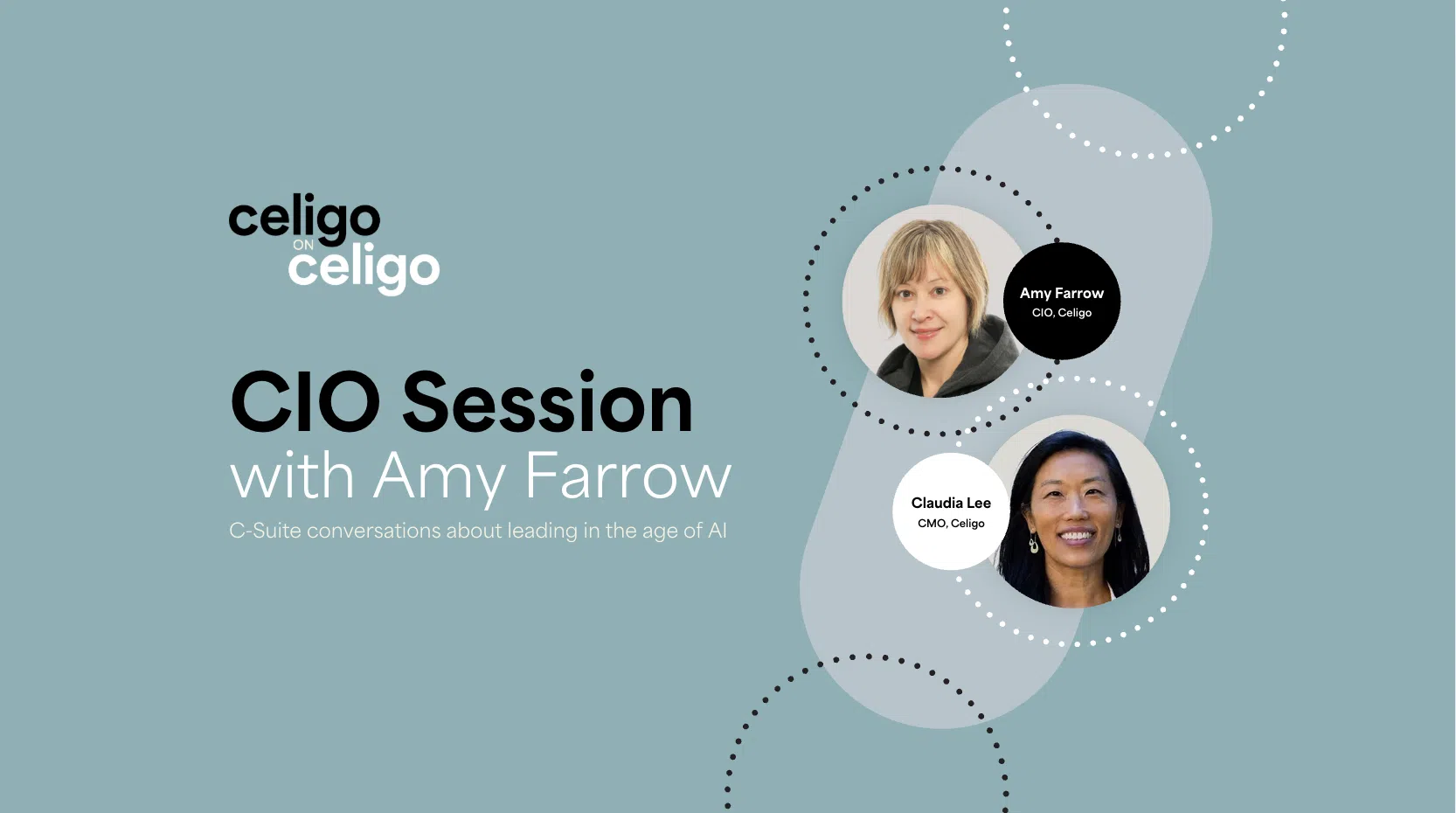
Those questions shaped the first session of Celigo on Celigo, a new virtual roundtable series where Celigo leaders share how they implement and govern AI using the Celigo platform, and learn from peers doing the same.
The main takeaway from the CIOs in the room: scaling AI is about building the right AI operating model.
Here’s what we heard.
1. How should CIOs measure AI maturity? By team, not by company
The most useful AI maturity model measures individuals and functions, not the organization as a whole, because most companies have teams at several stages at the same time.
There’s no shortage of AI maturity frameworks. Amy Farrow (CIO, Celigo) keeps hers deliberately simple. Her model has three levels:
- Adoption: Building the habit. People get comfortable using AI tools in their day-to-day work.
- AI in existing workflows: Teams insert AI into the ways they’ve worked for years.
- AI-powered: Teams redesign the work from first principles, based on what AI can do today.
The key shift is applying the framework to individuals and functions rather than the organization as a whole. That turns it into a conversation tool: where is this team today, and which use cases will move it toward level three?
Celigo CIO Amy Farrow walks through the three-level AI maturity model she uses internally, from building the habit to redesigning work around AI.
2. Who should build with AI? Move building to where the context is
In Celigo’s model, AI building happens inside the business functions that understand the problem, supported by a central platform team and a governance body. This is called a federated AI operating model.
Celigo’s long-standing vision is to empower anyone to build. This year, with new headless building capabilities from our product and engineering teams, that’s become much more real. To support it, Amy put a federated operating model in place:
- Domain builders sit inside each function and do the hands-on building.
- AI champions are business-aligned leaders, who own the vision and roadmap for which problems to solve.
- An AI platform team in IT owns the platform, capabilities, and controls, and forward-deploys to co-build with domain builders. Newer builders get more hands-on support; experienced builders get more independence.
- A cross-functional governance body sets standards, owns evaluation and audits.
Today, Celigo has about 50 AI builders across the business. Functions build their own vision for who they want to be in an AI-centric world, and IT’s role becomes enablement and governance.
Amy explains why Celigo embeds AI builders in every function, and how co-building keeps them connected to a central platform team.
Turning an AI prototype into a production-ready solution
Celigo’s sales ops team built a new account scoring methodology for our ICP. They prototyped in an AI assistant, moved the work onto Celigo’s integration platform, and iterated until it met the functional requirements. As expected with newer builders, the first version worked functionally but wasn’t built for cost at scale. That’s exactly where the platform team comes in.
The lesson: democratizing building doesn’t mean skipping engineering discipline. It means bringing that discipline to the builders. For larger cross-functional efforts, like one currently spanning sales and customer experience, Celigo spins up a dedicated delivery team of embedded builders and platform team members.
3. How do you balance AI speed and governance? Treat them as “close friends”
Governance and speed aren’t trade-offs.
Amy sees pressure from the business as healthy, but she rejects the idea that speed and governance are opposing forces. Governance applied at the right moments is what gives teams the confidence to go faster.
How AI agents earn autonomy: from human in the loop to acting alone
Amy shared about outbound prospecting agents built for Celigo’s go-to-market team. They launched with a full human in the loop, with agents teeing up messages for reps to review and send. Over three to six months, as the team measured results, ran evaluation and confidence checks, and built trust with sales, the team expanded what the agents could handle on their own, scenario by scenario. Some earned more autonomy. Others still need a rep’s judgment.
Amy describes how Celigo’s prospecting agents earned autonomy over three to six months, and why governance and speed belong together.
There’s real risk in full autonomy. That’s why teams need to have candid conversations about where you need AI and where you need deterministic rules, since enterprises depend on predictability.
4. How should CIOs approach enterprise AI architecture? Design for change
Instead of a three-to-five-year target state, the leaders in the room are building loosely coupled architectures, signing AI contracts of a year or less, and revisiting decisions every six to 12 months.
Who funds enterprise AI?
Asked how she makes AI technology decisions and who funds them, Amy described a hybrid model. A central AI budget, owned jointly with Celigo’s CFO, covers tooling and infrastructure. Individual functions can also make their own business cases. She credits a CFO who “sees the ROI potential more than the cost risk.”
4 ways IT leaders are building flexible AI architecture
Attendees also shared how they’re adapting:
- Layer it and keep it loose. A digital transformation leader at a cybersecurity company described a loosely coupled stack: builders on top, an independent control plane or gateway that handles orchestration and adaptive model routing, connectors to systems of record, and governance and auditability throughout. Smart routing also keeps costs in check, since a deterministic query shouldn’t burn premium model tokens.
- Keep contracts short. Some leaders won’t sign AI software contracts longer than a year, making vendor lock-in a top decision criterion.
- Own your context layer. Another CIO argued for a semantic and context layer that spans systems of record, since no single system holds all the context, and owning it keeps control in-house.
- Scope your MCP servers. Model Context Protocol (MCP) is the open standard that lets AI models connect to business tools and data. One IT leader said their early approach was to add MCP servers and “hope for the best,” which flooded users with noise. Moving to custom MCP servers with scoped, deterministic tools actually accelerated adoption.
Amy shared that governed MCP access is one of the most important ways Celigo uses its own platform internally, alongside deterministic and agentic access to systems of record. It’s a big reason Celigo has been able to grow builders and deploy as quickly as it has.
Keep the conversation going
No one in the room claimed to have every answer. In fact, the leaders making the most progress are treating AI as an operating model to iterate on: assess maturity team by team, put builders where the context lives, pair speed with governance, and keep architecture flexible enough to change course.
We’ve put together our learnings and experiences using our own platform to implement AI at Celigo. Explore and share our Operationalizing AI playbooks library with your team to learn more.