
De-risk AI and get costs under control: what technology leaders told us at Gartner IT Symposium
Notes from Celigo’s roundtable at Gartner IT Symposium/Xpo 2026, moderated by CIO Amy Farrow

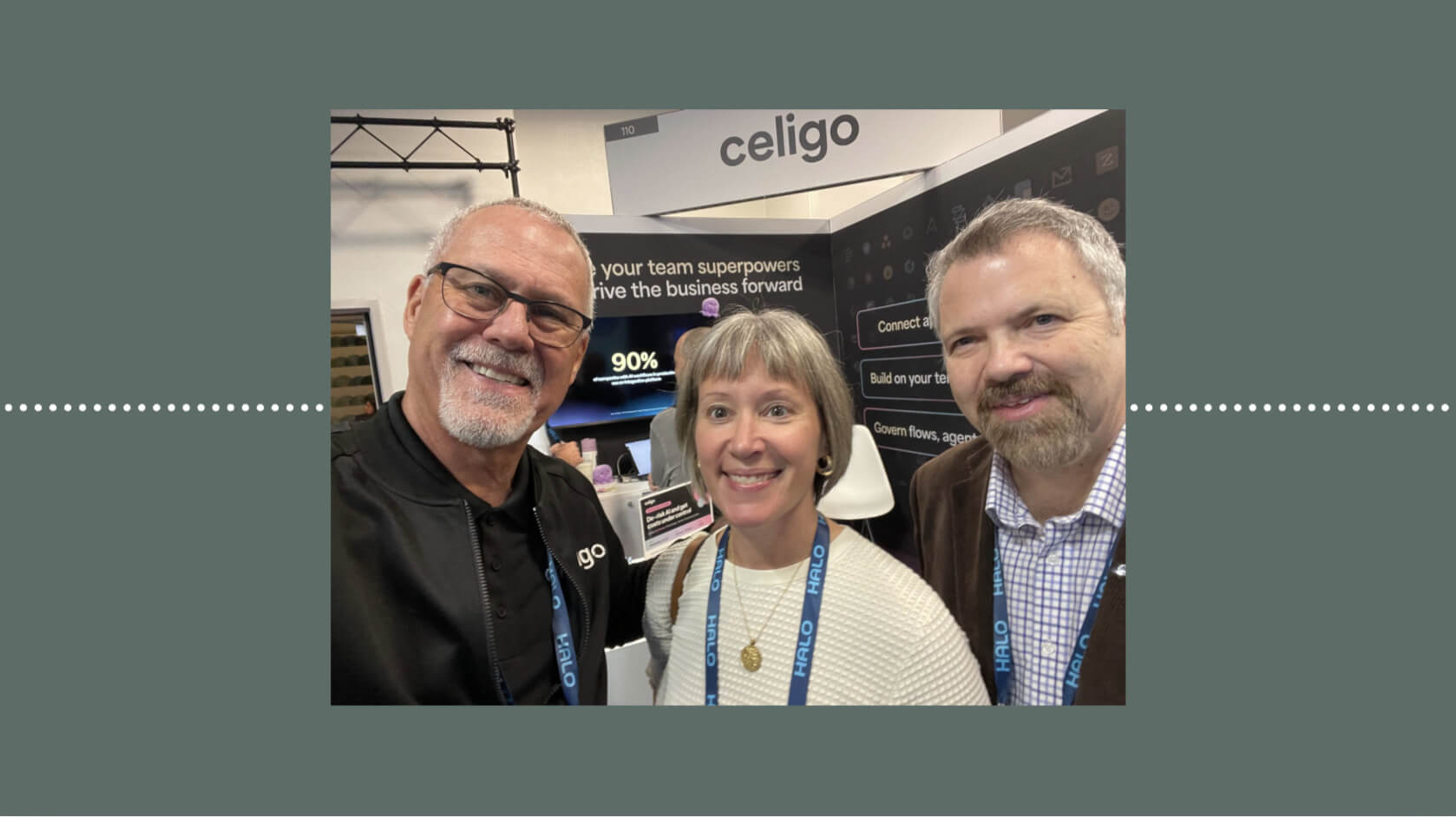
I’m Director of Product Marketing at Celigo, and I spent the whole week at Gartner IT Symposium/Xpo in Orlando. I went to get a better read on where the industry is heading and what enterprises are looking for, both from the analysts on stage and from the people who stopped by our booth. The market is changing fast, and I wanted to understand it better myself.
AI was everywhere, which won’t surprise anyone. I don’t think I saw a single session or floor demo that didn’t mention it. What most people I talked to were trying to figure out was the balance between AI’s value, its risks, and what it costs. That’s hard enough on its own, and it’s coming up right as companies build their 2027 budgets. I kept wondering how people are going to put real numbers on AI when so much about it is still uncertain.
The most useful conversation of the week was a roundtable. On Wednesday, October 21, Celigo hosted a session in Orlando called “De-Risk AI and Get Costs Under Control,” moderated by our CIO, Amy Farrow. The session abstract opened with a question Amy repeated to the room: how do you invest in AI architecture that could be obsolete tomorrow? She pointed out that three- to five-year enterprise architectures used to be normal, and now that timeline feels almost comical.
Early on she asked whether the AI conversations in everyone’s companies were mostly about risk or mostly about value. The first answers were “Risk. Risk. Value.”
That was pretty much the theme of the week. In Monday’s opening keynote, Gartner’s Daryl Plummer and Kristin Moyer said AI risk is growing faster than AI value. They cited a Gartner survey where 71% of organizations expect to deploy agentic AI within 12 months, while only 21% have agentic AI governance in place.
One person at the table explained why the balance is so hard to strike: cost and risk are fairly easy to measure, and value isn’t. Amy said something similar later. Everyone is aligned on the importance of value, but it is much harder to measure than cost. Value might mean account teams getting more time with customers, or finance closing faster, and neither of those shows up on a budget the way spend does.
Amy sits in an unusual seat for a session like this. She deals with the same AI cost and governance problems as everyone else at the table, but her team runs Celigo on Celigo, the same intelligent automation platform we sell. A lot of the room’s questions ended up being about that: which platform she uses to govern agents, how her MCP gateway works, and whether they could do the same thing.
At the booth, one question kept coming up: how do you let business teams build with agents and MCP tools safely, without giving them access to everything? It came up at the roundtable too, so I’ve added a section on it below.
Start with the process
Amy talked about three stages she’s seen. First you get people using AI, just to build the habit and get people acquainted with what is possible. Then people start fitting it into the workflows they already have. The stage she’s aiming for is redesigning the work itself, which she admitted is hard to do but where the value potential is greatest.
One IT leader at the table had a concrete way to get there. Their team mapped value streams like lead-to-order and procure-to-pay from start to finish. They ran a failure modes and effects analysis, worked out how long each breakdown took to fix, and applied labor costs to that time. In procure-to-pay it added up to millions in soft savings. They were clear these weren’t hard savings, just small bits of productivity spread across the process, but it was enough to pick three big projects that covered most of it. Before that, their business applications team had been fielding a steady stream of small projects with what they called “inconsequential results.”
I think about the same thing on the marketing side. If AI helps us build a campaign faster, the saved time only matters if we use it for something, like getting to market sooner or testing an idea we wouldn’t have had time for before.
Write down the baseline first
Another IT leader described an intake process for AI ideas that’s agentic itself. Employees bring an idea or a skill they’ve already built, and an AI interview asks them about business value, ROI, baseline metrics, legal risk and data risk. From there it goes to a committee of department leaders. Within a few weeks, they already had dozens of requests.
Whoever submits has to give a baseline, something like “it takes me an hour to do this five times a week,” and once the work is in production it gets measured against that. The person describing it also named the obvious gap: everyone is producing more, and nobody knows yet whether it’s better.
My read is that the team using the work has to define what a good result looks like. IT can see usage and performance, but it can’t easily tell whether a faster process just created more review work downstream. Even a rough measure helps if it’s specific enough to check later.
How Celigo runs AI on Celigo: least agency
Amy lets people experiment freely in Claude, with spending limits by role. When something proves worth standardizing, like a Claude skill a whole team should use, it moves into production on the Celigo platform, where her team can govern both data access and cost.
In moving an agentic workflow to production, the question her team asks is how much of it actually needs an agent. The principle they use is least agency, an analyst term Celigo has leaned into: give an AI agent only the decision-making authority the task needs, and keep rule-based steps in deterministic flows. Every step an agent handles uses tokens and adds risk, while a deterministic flow runs the same steps using rules-based logic.
Amy’s account-scoring example shows what that looks like. Sales ops built a new account-scoring skill and tested it heavily. Once it moved to production, they could see the cost per run was too high. AI was being used at every step, including steps that only pulled data, while the actual judgment happened at the end. They moved the data gathering into rule-based steps and kept the agent for the scoring decision. Amy said that cut the cost per run by about 80%.
That’s one workflow, but it’s the same balance we work through with customers: use an agent where judgment is needed, and let a deterministic flow handle the rest. Because integrations, flows and AI agents run together on one Celigo platform, a team can split a workflow that way without stitching separate tools together. Users can also ask Celigo Ora, Celigo’s natural language interface to the platform, to help apply least agency across their automations, since Ora knows all of them.
Why the room wanted to know about our MCP gateway
This part of the session got more follow-up questions than anything else, and most of them were about Celigo directly.
“Can you share the governance platform you’re using?” Amy’s answer: “We use our own platform.”
Then: “Would you characterize Celigo as an AI gateway?” Her answer: “We have an MCP gateway, yes.” A few minutes later someone asked if it was okay to “turn toward your product” and kept going.
Amy explained that Celigo is standardizing on its own MCP gateway: bringing its MCP servers, native and custom, into one control plane so agent calls go through a single governance layer. As each MCP moves over, her team limits it to what a specific agent needs.
Limiting access also lowers cost. When an agent can only reach the tools and data its task needs, it pulls back less data, so the model has fewer tokens to process. “I don’t often see security and cost this well aligned,” Amy said. Most of the time she’s arguing for security investments that make the budget increase. In this case, tightening access lowered the cost too.
The challenge with native MCPs is that by default an agent gets access to everything the user already has. Celigo can proxy native MCPs through its platform or replace them with narrower MCPs built for a specific role. One attendee pushed it further: “You have to have a single gateway where you can enforce things.” Amy compared it to identity, access control and RBAC for employees, and said agents need the same treatment.
Gartner made a related argument in the keynote. Plummer and Moyer recommended an “AI Central Bank,” which Plummer described as “a virtual control plane for AI decision making across the enterprise.” For agent access, that’s the direction Amy’s team is taking at Celigo: one control plane where a single team decides which tools each agent can reach, across native and custom MCP servers, with throttling at the MCP level.
More of the building will happen outside IT
Toward the end, Amy brought up something she’s still working on: “growing builders inside the company is a really big goal of mine. We’re in an era where a lot more building is going to happen outside IT and technology teams.” She wants to make that safe and accessible, and she’s relying on Celigo’s own platform to get there.
She described the risk with an old example, the server under someone’s desk running something mission critical. Today it could be a skill in one person’s Claude account that a whole department relies on. Someone at the table said “MS Access.”
Another participant said adoption was hard to control before their guardrails were in place. After, “we can’t give it to them fast enough.”
That’s the conversation I kept having at the booth. People wanted to give business teams access to agents and MCP tools so they aren’t waiting on engineering for every request, but with guardrails so they can’t reach systems they shouldn’t. Moyer touched on the same idea in the keynote: “To expand the value side of the flywheel, empower AI entrepreneurs.” And someone at our table brought up Will Guidara’s keynote, where he talked about leadership having the authority while the front line has the information.
Business teams are closer to the work, and they often know where AI would help before IT does. The account-scoring skill is an example. Sales ops built it, not engineering.
This is what Celigo Enterprise MCP Management is built for. It gives IT a way to say yes to business builders. IT decides which tools exist and which roles and agents can use them, and it can throttle access at the MCP level. Business teams build within those limits. If something they build becomes important to their department, it moves to production as an enterprise grade capability where IT can govern it.
What I’m taking back to marketing
Most of the questions in that room were about what happens after a pilot: what a workflow costs per run, how much of it actually needs an agent, and who’s allowed to build one. Amy’s team is working through those questions inside Celigo now, on our own platform, and already has some real proof.
That’s what I want our marketing to show more of. The account-scoring workflow and the MCP gateway come from how Celigo runs itself, and they answered this room’s questions better than a product overview would have.
If you want to see how her team governs agent access, see Celigo Enterprise MCP Management in action.