Celigo receives highest score for Data Consistency (Applications) Use Case in 2026 Gartner® Critical Capabilities for iPaaS: Here’s what we think it means


In the 2026 Gartner Software Engineering Survey, 26% of engineering leaders cited “difficulty integrating software systems and platforms” as a barrier to achieving strategic priorities.
That’s more than one in four technology leaders saying that integration, the connective tissue of the modern enterprise, is actively slowing them down. And that number gets harder to ignore when you consider that reliable data flows are now the prerequisite for everything on the modern technology roadmap, including AI.
That’s exactly the problem Celigo was built to solve.
What the Gartner® report evaluates
“Critical capabilities” are attributes that differentiate products/services in a class in terms of their quality and performance. The Critical Capabilities for Integration Platform as a Service evaluates iPaaS providers across six use cases:
- Data Consistency (Applications)
- Data Consistency (Data)
- Multistep Process (Internal)
- Multistep Process (External)
- Composite Service
- AI Enablement.
In the 2026 edition, 18 vendors were evaluated. Each vendor receives a product score from 1.0 to 5.0 for each use case, based on how well their platform capabilities align with that use case’s requirements.
Celigo’s Scores
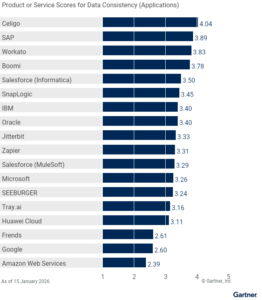
Among the 18 vendors evaluated, Celigo received the highest product score for the Data Consistency (Applications) Use Case — a 4.04 out of 5.0.
Across all six use cases, Celigo’s scores were:
- Data Consistency (Applications) Use Case: 4.04 — Highest score of all 18 vendors evaluated
- Multistep Process (Internal) Use Case: 3.67 — #4 of 18
- Data Consistency (Data) Use Case: 3.28
- Multistep Process (External) Use Case: 3.27
- AI Enablement Use Case: 3.32
- Composite Service Use Case: 3.31
What we think our Gartner score means for Celigo
So what does a 4.04 actually mean? Here’s our take.
Data consistency (Applications): The ability to detect changes in source application data and initiate integration workflows that validate, enrich and transform data and route it to destination applications.
When a customer record updates in your CRM but doesn’t reach your ERP, support team, or billing system, you don’t just have a data problem. You have a customer experience problem. A revenue operations problem. And when AI agents start making decisions based on that data, those problems compound at the speed of automation.
In our opinion, Celigo scored highest in the Data Consistency (Applications) Use Case because we’ve spent years building specifically for this challenge: fast-to-deploy, pre-built integration templates for the SaaS applications businesses run on, paired with the monitoring, error handling, and governance controls that make data flows reliable in production, not just in demos.
Why our Celigo Gartner score matters for AI
There’s a reason data consistency feels more urgent than it did five years ago: AI.
Every AI initiative, whether it’s a copilot, an agent, a recommendation engine, or an autonomous workflow depends on clean, consistent, trustworthy data. If your systems aren’t synchronized, your AI outputs won’t be either. Inconsistent data in, unreliable AI out.
We believe that #1 score in the Data Consistency (Applications) Use Case reflects the kind of governed, production-grade data foundation that makes AI reliable in practice, not just in a demo.
Celigo is the intelligent automation platform that runs the full spectrum of enterprise automation on one governed foundation, from data pipelines, rules-based EDI, and application integration to human-in-the-loop workflows, AI agents, and autonomous processes. Teams decide at design time where to use rules, where to use AI, and where to keep people involved. Every automation on Celigo, deterministic or agentic, runs under one governance model. That’s what it means to govern by design.
A track record that matters
This is not a demo environment. Celigo processes 15 million orders and 40 billion transactions per month. We’ve supported more than 11 Black Friday and Cyber Monday seasons without a missed transaction. 96% of exceptions are resolved automatically, the rest are routed with full context via Celigo Ora, our built-in AI interface.
We believe that production track record is the foundation AI agents need to run reliably in enterprise environments, not a pilot, not a proof of concept, but the live workflows that run the business.
Access the Full Report
If you’re evaluating iPaaS platforms, whether for today’s integration needs or tomorrow’s AI ambitions, independent analyst research is a useful benchmark. We’d encourage you to access the full Gartner® report and draw your own conclusions.
And if you want to see what the full spectrum of enterprise automation looks like in practice, from the data flows that scored highest in the Data Consistency (Applications) Use Case to the AI agents and autonomous workflows built on top of them, we’re ready to show you.
Access the Full Gartner® Report →
See Celigo’s Intelligent Automation Platform →
Gartner, “Critical Capabilities for Integration Platform as a Service,” Shrey Pasricha, Andrew Humphreys, Allan Wilkins, Keith Guttridge, 17 March 2026.
GARTNER is a trademark of Gartner, Inc. and/or its affiliates.
Gartner does not endorse any company, vendor, product or service depicted in its publications, and does not advise technology users to select only those vendors with the highest ratings or other designation. Gartner publications consist of the opinions of Gartner’s business and technology insights organization and should not be construed as statements of fact. Gartner disclaims all warranties, expressed or implied, with respect to this publication, including any warranties of merchantability or fitness for a particular purpose.
Learn more