


Your team scopes a data integration project: two weeks, one developer, ERP to warehouse. Six weeks later, you’re still troubleshooting.
The “simple” ERP connection actually pulls from seven systems. Half the source data has duplicates, missing fields, and formatting issues. The custom script works—until Black Friday traffic hits 50x normal volume and fails spectacularly.
Finance wants to know why their dashboards haven’t updated in three days.
This happens every week. Projects stretch from weeks to months. Budgets double. Integrations break during quarter-end close, peak season, and board meetings—exactly when executives need the data.
The problem isn’t the technology. It’s underestimating seven specific challenges that derail even well-planned projects. Here’s what goes wrong—and how to prevent it.
What is data integration?
Data integration is the process of combining data from multiple sources to create unified, actionable insights across your organization.
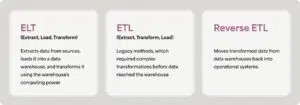
Modern data integration uses ELT (Extract, Load, Transform). It extracts data from sources, loads it directly into cloud data warehouses like Snowflake or BigQuery, and then transforms it using the warehouse’s computing power.
This replaced legacy ETL (Extract, Transform, Load) methods that required heavy data preparation and complex transformations before data reached the warehouse.
Cloud data warehouses changed the game by offering massive processing capabilities that make in-warehouse transformation faster and more flexible than older approaches.
Modern platforms like Celigo support reverse ETL—moving transformed data from warehouses back into operational systems, turning your data warehouse into both a reporting destination and a distribution hub.
What makes data integration so challenging?
Data integration looks deceptively simple on paper: you move data from System A to System B, and you’re done.
Reality proves far more complex, with multiple systems requiring synchronization, conflicting data formats, emerging real-time requirements, and unexpected governance demands.
What begins as a “simple” use case quickly reveals dependency chains, system-of-record questions, and edge cases nobody anticipated during planning.
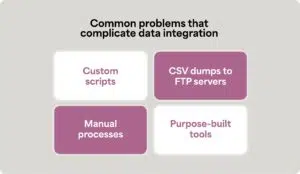
Failed approaches are common:
- Custom scripts that break when APIs change
- CSV dumps to FTP servers requiring manual intervention
- Manual processes that don’t scale with business growth
- Purpose-built tools that solve only part of the problem
Organizations need strategic approaches, not tactical band-aids. Understanding the challenges below helps you build data integration infrastructure that scales rather than breaks under pressure.
7 data integration challenges
Here are the seven most common challenges that derail data integration projects and practical solutions for overcoming each one.
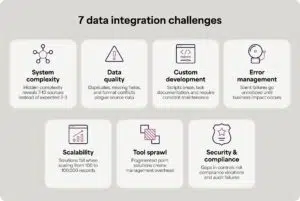
1. Underestimating system complexity and data sources
Organizations think they need data from two to three systems, when in reality, their existing infrastructure is already more complex than they realized… and they need seven to 10 sources instead.
Why this happens:
Incomplete requirements mapping means teams don’t identify the true system of record for each data element. They start implementation, then discover dependencies mid-project that weren’t part of the original scope.
Real-world example:
Your team starts by thinking they only need to get just your ERP data to the data warehouse.
Then you realize sales data lives in the CRM, customer service data sits in a separate system, inventory comes from warehouse management, and financial data splits across the ERP and billing platform.
Each discovery adds weeks to the timeline and complexity to the architecture.
Business impact:
- Project scope creep and timeline delays
- Budget overruns as requirements expand
- Incomplete reporting that doesn’t answer business questions
- Frustrated stakeholders who expected faster results
The solution:
- Conduct a thorough data source audit before starting implementation, and map business requirements back to the system of record for each data element.
- Plan for iterative implementation that can accommodate discovery.
- Choose a platform that grows with complexity rather than requiring architectural rewrites when new sources emerge. Celigo’s data integration features work alongside our other advanced automation solutions.