Operationalizing AI for sales prospecting: Ultimate guide


AI is now common across revenue teams. Sales reps use it for research. SDRs use it to draft outreach. RevOps teams use it to improve scoring and prioritization. But many enterprises still struggle to turn AI output into repeatable execution that creates a qualified pipeline and improves outbound performance.
The problem is not insight generation. The problem is operationalization. AI can recommend the next best action, but the pipeline only moves when that recommendation is executed inside the CRM and across the revenue stack through governed workflows.
Operationalizing AI for sales prospecting means using AI to detect signals and prioritize what matters next, then using automation to update records, trigger tasks, route work, and monitor outcomes without relying on manual follow-through. That requires clean data, consistent enrichment, and an integration layer that can carry those decisions across systems.
This guide explains how to use AI for sales prospecting to drive measurable pipeline impact. It also touches on sales forecasting, since both depend on trusted data, connected systems, and consistent execution.
What is AI for sales prospecting?
AI for sales prospecting is the use of AI to identify, prioritize, and act on opportunities using signals from your CRM and revenue stack.
In enterprise settings, it typically includes:
- Lead generation support, including ICP fit signals and intent indicators
- Lead scoring that adapts based on engagement, account data, and outcomes
- Data enrichment to improve account and contact completeness
- Outbound optimization, including cold emails, sequencing, and deliverability controls
- Workflow triggering, such as tasks, routing, alerts, and cross-functional escalations
This is different from basic sales tools that only help write messages. The real value comes when AI informs a decision, and the workflow layer executes it inside the pipeline.
Practical examples for enterprise sales prospecting:
- Auto-prioritize accounts based on buying signals, plus CRM stage and activity
- Trigger outbound actions when pipeline risk increases
- Enrich missing firmographics, hierarchy fields, and contacts automatically
- Surface stalled deals that need intervention
- Flag upsell or cross-sell opportunities tied to billing or usage signals
Why siloed data keeps AI prospecting stuck in insights mode
Most AI sales tools can only act on the data they can access. In enterprise environments, that data is rarely in one place. Pipeline and activity live in the CRM, but intent and engagement signals often live in marketing systems. Enrichment may happen in separate tools. Signals that affect deal quality and closing risk often show up in support, billing, product, and finance systems.
When those systems are siloed, lead scoring becomes inconsistent, qualified pipeline gets routed incorrectly, and sales reps end up working from stale information. AI can still generate insights, but the output is incomplete, and execution breaks when a workflow needs to act across disconnected systems. For example, a risk flag in the CRM does not reliably trigger the right follow-up if billing status or support escalations are not connected to the opportunity workflow.
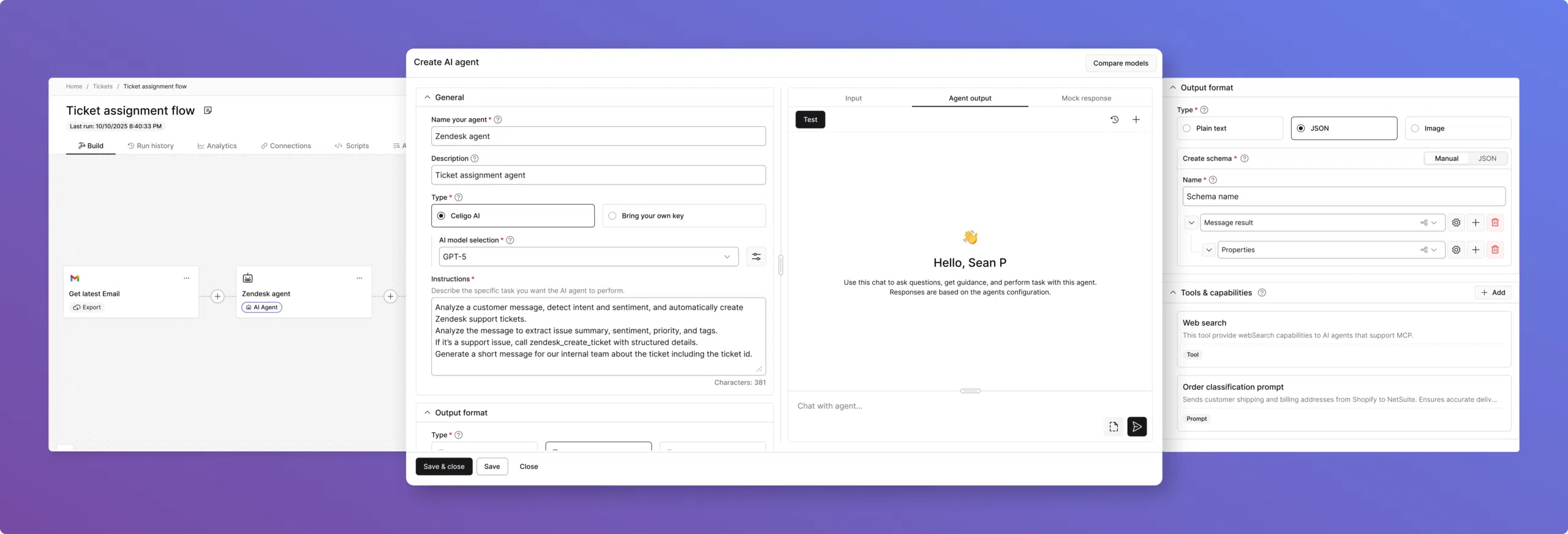
This is where Celigo fits in the conversation. Celigo is the integration and automation layer that connects systems and shapes revenue execution. Celigo’s own product framing emphasizes governed workflows, observability, exception management, and AI-enriched or agentic steps inside deterministic business processes, which is exactly the operating model enterprises need when they want AI output to trigger real work across systems.
Why most AI sales prospecting efforts stall
Most AI prospecting programs stall because the insights never become operational. Teams pilot tools that generate recommendations, but those recommendations live outside the CRM where the work is executed. At the same time, poor data quality undermines lead scoring and routing. Duplicate records, inconsistent account hierarchies, and missing fields create noise that AI cannot fix on its own.
Another common failure mode is ownership. If IT and RevOps do not agree on who governs data, workflows, and access, then changes are slow, and pilots stay isolated. The result is predictable. AI can recommend next steps, but sales reps still chase stale information, outbound workflows fire inconsistently, and qualified pipeline does not move faster through the funnel.
How to use AI for sales prospecting from insights to execution
Operational AI for sales prospecting follows a consistent pattern: detect signal, interpret context, trigger action, update CRM, and monitor outcomes. Here is a practical approach that aligns with enterprise needs.
1) Surface high-impact opportunities using live CRM data
Use AI to detect which accounts and deals deserve attention based on:
- Stage age and inactivity
- Engagement signals from email and meeting activity
- Intent and web behavior signals
- Account health signals from support and billing systems
This shifts prospecting from a static list to a dynamic prioritization model.
KPIs to track:
- Time in stage
- Follow-up SLA adherence
- Meetings booked per SDR
- Opportunity progression rate
2) Improve lead scoring with governed enrichment and data quality
Lead scoring fails when it is built on incomplete or inconsistent data. AI can help incorporate more signals, but the workflow layer still needs to keep data usable and trustworthy.
That means:
- Enriching industry, revenue, employee count, tech stack, and key contact data
- Resolving account hierarchies and parent-child relationships under defined rules
- Detecting duplicates and routing merges or updates through approved processes
- Adding conversation and engagement signals to scoring models
KPIs to track:
- Percent of leads that become qualified leads
- Lead scoring accuracy by segment
- Duplicate rate in CRM
- Missing-field rate on routed leads and accounts
3) Automate next step execution inside the pipeline
If AI detects risk or opportunity, sales automation should execute consistent actions:
- Create tasks and reminders for sales reps and SDRs
- Enroll contacts into approved outbound sequences
- Notify managers when high value deals stall
- Update CRM fields such as priority tier, risk flags, and next step
KPIs to track:
- Task completion rate
- Response time for inbound and outbound actions
- Conversion rates by priority tier
4) Optimize outbound while protecting deliverability
AI can help tailor messaging and prioritize outreach, but enterprises should treat deliverability and compliance as workflow responsibilities, not as side effects of better copy.
That means:
- Enforcing suppression rules and compliance checks
- Preventing duplicate enrollment across sales tools
- Adapting messaging using buyer context, with approvals where needed
- Routing high-risk outreach patterns for review
KPIs to track:
- Bounce rate and spam complaint rate
- Reply rate by segment
- Meeting conversion rate from outbound
5) Trigger cross-functional actions when signals require it
The highest-value prospecting workflows often include downstream actions:
- Flag pricing or contract risks that require RevOps review
- Alert customer success when churn indicators affect the expansion pipeline
- Notify finance when billing issues may block closing deals
- Trigger enrichment backfills when data gaps block routing
KPIs to track:
- Handoff latency between teams
- Exception volume requiring manual triage
- Cycle time from signal to action
Minimum guardrails for agentic prospecting in production
If AI or agentic workflows can write to your CRM or trigger downstream actions, guardrails are mandatory. The minimum set should cover access control, traceability, reliability, and safe rollout.
- Curate allowed actions and enforce least-privilege access
- Require approvals or human review for high-impact changes such as discounts, credits, sensitive fields, or reassignment rules
- Maintain audit logs with traceability for what changed, by whom, and why
- Use idempotency and deduping to prevent duplicate tasks, duplicate outbound enrollment, or duplicate record updates
- Implement monitoring, retries, and error queues to prevent silent failures
- Separate dev, test, and prod environments and use controlled rollout
- Define what data can be sent to AI models, and enforce those policies in the workflow layer
These guardrails are also consistent with how Celigo describes AI-enabled operations in its own materials: monitored execution, exception management, execution logging, and governed workflows rather than unmanaged autonomy.
Types of AI sales prospecting tools
This is not a ranking. These categories explain where prospecting capabilities typically live in the revenue stack.
CRM native AI
Helps inside the CRM with lead scoring, summarization, and recommended actions. Useful, but limited when workflows need to span systems and enforce governance.
AI engagement platforms
Support outbound sequences, personalization, and automation around cold emails. They can improve SDR throughput, but depend on accurate CRM data and strict deliverability controls.
Revenue intelligence and conversation intelligence platforms
Use conversation intelligence and activity signals to detect risk, coaching opportunities, and forecast signals. They often generate insights that still need workflow automation to trigger action.
AI research and data enrichment tools
Improve lead generation and targeting by enriching records and identifying accounts. They add value, but they do not operationalize execution without integration into CRM workflows.
Key point: tools alone do not operationalize AI. Enterprise impact requires connected data, governance, and workflow orchestration across the systems that determine revenue outcomes.
How is AI used in sales forecasting?
AI is used in sales forecasting to reduce manual bias and improve accuracy by analyzing a wider set of signals than traditional rollups. In practice, it typically improves forecasting in three ways.
First, it improves pipeline health assessment by evaluating patterns such as stage progression velocity, time in stage, activity gaps, deal size changes, and conversation intelligence signals. That helps leaders see risk earlier, not just at the end of the quarter.
Second, it identifies leading indicators that correlate with slippage or wins. For example, late-stage deals with decreasing activity, accounts with rising support escalations that impact renewals, or billing friction that predicts delays. When those signals are connected to CRM workflows, AI can flag risk automatically and trigger sales automation to address it.
Third, AI forecasting becomes far more useful when the outputs are operationalized. Forecast changes need to update CRM fields in a controlled way, capture the rationale and inputs used for the change, notify owners when action is required, and route exceptions into monitored queues. Without that execution layer, forecasting becomes another dashboard. With it, forecasting becomes a workflow that helps with closing deals.
How integration platforms enable AI at scale
AI for sales prospecting delivers real value when it moves beyond surface-level assistance and becomes embedded in workflows that sales reps and SDRs rely on daily. That requires connected systems, consistent data enrichment, governed lead scoring inputs, and monitored sales automation that does not silently fail.
Celigo provides an orchestration layer that connects AI-driven steps to CRM data and downstream revenue workflows through governed access, monitoring, and control. That enables AI outputs to translate into prioritized actions, updated records, and triggered workflows across the systems that drive revenue outcomes.
Request a demo to see how Celigo turns AI outputs into real execution across your CRM and revenue stack, with auditability, retries, and centralized visibility.