Celigo’s March 2026 Release
 Updated Mar 11, 2026

The March 2026 release helps you scale automation across the enterprise by modernizing multi-environment management, improving operational visibility, simplifying complex transformations, and expanding performance for high-volume integrations.
Platform
Modernized multi-environment architecture
Customers using the legacy production + sandbox model can now migrate to Celigo’s structured multi-environment architecture through a guided experience designed for minimal disruption.
The migration includes a readiness assessment that identifies shared resources, automatically reassigns artifacts, and walks administrators through validation steps. Production remains accessible during the transition, while sandbox assets are reassigned into a dedicated non-production environment.
By formalizing development, testing, and production separation within a single unified platform, this upgrade reduces deployment risk and strengthens change control. Teams gain clearer promotion paths and stronger governance without rebuilding integrations or interrupting live operations. As organizations scale across business units or regions, this architecture provides a cleaner, more resilient foundation for enterprise automation.
→ Learn more about multi-environment migration
Enhanced Run Console for faster troubleshooting
Operational transparency improves significantly with expanded Run Console visibility.
Retry and auto-retry jobs are now surfaced directly within the Run Console and grouped under their originating exports. Teams can filter by job status or error count, download diagnostics, and clearly see how runs were triggered—whether manually, on a schedule, or by another flow.
By consolidating execution visibility into one place, troubleshooting becomes more direct and predictable. Instead of navigating across multiple views, operations teams can isolate issues quickly and reduce resolution time — helping integrations run reliably and preventing downstream business impact.
Smarter data transformation with Mapper 2.0
Complex transformation logic often slows implementation and increases maintenance overhead. Mapper 2.0 enhancements reduce that friction so teams can build faster with less custom code.
Direct mapping of stringified JSON
Builders can now map stringified JSON directly into object and object array fields without custom parsing scripts. Structured JSON outputs flow naturally into downstream objects, simplifying transformation logic and reducing reliance on custom code.
This makes workflows easier to design, adapt, and maintain over time.
Explicit index generation for relational integrity
When source systems don’t provide unique identifiers, relational mapping becomes difficult. Mapper 2.0 now supports explicit index generation for objects and parent-child relationships within nested arrays.
By generating stable primary keys and referencing parent indexes as foreign keys, teams can preserve relational integrity directly within the mapper. This streamlines loading into databases and analytics systems, eliminating common scripting workarounds and reducing transformation complexity.
Onboard your team more easily – expanded integration-level user invitations
Manage-level users can now invite additional users up to their own permission level directly within an integration (when enabled).
This enhancement removes routine administrative bottlenecks while preserving strict role boundaries. Teams can onboard collaborators faster, scale access more efficiently, and maintain governance controls all without centralized overhead slowing execution.
Connectivity & scalability
Enterprise automation depends on handling growing data volumes securely and efficiently. March introduces several enhancements that strengthen throughput and reliability across high-scale scenarios.
Expanded CSV support to 2,000 columns
The CSV parser now supports up to 2,000 columns, quadrupling the previous limit.
Large enterprise datasets, especially those from CRM or ERP platforms with extensive custom fields, can now be processed without file splitting or schema restructuring. This simplifies ingestion workflows and removes artificial constraints that previously required workarounds.
Optimized Snowflake bulk load performance
Bulk loading into Snowflake now supports datasets exceeding 1 GB through automatic file segmentation behind the scenes. Files are split into optimized chunk sizes and can begin loading incrementally as they are generated.
This approach reduces memory constraints, improves reliability for large onboarding jobs, and enhances warehouse efficiency during high-volume ingestion. Historical migrations and peak-season loads can now be handled more predictably and with greater stability.
Larger webhook payload support with structured extraction
Webhook exports now accept payloads up to 50 MB. A configurable “Path to records” setting allows nested payloads to be segmented before paging so that only relevant record arrays are processed within page limits.
Optional preservation of parent metadata ensures contextual information remains attached to each record. Additionally, webhook challenge-response flows now support HMAC validation for providers requiring signed verification.
These improvements unlock batch webhook scenarios that were previously limited by payload size and make secure endpoint validation easier to implement within governed automation flows.
Microsoft Entra ID Service Principal authentication for MS SQL
The MS SQL connector now supports Service Principal authentication through Microsoft Entra ID. By using application-level credentials instead of user-based authentication, organizations strengthen security posture and align with modern identity governance standards. This approach supports automated integrations more cleanly and reduces reliance on individual credentials in production environments.
DynamoDB concurrency management
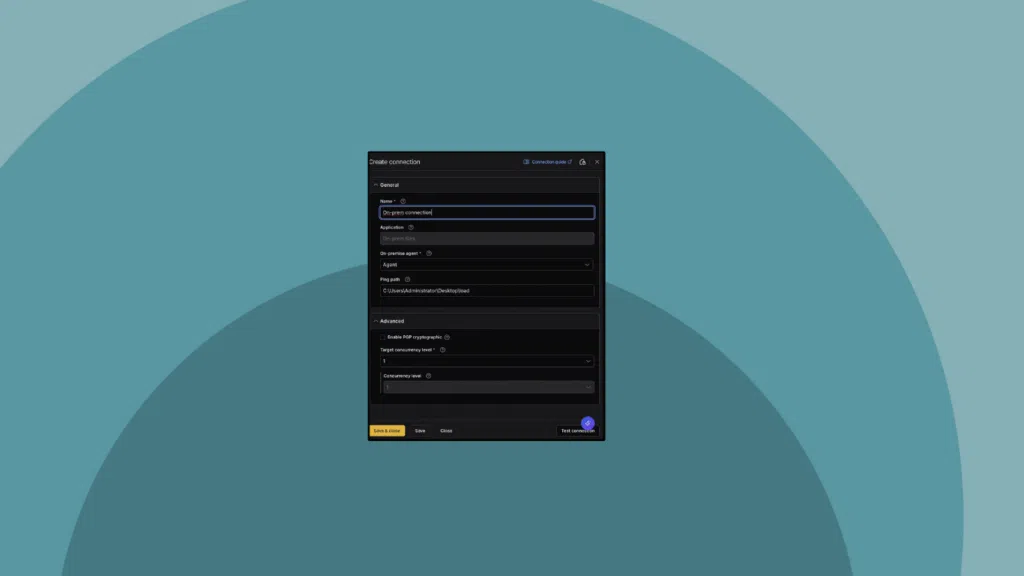
The DynamoDB connector now includes configurable concurrency controls and rate-limit recovery options.
Teams can define target concurrency levels, manage throughput more precisely, and automatically recover from throttling events. These capabilities provide greater stability when processing high-volume workloads, ensuring that performance tuning can be aligned with infrastructure limits.
API Management
API Builder and API Management receive several enhancements that improve production resilience and troubleshooting efficiency.
New capabilities include:
- Configurable API timeouts at both account and API levels
- Flexible version formatting aligned with semantic versioning practices
- In-context script execution logs
- Step-level runtime debugging
- Improved routing configuration in API Management
- Multi-segment context path support
- PATCH method support during publishing
Greater timeout control reduces the risk of stalled integrations, while in-context logging and step-level debugging streamline issue resolution. Improved routing and publishing flexibility make API lifecycle management more predictable in complex enterprise environments.
B2B Manager
Visual EDI Rule Builder
Configuring EDI File Definition Rules is now significantly more intuitive through a structured, visual editing experience.
Users can define segments, elements, loop logic, enumerations, and validation constraints within a tree-based interface. Inline validation highlights issues immediately and directs users to the exact element requiring correction.
This modernized approach reduces onboarding friction for new trading partners, minimizes configuration errors, and shortens implementation cycles. EDI setup becomes less dependent on deep technical familiarity with raw definition formats and more accessible to operational teams.
Direct API access to EDI documents
A new API endpoint enables programmatic retrieval of EDI document payloads and metadata.
This supports automated audit workflows, downstream integrations, and validation processes without manual extraction. Teams gain more control over EDI data handling while improving operational transparency and efficiency.
Integration Apps
Shopify – NetSuite IA: Native exchange support
The Shopify – NetSuite Integration App now supports Shopify’s native exchange model across online and POS channels.
Exchange activity is consolidated into a single Return record in NetSuite that captures both returned and replacement items. Multi-order exchanges, restocking fees, and return shipping adjustments are handled more accurately to reflect Shopify’s updated APIs.
Financial adjustments now align more closely with Shopify’s transaction logic, so reconciliation is more accurate and consistent. Ecommerce teams gain clearer visibility into return flows while finance teams benefit from reduced discrepancies across systems all within a unified automation environment.
→ Watch the Shopify – NetSuite Integration App walkthrough
Zendesk – NetSuite IA: OAuth 2.0 upgrade
Zendesk connections within the Zendesk – NetSuite Integration App now support OAuth 2.0 authentication with automatic token refresh.
This strengthens security, reduces unexpected session timeouts, and ensures continued compatibility with Zendesk’s authentication requirements. Customers must migrate to OAuth 2.0 before April 30, 2026 to avoid disruption.
Integration Marketplace
New connectors available
- Check out the new HTTP connectors available in the Integration Marketplace.
- The EDI trading partners article provides an alphabetical listing of trading partners, search functionality, and filters.
Looking for more?
For more on integration strategies and real-world applications, Builder’s Hub provides tutorials and video demos for builders and IT teams.
Access step-by-step tutorials, product demos, and review best practices for building, managing, and scaling integrations.
Integration insights
Expand your knowledge on all things integration and automation. Discover expert guidance, tips, and best practices with these resources.