
What is enterprise iPaaS? 3 Reasons Celigo leads the category

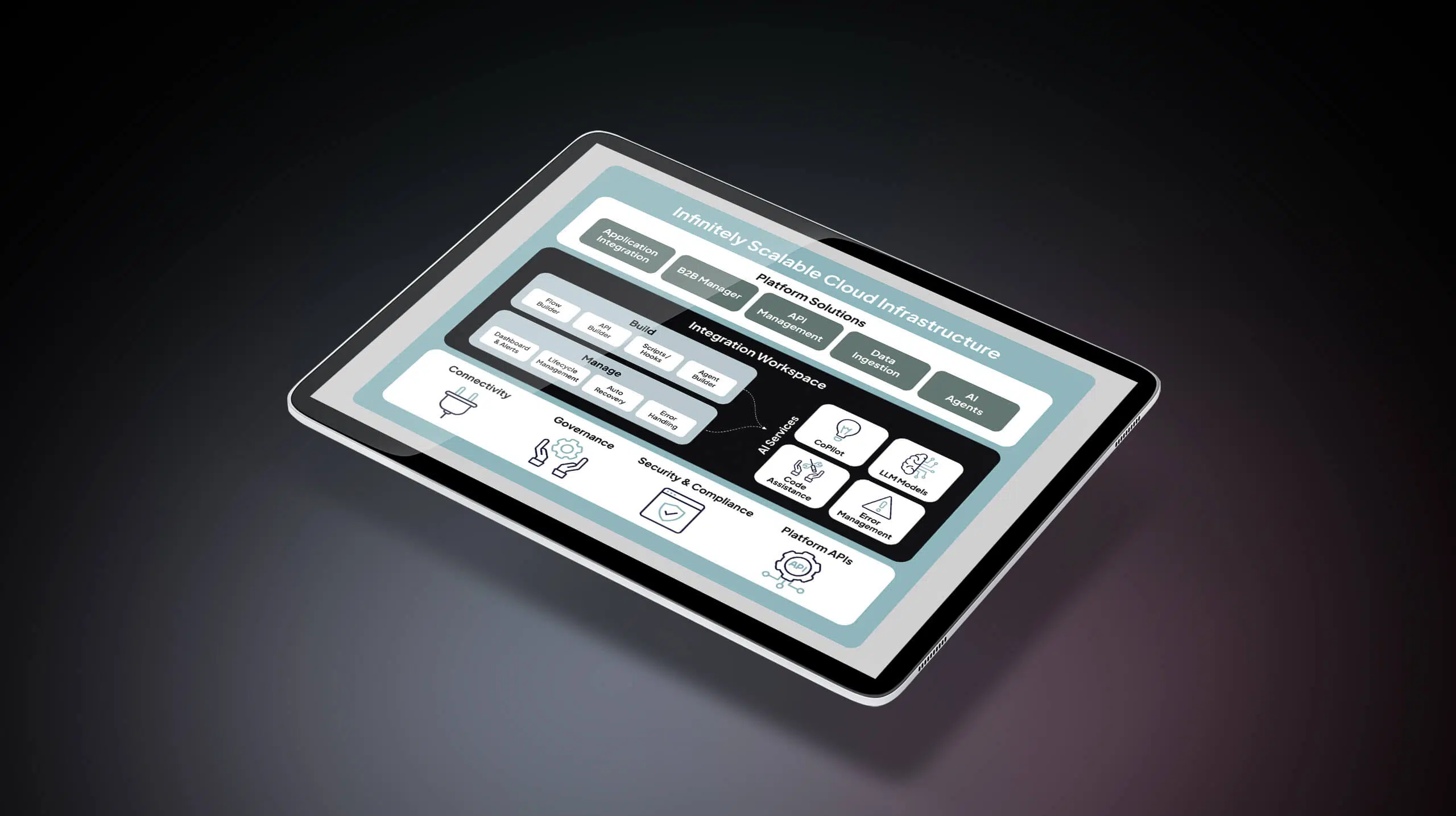
An enterprise iPaaS (integration platform as a service) is the infrastructure layer that connects applications, automates business processes, and enables AI-driven workflows across an organization.
For modern enterprises, choosing the right iPaaS platform has become mission-critical. It’s no longer just about connecting applications. The rise of AI raises the stakes even further, making integration platforms (iPaaS) core infrastructure for executing end-to-end, AI-driven processes.
The challenge is that many existing approaches become constraints rather than enablers. Legacy integration tools offer control but require heavy developer investment to build and maintain. Lightweight solutions are fast to start but break down as workflows expand across teams, regions, and mission-critical systems.
For enterprises, iPaaS can no longer be a choice between control and speed. An enterprise iPaaS has to deliver both usability without sacrificing power, flexibility without re-architecting workflows, and resilience under peak demand. It should scale as complexity increases and evolve alongside AI-driven automation.
That is exactly what Celigo is built for. Here are three reasons enterprises choose Celigo as their integration foundation.
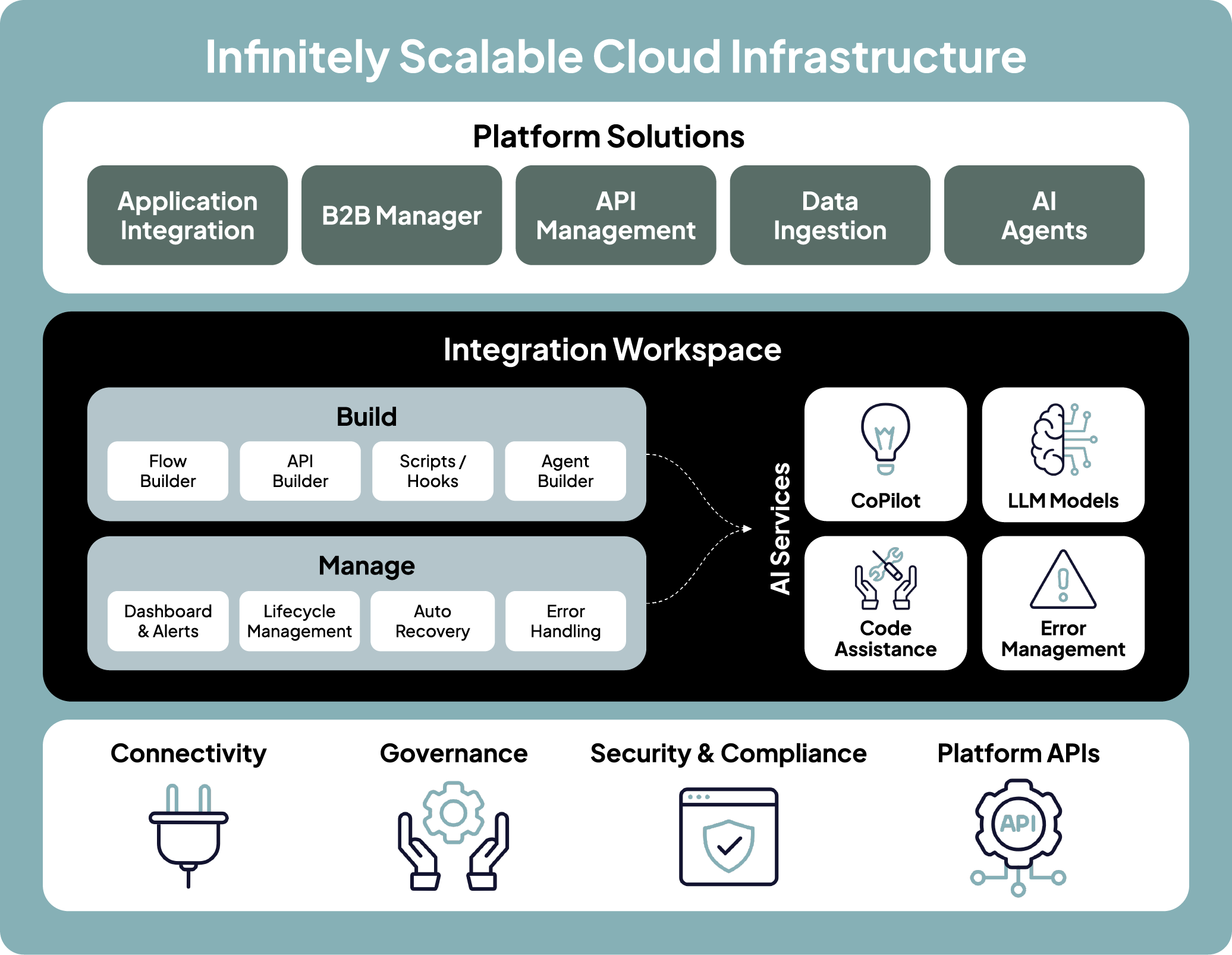
3 reasons Celigo is an enterprise-grade iPaaS solution
1. Unified platform for every automation, from integration to agentic
Enterprise integration is a long-term decision. As systems, teams, and use cases grow, Celigo offers a single, unified enterprise iPaaS platform that scales from basic SaaS-to-SaaS integrations to complex, multi-system agentic workflows on the same platform, so organizations do not have to revisit their integration strategy.
Reusable integrations for faster time to value: Celigo provides a marketplace of more than 1,000 prebuilt connectors and packaged integrations to automate complete business processes such as order-to-cash, quote-to-cash, hire-to-retire and more. These are fully customizable, built and maintained by Celigo, and reflect best practices refined through thousands of real-world customer implementations.
Beyond templates, Celigo’s reusable components — including entire flows, connections, imports, exports, and lookups — can be shared across projects, giving enterprise integration teams consistent patterns that eliminate the need for builders to relearn patterns or reinvent logic as integration demand scales.
Customization that adapts to changing business logic: As your business logic changes, Celigo is designed to adapt and build more advanced, multi-system processes — without re-architecting your integrations.
- Scriptable logic using JavaScript and Handlebars for complex validations, transformations, and conditional branching
- Dynamic mappings, structured data support, and reusable modules for advanced customization
- Instance-wide orchestration that allows flows to trigger and reference one another supporting multi-step, cross-system processes
- Full integration lifecycle management with versioning, rollback, change tracking, and optional GitHub/GitLab integration
- Production and sandbox environments for structured development, testing, and deployment
Customer example: Therabody migrated from a legacy iPaaS to Celigo, starting with order-to-cash. They have since expanded to Customer 360°, product data management, payout reconciliation, and IT service management — all on the same platform — without having to revisit their integration architecture during a critical growth phase.
One platform for all integration patterns: Celigo extends beyond core iPaaS capabilities to support key enterprise integration patterns within a single, unified platform. For enterprises, this reduces tool sprawl and enables expansion as new integration needs emerge.
- Application integration for SaaS-to-SaaS and SaaS-to-ERP workflows.
- API management (APIM) to build, secure, deploy, govern, and monitor APIs using Celigo’s API Builder and APIM console.
- EDI integration to support common formats and protocols, along with prebuilt templates for standard transaction types.
- Data ingestion, enabling reliable movement of SaaS data into data warehouses and analytics platforms.
- Agentic workflows, allowing teams to build AI-driven processes that analyze data, reason with context, and take action across systems.
Here is an example of an Accounts Receivable (AR) inquiry response agent. In this workflow, Celigo uses an AI-driven, agentic flow to analyze, categorize, and draft responses to common customer billing emails such as requests for invoice copies or W-9 and banking details.
Incoming billing emails are automatically interpreted using AI, routed to the correct process, and fulfilled by securely retrieving relevant data from systems such as NetSuite, Snowflake, and Google Drive. The platform then drafts a contextual response within Gmail, turning a high-volume AR inbox into a structured, governed process.
Rather than deploying a standalone chatbot, AI operates inside an end-to-end workflow with clear orchestration, system integration, and human oversight.
2. Built for mission-critical operational resilience
At enterprise scale, integration failures are not just technical issues; they directly impact customer trust, operational continuity, and revenue. Celigo’s architecture is built to keep critical workflows reliable, secure, and performant as integration volume and business complexity increase.
High performance at scale: Celigo has a fully elastic, cloud native architecture that auto-scales behind the scenes to handle surges in transaction volume without performance degradation,
- Workloads are distributed across the platform, ensuring integrations continue running reliably as volume increases.
- Parallel processing enables large data volumes to be handled efficiently, preventing bottlenecks during peak demand.
| 36.5B records | Processed in November 2025 (Black Friday / Cyber Monday period) |
| 66% surge | Increase in order volume handled without slowdowns |
| 100% uptime | Maintained for the 11th consecutive year during peak period |
| >99.99% uptime | Historical availability over more than three years, per independent monitoring |
Built-in, autonomous error recovery: Unlike iPaaS platforms that require users to manually build exception handling into each flow, Celigo treats error management as a first-class platform capability.
- Errors are automatically detected, categorized, logged, and routed for resolution.
- AI-powered auto resolution handles up to 95% of common issues without human intervention.
- When manual action is needed, record-level execution logs provide precise traceability to identify where and why a failure occurred.
High availability, uptime, and reliability: Integration teams rely on Celigo to support always-on, mission-critical integrations.
- Consistent uptime, with historical availability exceeding 99.99% for more than three years, tracked by independent monitoring services.
- Zero downtime deployments (ZDT) ensure releases occur without disrupting running integrations.
- 24×7 platform monitoring and incident response with real-time alerting and a distributed DevOps team.
- Global deployment flexibility with Public Cloud in the US and Europe (Canada and Australia coming in 1H ’26) and Private Cloud support across 20+ data centers worldwide.
Governance and security: Celigo embeds governance and security directly into how integrations are built, managed, and operated, enabling enterprises to protect sensitive data and meet regulatory requirements.
- Granular role-based access control (RBAC) and comprehensive audit logging.
- Built-in security controls, multi-factor authentication (MFA), single sign-on (SSO), and regular third-party penetration testing, ensure secure access.
- Recognized security certifications, such as SOC 2, HIPAA, and GDPR, and real-time visibility through Celigo’s public Trust Center.
3. Future-proof and AI-forward
Celigo is designed to evolve with the business, providing a stable integration foundation that adapts as automation models advance and AI-driven operations become embedded across the enterprise.
Continuous platform investment: Over the past year alone, Celigo has delivered more than 500 product enhancements across core integration capabilities.
- A next-generation flow builder and multi-instance flow support.
- Expanded B2B and EDI coverage with EDIFACT support and 500+ prebuilt trading partner connectors.
- A low-code API builder, lower-latency runtime, and expanded governance controls for API management.
- High-speed bulk loading and event-driven replication for data integration and analytics use cases
AI embedded into platform: Celigo has built-in AI assistance throughout the platform itself to speed up your time to market.
- Copilot, a chat-based, context-aware interface that lets builders interact with the platform in natural language, issuing commands like ‘delete flows that haven’t run in 15 days’.
- AI Code Assistant, which converts natural-language instructions into JavaScript, Handlebars expressions, SQL queries, and filter rules.
- Knowledge Bot, which leverages Celigo’s product documentation to deliver instant, contextual guidance within the platform.
Build AI Agents using the platform: Celigo supports both deterministic and agentic workflows within the same governed platform, enabling incremental AI-driven automation at enterprise scale.
- Agent Builder, a low-code integrated experience for building and monitoring AI agents that reason over data and take action across systems.
- MCP Server, a standardized way to expose Celigo APIs, integrations, and business logic to AI agents and LLMs.
- LLM and vector database connectors for leading AI platforms such as Amazon Bedrock, OpenAI, and Gemini.
- Guardrails, a dedicated trust and governance layer that enforces data controls and operational boundaries across the integration environment.
Why enterprises trust Celigo?
Celigo’s market position is built on customer outcomes. While many competitors have grown through consolidation, Celigo’s leadership, investors, and partners remain focused on long-term customer success — a commitment reflected in consistent recognition from customers and analysts.
Customer and analyst recognition
Celigo’s approach is consistently validated by customer feedback and independent analyst research.
G2 recognition reflects strong customer trust and satisfaction:
- Consistently rated #1 for iPaaS, with a 100% Satisfaction score.
- Named a 2026 G2 Best Software winner for Development Products and IT Infrastructure Products.
Gartner recognition highlights product maturity and market momentum:
- Named the only vendor recognized as a 2025 Gartner® Peer Insights™ Customers’ Choice for iPaaS.
- Positioned in the Visionary quadrant of the 2025 Gartner Magic Quadrant for iPaaS.
Strong ecosystem of partners and builders
Celigo is supported by a global ecosystem that helps enterprises implement, extend, and scale their integration strategies.
- Professional services, an in-house team of Celigo experts providing implementation, optimization, and advisory services.
- Partner network, spanning more than 1,300 partners across North America, EMEA, APAC, and LATAM.
- Builders enablement, with more than 5,000 registered users in the revamped Celigo University program.
- Connective, a growing & actively moderated community of nearly 3,000 users to share knowledge, best practices, and expert guidance.
Customer success across industries and stages of growth
Celigo supports a growing global customer base across industries, company sizes, and integration maturity levels. We have endless stories of customers beginning with one integration initiative and expanding over time.
One such example is Outdoor Research. They began with a small set of integrations and expanded to more than 20 systems across commerce, operations, and EDI, consolidating workflows on Celigo as needs grew rather than adding new platforms.
“We knew the potential of the rest of the Celigo platform. This was a real opportunity to drop our existing EDI solutions and migrate everything.”
— Eric Leung, Director of Enterprise Applications, Outdoor Research
Results: Today, Outdoor Research relies on Celigo as a central integration platform, supporting high-volume sales, self-service integrations, and AI-assisted error resolution. As Eric Leung puts it, “If there is something we want to automate, we turn to Celigo first.”
You can read all our customer success stories here.
Celigo: the enterprise iPaaS that grows with you
As systems, automation models, and the broader technology landscape continue to evolve, enterprises need an iPaaS that evolves with them. Celigo scales from simple integrations to complex, multi-system, and agentic workflows on the same platform. It is built for resilience, governance, and reliability as integration volume and business criticality increase.
→ Book a demo to explore how Celigo can power your integration strategy with enterprise-grade capabilities and the simplicity your teams need to move fast.
FAQ's
Integration insights
Expand your knowledge on all things integration and automation. Discover expert guidance, tips, and best practices with these resources.