
Ecommerce Trends 2026: Key Takeaways from ShopTalk Spring

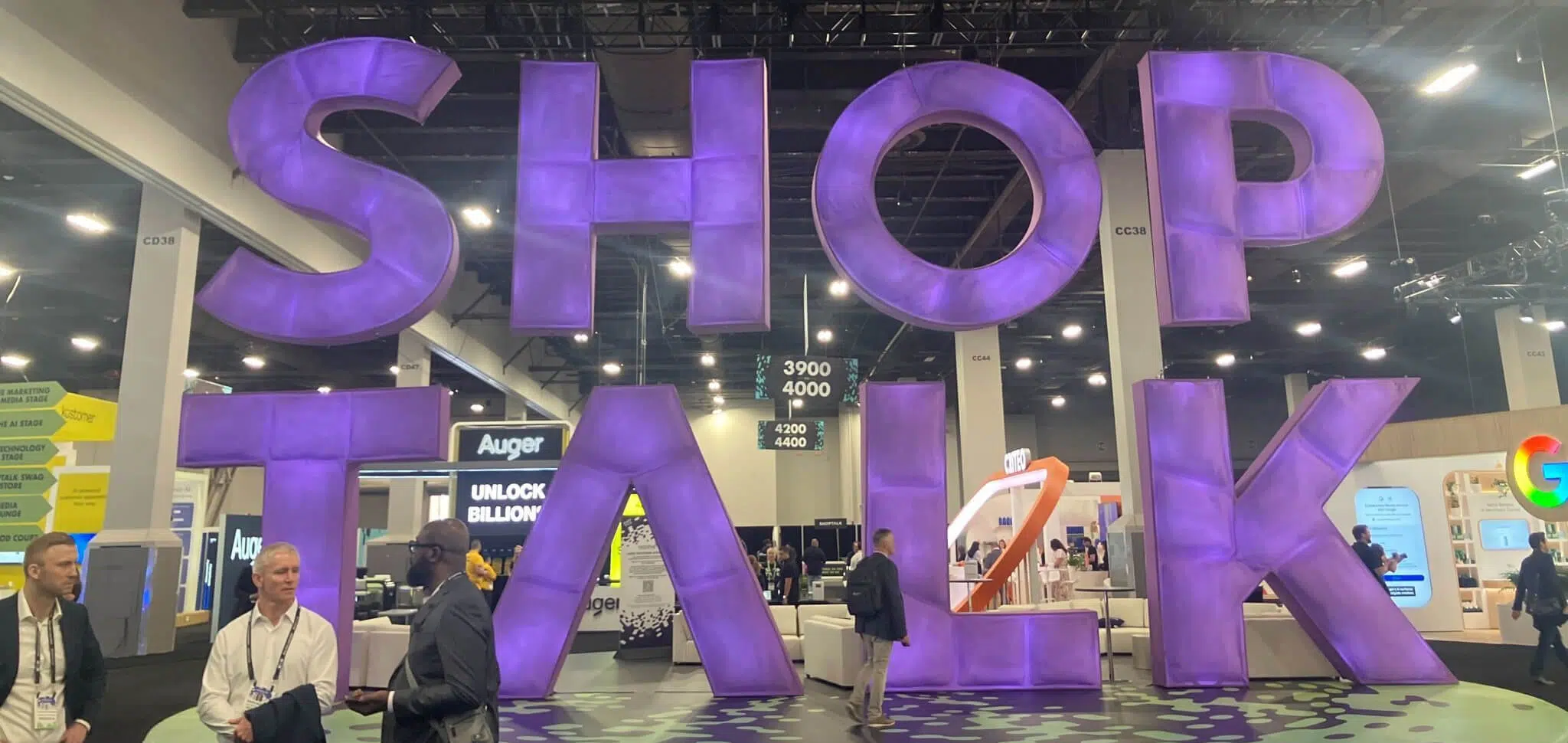
Before ShopTalk Spring 2026, I published a framework for how retail organizations should think about operationalizing AI — the right processes to target, the governance model that actually works, and why a connected integration foundation isn’t a prerequisite you check off, but the thing that determines whether AI produces reliable outcomes at all.
ShopTalk 2026 was the test of that framework against reality. Our team spent three days having conversations with commerce leaders at every stage of the AI maturity curve, from Aspirants running their first pilot to Orchestrators managing agentic workflows at scale.
As always, ShopTalk Spring 2026 set the agenda for where commerce is heading. Previous years were dominated by the question of how AI would transform commerce. At ShopTalk 2026, the conversation had moved on to: why are so many AI deployments in commerce failing, and what does it actually take to get them right?
I was at ShopTalk Spring 2026 as both a speaker and a student. I led a fireside chat with Nick Reshamwalla, VP of Engineering at Dollar Shave Club, on how commerce teams are scaling operations with AI. And our CEO Jan Arendtsz joined leaders from Salesforce, PayPal, and Extend on the Technology Stage to discuss the technologies enabling unified commerce.
We walked away with a clearer picture of the biggest ecommerce and AI trends that will shape 2026, and what that means for commerce teams building their strategy for the year ahead.
The defining ecommerce trend of 2026: teams are still figuring out how to operationalize AI.
The question at ShopTalk 2026 wasn’t whether to use AI. That debate is settled. The question was why so many AI deployments in commerce aren’t delivering what was promised — and what separates the ones that are working from the ones that aren’t.
Celigo’s research with MIT gives a clear answer: 90% of firms with AI workflows in production rely on integration platforms.
The pattern is consistent. AI gets deployed on top of systems that aren’t ready to support it. When that happens:
- Inventory data doesn’t reconcile across channels.
- Order flows rely on integrations that were never built to handle real operational load.
- Fulfillment handoffs between systems create blind spots rather than visibility.
Laying intelligence on top of disconnected, siloed data doesn’t produce reliable outcomes. As my colleague April Rassa put it – AI won’t fix your broken processes. It will expose them.
At best, siloed AI produces a productivity tool within a siloed workflow. That’s not operationalizing AI. Operationalizing AI means deploying it into entire business processes — ones that span multiple systems and departments — and having those processes run reliably at scale.
The brands reporting real results at ShopTalk 2026 had done the foundational work first. They hadn’t skipped stages.
The B2B ecommerce trend not covered enough: fragmented stacks are a strategic liability
One pattern came through sharply at ShopTalk, particularly in conversations with brands managing both DTC and wholesale channels: the cost of maintaining separate tools for API integrations, EDI connections, and AI-specific workflows is no longer just a budget line. It’s an organizational drag.
With fragmented stacks…
- Teams are context-switching between platforms.
- Errors fall through the gaps between systems.
- Every new trading partner or channel requires a new integration project rather than a configuration on an existing foundation
- When something breaks, there’s no unified view of what happened, what it affected, and what to do about it.
This is the B2B ecommerce trend worth paying attention to in 2026: the brands pulling ahead are consolidating onto unified platforms that handle API, EDI, and AI in one place.
Fragmentation actively slows down the kind of cross-functional AI adoption that moves organizations from Experimenters to Practitioners. The integration standards and data pipelines that IT needs to govern AI at scale are nearly impossible to establish across a fragmented stack.
The ones who’ve built that unified foundation are moving faster, and taking on less risk.
Shopify’s agentic plan: what it means for ecommerce in 2026
One of the most significant announcements on the ShopTalk floor came from Shopify: the launch of their Agentic Plan, which allows merchants to sell directly through AI channels — ChatGPT, Microsoft Copilot, Google AI Search, Gemini — via Shopify Catalog, without needing a Shopify storefront or platform migration.
This matters because it changes the nature of the integration foundation question from operational to commercial.
Agentic commerce means AI is no longer just a tool teams use internally. It’s becoming a customer-facing channel — one where catalog quality and data completeness determine whether a merchant appears at all. Catalog data optimized for a traditional storefront, where a human browses and filters, is often not structured for the way AI surfaces and recommends products. Attributes, categorization, descriptions, and completeness matter in new ways when an AI agent is the intermediary between buyer and purchase.
For commerce teams, this is a direct consequence of the AI maturity stage they’re operating in. Orchestrators — companies that have adopted AI extensively— are positioned to move into agentic channels quickly. Aspirants (companies interested in AI but not yet making a meaningful effort to implement) and Experimenters (firms that are using a wide range of AI tools without a coherent strategy) will find that a new high-value channel has opened that they can’t effectively access.
The integration layer is, once again, the determining factor. Merchants who can get catalog data from any system — including major ERPs, with products already optimized for AI discoverability — into Shopify quickly and at scale are positioned to compete from day one.
Agentic commerce isn’t a future ecommerce trend. It’s already happening.
How peak demand exposes your integration foundation
Peak demand is the most reliable stress test your integration foundation will face all year. Whether it’s Black Friday, Cyber Monday, a viral product drop, or a major promotional event, peak demand is top-of-mind for high-performing ecommerce teams.
When order volume spikes, orders, inventory, and fulfillment data need to move instantly between systems. If those integrations are fragile — point-to-point scripts, manual handoffs, brittle middleware — peak demand doesn’t just create operational problems. It destroys revenue. A missed order during BFCM isn’t recoverable. A fulfillment error that reaches a customer at peak costs far more than the order itself.
This is the frame through which every AI and automation conversation at ShopTalk should be understood. The brands who get real results solve for reliability first — automating the workflows behind every order so that processes run automatically rather than through manual work or fragile integrations. From there, they can use AI to extend what that reliable foundation can do.
Celigo maintained 100% uptime across 11 consecutive Black Fridays, auto-resolved 95% of integration errors, and processed 36.5 billion records in November 2025 alone.
That’s what a mature integration foundation looks like under real peak-season load. And it’s the baseline that makes AI-driven optimization meaningful rather than aspirational.
What Dollar Shave Club taught us about scaling commerce with AI
A highlight for me was leading a fireside chat with Nick Reshamwalla, VP of Engineering at Dollar Shave Club. He walked through how DSC manages every step of order and fulfillment across online stores, retail partners via EDI, and logistics providers.
They are living proof that this work can be done with a small team and have a huge business impact.
The multi-channel complexity is real: a missed handoff anywhere in that chain becomes a customer-facing failure. Before AI could be part of the conversation, the underlying systems had to be connected to a standard that could hold up under real peak-season volume.
With that foundation in place, DSC could apply AI where it genuinely adds value — product data quality, demand forecasting, fulfillment scheduling — with the governance and controls needed to run AI confidently in production, not as a pilot but as an operational reality.
This is what moving from Experimenter to Practitioner actually looks like. It’s not a technology decision. It’s an architectural one. And it requires resisting the temptation to reach for AI before the integration work is solid enough to support it.
Unified Commerce in 2026: What the Technology Stage Made Clear
Our CEO Jan took the stage with leaders from Salesforce Commerce Cloud, PayPal, and Extend for a panel discussion about what unified commerce looks like today.
Jan shared a three-step framework for how commerce teams should think about AI and automation that I think every operator in 2026 should internalize. It validated what we’ve been hearing from customers and seeing in the data.
Here’s the three-step framework he shared worth carrying into any 2026 commerce strategy.
Step one: Connect everything properly. Teams need a governed, standardized foundation across storefront, OMS, 3PL, EDI trading partners, and marketplaces — so orders, inventory, and fulfillment data move automatically and reliably at the volume peak season demands.
Step two: Build visibility and control into that foundation. Teams deserve true operational awareness: what broke, why it broke, what it touched, what to do about it — surfaced in time to act.
Step three: Add AI. Once the foundation exists — clean data, governed workflows, automatic error resolution — AI can do what it’s built for: accelerating workflow creation, detecting issues before they surface, and optimizing decisions that previously required manual judgment.
When rules-based automation is possible, it’s inevitably going to be faster, more accurate and cheaper; however, when judgement is needed or when rules-based automation is not practice, AI is the way to go. Rules-based steps and agentic judgement often live as part of the same workflow.
The right commerce automation strategy in 2026 isn’t deterministic or autonomous. It’s both, on one platform, applied where each fits.
What every commerce team should demand from their platforms in 2026
The standard commerce teams should be setting for their technology partners is evolving.
We are redefining the nature of automation in your business. What took weeks or months with highly technical teams can now be accomplished in days, whether that is through foundational integration or advanced agentic workflows.
The old model: fragmented tools for API, EDI, and AI. Platforms that move data but can’t explain why something broke or what a change would affect. AI deployed on foundations that weren’t ready for it. And sluggish pace, where integrations take months and basic changes in business processes require involvement from IT or an external vendor.
The new standard is a platform where API, EDI, API Management, data ingestion and AI are all managed in one unified foundation. Imagine if AI lived inside the platform, understanding your entire operation, rather than calling it from outside. As Jan put it, we believe this should be the baseline for the entire category.
This is exactly what we’ve built at Celigo. With Agent Builder, commerce teams can create autonomous agents in clicks and natural language, not code — automating the judgment-intensive workflows that used to require manual intervention. Every workflow and connection can be exposed as our enterprise MCP server, making Celigo a tool that other AI products can use natively.
And Ora, our AI copilot in beta, is embedded directly in the platform — not bolted on top of it. It understands every integration, every flow, every dependency in your account. Imagine a future where you can build, fix, and manage integrations in plain English (or plain any other language, for that matter). That’s the future we’re building.
This is the platform built for the ecommerce trends coming out of ShopTalk Spring 2026.
If you want to see what intelligent commerce automation looks like in practice, my team is ready to help you find the fastest win.