AI governance in finance: what CFOs need before they automate with AI

Finance teams don’t get to be approximately right. The numbers they produce end up in board decks, in audits and, for public companies, in the stock price. So when CFOs look at agentic AI, the first question isn’t how much time it will save. They want to know whether they can trust what it produces.
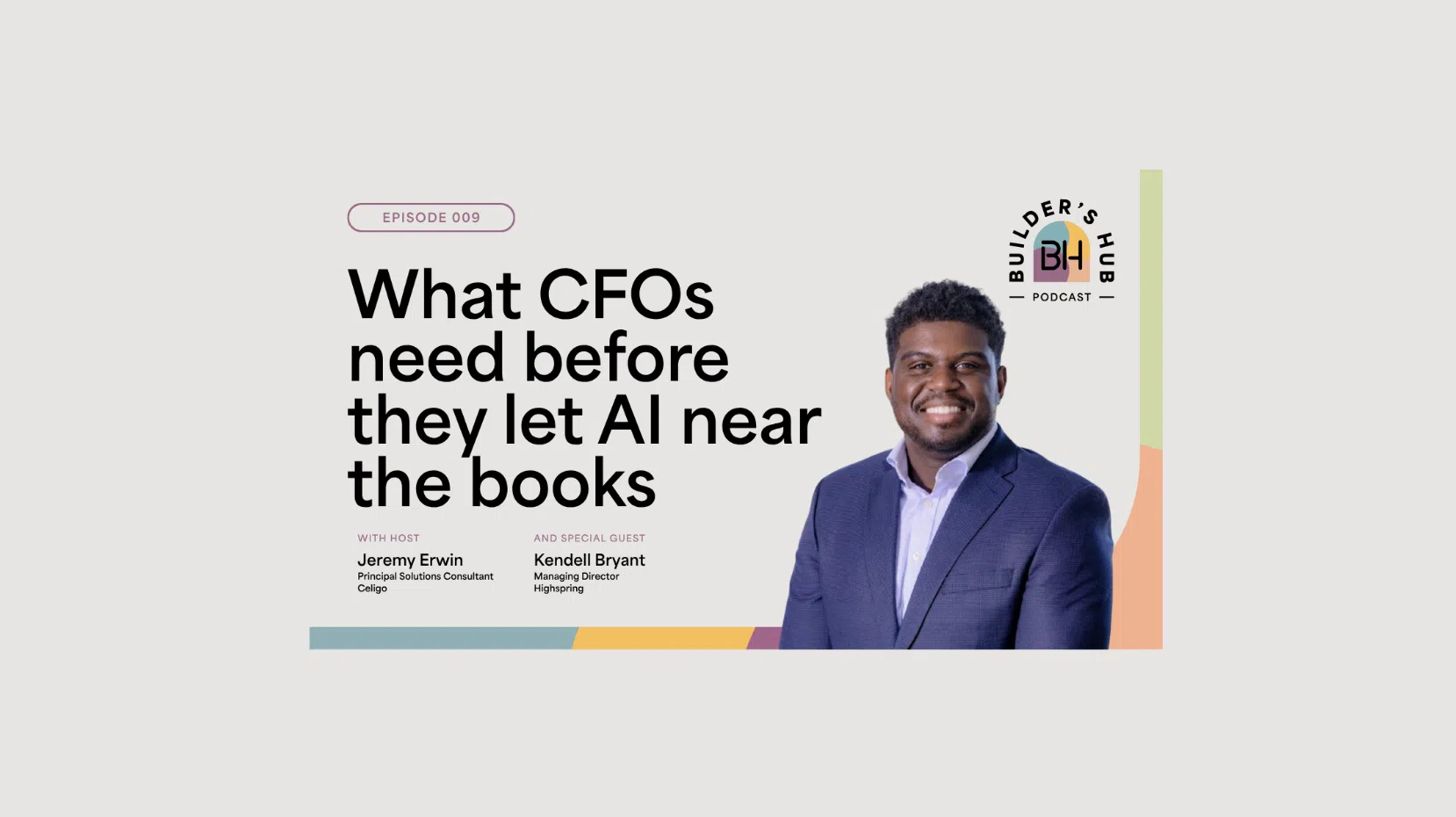
Kendell Bryant leads the NetSuite ERP practice at Highspring, where he works with technology, financial services and professional services companies to transform the office of the CFO and CIO. On Celigo’s Builder’s Hub Podcast, he sat down with Jeremy Erwin to talk about what AI governance in finance looks like in practice.
This guide pairs Kendell’s advice with Celigo’s experience: eleven years of running mission-critical automation. It covers where AI fits in finance, what governance has to cover, and how to get started.
Key takeaways
- Finance needs confirmation that AI output is accurate, plus a full audit trail of every action an agent takes.
- Organizations need to agree on ownership between IT and finance before the first workflow goes live.
- Start small. Give AI read-only access to one data object, and automate deterministic work before adaptive work.
- Running AI on one intelligent automation platform keeps every workflow under one governance model, instead of spreading it across disconnected point tools.
What is AI governance in finance?
AI governance in finance is the set of controls that decide what data an AI agent can access, what actions it can take, who configures it, and how each action is logged for audit. It applies the standards finance already uses for SOX, SOC 2 and internal review to the agents and workflows that now touch the books.
Finance manages a company’s external risk. It decides what data the business exposes, who gets access, and how much tolerance there is for a data mistake. Kendell’s view is that AI doesn’t get its own rulebook. “It’s not its own brain, its own engine,” he says. “It still falls within that governance framework.”
Highspring’s research suggests many companies aren’t ready for that. According to Kendell, 92% of leaders surveyed are confident their company could handle a major unexpected disruption, but only 47% say their plans account for one.
The concern Kendell hears most often is accuracy. If an agent calculates a trial balance or a reconciling amount, finance needs to know the result matches what an AP or AR clerk would produce by hand.
That means testing AI output against known results before anyone relies on it. “We can’t guesstimate,” Kendell says. “This is the market of confirmed results.”
Why a fragmented AI stack creates governance risk
Accuracy also depends on what the AI is connected to. Many finance teams are already automating, but they do it in pieces: one tool for expense approvals, another for invoice processing and a third for close management. Each tool has its own connections and its own failure risks.
Celigo’s view is that AI has to connect to the systems the close actually runs on: the ERP, the CRM, the billing platform and the expense tool. Layering AI on top of broken processes is not transformation. Without those connections, discrepancies surface late and delay the close, and audit documentation gets assembled by hand under pressure.
An integration platform puts connections, AI agents and deterministic workflows under one governance model. The ERP connection built for invoice processing gets reused for close orchestration. The controls you configure for one workflow apply to all of them.
Traceability: an audit trail you can print
Kendell treats traceability as a systems problem. Every action an agent or workflow takes should be logged, so finance can see what happened at each step.
His test is simple. Can you export the record, print it on a big sheet of paper, and hand it to an auditor as an explanation of exactly what the agent did?
Highspring already builds point-to-point reconciliation into data flows, so finance can trace a data set from its source to its target. Agentic workflows need the same treatment. In Celigo, context moves through the integration layer instead of being held inside the AI. Every data handoff is logged, and every decision is logged against the record it came from.
Who owns AI in finance: IT or finance?
Both teams do, with different responsibilities. IT runs the infrastructure and security. Finance owns the data and understands the balances.
When something goes wrong, Kendell says the investigation usually starts with IT, InfoSec and infrastructure. They check whether an agent accessed data it shouldn’t have or whether a control failed. Finance then interprets what the failure means for the books.
The key is to settle ownership early. Kendell tells clients to bring finance to the table before any workflow is scoped, even at companies that treat finance as a back office function.
Celigo calls this the federated approach. IT owns the integration layer, agent configuration and access policies. The business team owns the process being automated and works within the parameters IT defines. Any change to an agent’s scope needs IT approval.
The AI governance checklist for finance
Before an AI agent touches financial data, you should be able to answer these questions. Here’s how Celigo answers these questions using our own platform:
- What data can the AI access? Only the records IT explicitly exposes, such as invoices, account histories and expense reports. It has no direct system access and can’t reach across unrelated data.
- Which actions can it take? IT defines the permitted actions for each workflow, such as read, draft, flag, escalate and post. Agents can’t act outside their configured scope.
- How is context stored? Context moves through the integration layer and doesn’t stay inside the AI. Nothing persists beyond the current workflow.
- Who controls configuration? IT owns agent configuration and access policies, and business teams operate within those parameters.
- How are actions audited? Every decision is logged against the originating record. A full audit trail is available for SOX, SOC 2 and internal review at any time.
Which finance processes need AI, and which need automation?
Not every finance process needs AI. Finance work falls into three categories:
- Deterministic: The same input produces the same output every time. Examples include invoice matching, payment runs, journal entry posting and GL account mapping. Rules-based automation handles this work best.
- Adaptive: The right answer depends on context and history. Examples include AR inquiry triage, expense policy edge cases and close discrepancy resolution. This work suits AI agents with a human making the final decision.
- Human-essential: Accountability or regulation requires a person. Examples include revenue recognition judgments, CFO sign-off on write-offs and board-level financial narrative. Automation supports this work, but a person still does it.
Start with deterministic work. It delivers the fastest ROI and lays the foundation for adaptive automation. Kendell gives a practical filter: look for work your team does in Excel or Word that eats hours every month.
How to connect AI to NetSuite safely: start with one data object
Kendell’s most practical advice is about scope. When teams connect AI to NetSuite through an MCP connector, he recommends starting with read-only access to a single data object, like the chart of accounts. From there, you check two things. Does it return the information you need? Are there metadata attributes you still need to capture? You expand only after both answers are yes.
Celigo supports that approach with two tools. The Celigo MCP Server lets teams build governed tools for agents. The MCP Gateway controls what agents can access. Celigo is also building agentic templates and pre-configured MCP servers, so teams with similar use cases can turn them on instead of building from scratch.
AI use cases in finance that work today
Highspring shared the following AI use cases:
- Sub-ledger reconciliation: One Highspring client managed billing and revenue recognition outside NetSuite. An analyst spent four to five days a month reconciling that sub-ledger to the general ledger with queries and saved searches. Highspring built an agentic workflow that pulls source and ERP data, runs it through a reconciliation rules engine, and produces a dashboard showing what reconciles, what needs investigation, and where balances differ. The monthly reconciliation dropped from five days to about an hour.
- Process documentation: Public companies need documented procedures for audit, and nobody enjoys writing them. Highspring uses agentic workflows to draft process flow documentation in Lucidchart from ERP workflows, meeting transcripts and existing documents. The same output helps new hires get up to speed without depending on a departing colleague’s memory.
Celigo’s Operationalizing AI in Finance playbook walks through each of the following AI use cases step by step, including the governance controls for each.
- Customer billing inquiries: An agent monitors the AR inbox, classifies each email by intent and pulls invoice history from the ERP. It drafts a response, sends the routine ones and escalates disputes to the AR team with full context. Response times drop from days to minutes.
- Expense policy compliance: Rules check each line item against policy and auto-approve compliant reports. AI explains violations in plain language and routes edge cases to finance. Nothing posts without at least one approval step.
- Financial close orchestration: An agent aggregates data across the ERP, revenue and expense systems, flags discrepancies with a recommended resolution, and tracks the close checklist. Journal entries post only after the Controller signs off.
Celigo has also developed agentic templates to help financial leaders launch agents faster.
- AR Email Processing: Classifies and routes incoming accounts receivable emails (document requests, record updates, follow-ups) with duplicate prevention.
- Payout Reconciliation Assistant: Investigates unmatched payout variances, identifies likely causes, and writes review notes on the variance without altering transactions.
- AP Expense Automation: Reviews expense reports against company policy and auto-approves, rejects, or escalates exceptions.
- Bank File Parser Agent: Updates cash application bank file parser field positions when a bank changes its format, with guardrails and one-click revert.
- AP Invoice Ingestion Agent: Extracts vendor invoices from email/PDF, matches to POs, screens duplicates, and posts vendor bills touchlessly or routes exceptions for review.
More than 60 agentic templates are available now in the Celigo integrator.io marketplace.
If you’re already a Celigo customer: Log in to integrator.io, open the template library, and ask Celigo Ora to help you find and install one.
If you’re not yet a customer: Start a free trial, and the templates are included.
See Celigo live at SuiteWorld 2026
Stop by to see how the Celigo gives finance teams AI with governance built in. Book a 30-minute meeting with our team to find where AI is worth the investment in your NetSuite environment.