What is iPaaS? Essential guide to integration platforms (2025)
How an iPaaS works, what it’s used for, and how integration has evolved in today’s business world.


In today’s hyperconnected business world, your apps shouldn’t live in silos. From finance systems and CRMs to ERPs and AI tools, seamless connectivity is critical to productivity, accuracy, and innovation.
This is where an iPaaS, integration platform as a service, comes in. iPaaS platforms enable organizations to connect applications, data, and business processes in a scalable, secure, and streamlined way.
What is iPaaS?
An iPaaS is a cloud-based platform that connects different applications and systems so they can work together. An iPaaS enables organizations to integrate their applications, systems, and data across cloud and on-premise environments. iPaaS platforms simplify the design, execution, and monitoring of integrations, often with low-code tools.
With an iPaaS, you can automate business processes, ensure consistent data across systems, and reduce the burden on IT teams. Whether you’re syncing customer data, automating order processing, or enabling AI-driven analytics, iPaaS is the engine behind the scenes.
Modern iPaaS solutions, like Celigo, support integration patterns across apps, data warehouses, B2B (EDI), APIs, and events, all through a single interface.
Some of the most common business processes automated via an iPaaS are:
- Order-to-cash automation
- Lead lifecycle management
- Employee onboarding and offboarding
- Finance and accounting sync
- IT service management
- Inventory and supply chain coordination
- Data warehousing and analytics feeds
Benefits and use cases
Benefits
The advantages of adopting an iPaaS include:
- Automation of manual tasks: Reduces time spent on data entry and reconciliation.
- Improved data accuracy: Syncs data in real-time across your systems.
- Operational efficiency: Streamlines processes like quote-to-cash and order fulfillment.
- Scalability: Handles millions of records and dozens of integrations.
- Agility: Quickly responds to new business opportunities with fast integrations.
- Compliance and governance: Meets data privacy and audit requirements with role-based access and encrypted data flows.
- Lower IT burden: Empowers business users to build and manage integrations without developer intervention.
- Enhanced security and compliance through centralized integration: Enhances enterprise security by providing encrypted data transfers, role-based access controls, and proactive error management to ensure safe and compliant integration across systems.
Use cases
An iPaaS can address a wide array of integration challenges:
- Scalable application integration: Simplifies connecting cloud and on-premises applications with prebuilt connectors and reusable components, enabling faster deployment and easier maintenance of integrations as your tech stack evolves.
- Data consistency: Syncs customer, product, or order data across apps like NetSuite, Salesforce, Shopify, and HubSpot.
- Multistep workflows: Automates quote-to-cash or procure-to-pay across departments and systems.
- B2B (EDI) integration: Manages trading partner connections with prebuilt EDI templates and VAN support. See Celigo’s B2B Manager for EDI.
- AI-powered automations: Uses LLMs to summarize tickets, classify issues, or route decisions.
- APIs & composite services: Exposes internal flows as secure APIs for partners or external teams.
How iPaaS works
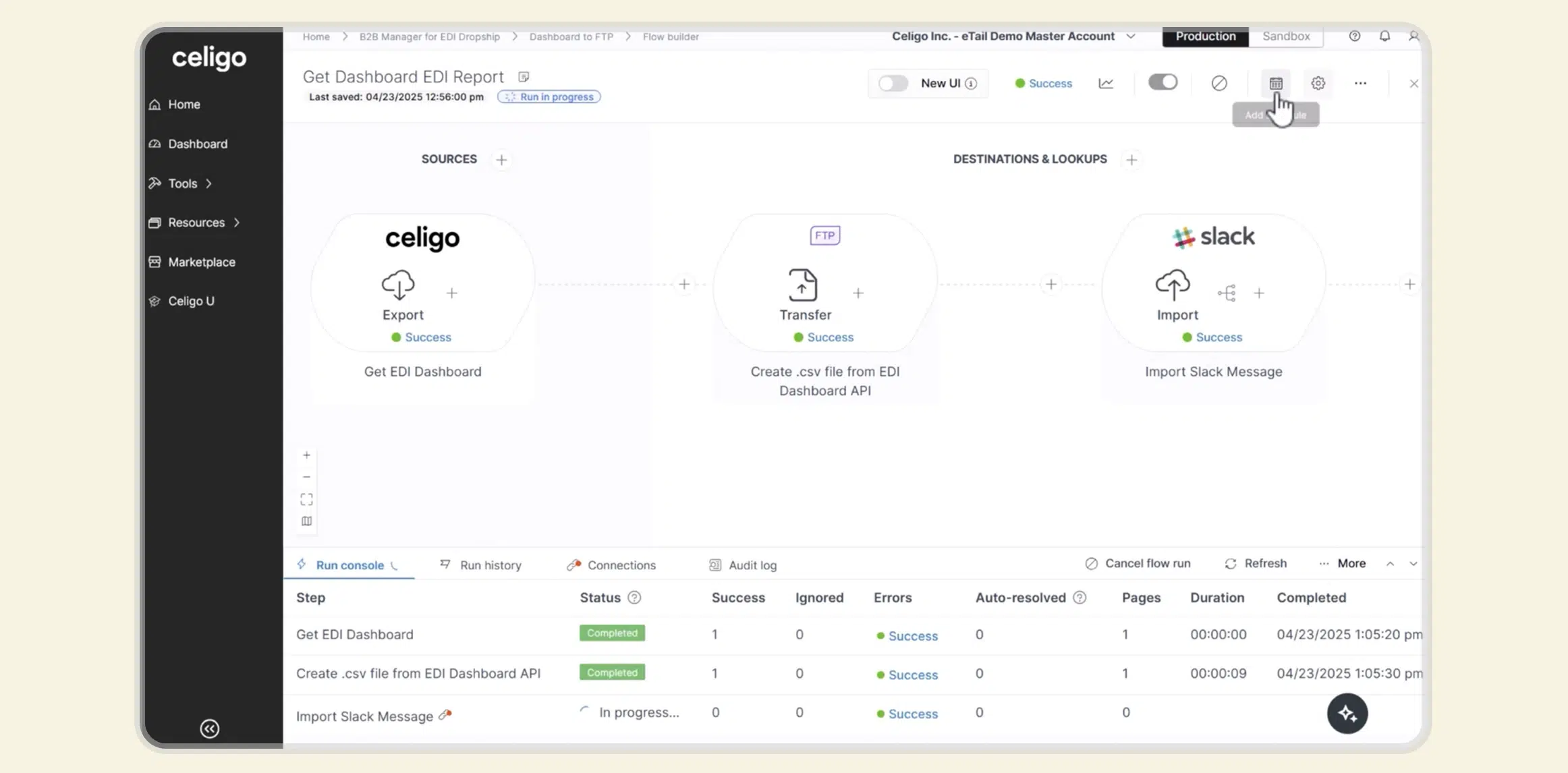
An iPaaS acts as middleware, sitting between applications and enabling them to share data and trigger actions. Think of it as a digital bridge that moves data between apps like Salesforce, NetSuite, Slack, or custom databases.
Here’s what it typically does:
Integration of applications and data sources
At its core, iPaaS exists to connect your systems, such as cloud apps, ERPs, CRMs, databases, or custom APIs, so they can share data and work together in real-time. This is especially important in organizations where data is spread across dozens of platforms that were never designed to talk to each other.
iPaaS platforms typically come with hundreds of prebuilt connectors for popular applications like Salesforce (CRM), NetSuite (ERP), Shopify (ecommerce), Workday (HR and finance), and Snowflake (data warehouse).
Because the technical complexity is handled behind the scenes, users can connect systems faster without needing to write custom code or API wrappers for every app. Standard connectors manage authentication and communication, while Integration Apps include built-in logic to handle common data flows and business processes.
For a real-world example, let’s suppose you need to sync customer data between Salesforce and NetSuite. The connectors pull leads from Salesforce’s API and create customer records in NetSuite, and the iPaaS handles field mapping and authentication, while allowing users to define how the data should move and be transformed.
Data mapping and transformation
When two systems, such as a CRM and an ERP, talk to each other, they often use different formats, field names, or data structures. Data mapping and transformation is how an iPaaS ensures that information from one system makes sense in the other. It translates data between systems so it lands correctly and in the right format.
Most iPaaS platforms have visual tools or rule builders to set up these mappings, without the need for coding. Users can select what data comes from where, how it should be transformed, and where and how it should be delivered.
Workflow automation
Workflow automation is when you set up a series of steps that happen automatically between different apps and systems without needing someone to manually enter data, send an email, or check for updates.
Connectors provide the connectivity needed to move data between systems, but they don’t define the logic or steps involved. Workflow automation comes from how those connectors are used within flows, especially when integration templates (prebuilt flows) are deployed. Integration Apps include multiple flows with embedded logic for end-to-end business processes.
Let’s say your business uses Shopify for online orders, NetSuite for inventory and financials, and Zendesk for customer support
Without automation, your team might:
- Manually enter orders from Shopify into NetSuite
- Send an email to shipping when the order is ready
- Create a support ticket in Zendesk if there’s an issue
With workflow automation, all of that happens instantly and accurately:
- A customer places an order on Shopify.
- iPaaS picks it up and sends the order details to NetSuite automatically, and notifies the shipping team.
- If inventory is low or an error occurs, it creates a ticket in Zendesk automatically.
iPaaS removes the need for copying and pasting and helps to avoid human error and missed steps. Workflow automation with iPaaS enables faster processes, better visibility, and teams more focused on meaningful work instead of tedious data entry.
iPaaS security and governance
An iPaaS gives IT the visibility, control, and security needed to orchestrate connections at scale, without becoming the bottleneck or allowing integrations to become too complex.
Centralized management: Instead of scattered scripts and one-off tools, an iPaaS provides a single platform where IT can view, monitor, and manage all integrations. A modern iPaaS should provide unified dashboards with real-time visibility and the ability to pause, update, or reroute workflows.
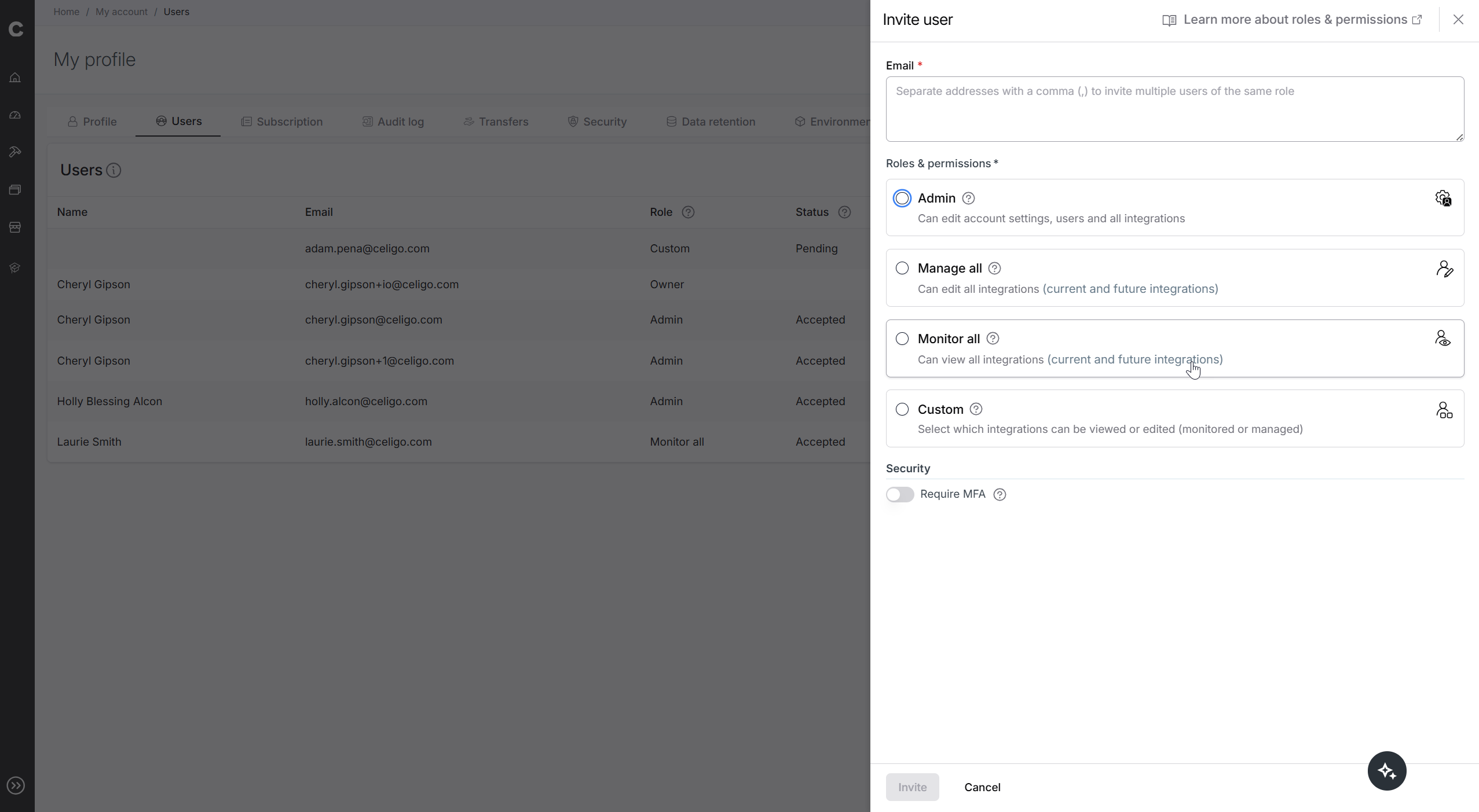
Built-in governance: Governance, which has historically been treated as an afterthought in integration processes, is often built into integration platforms. This allows teams access controls, sandboxes for different teams, IT-regulated rules, and consistent standards for logging integrations.
Secure data flows: Data security is foundational in modern integration. An iPaaS ensures data encryption, secure authentication, and logging for audits and regulatory requirements.
Policy-driven controls: An iPaaS should allow IT to enforce policies like limiting data exposure (for example, no PII leaves certain environments), defining retry limits or timeout settings, and setting alert thresholds for anomalous activity.
Scalability: As the number of apps and teams grow, iPaaS scales with you, without multiplying risk. This helps reduce “SaaS sprawl” and custom code that’s hard to maintain, and avoids shadow IT by giving teams what they need inside the platform.
What’s new in iPaaS for 2025?
The iPaaS market has rapidly evolved beyond just connectivity. Today’s top platforms drive business transformation through:
- Agentic AI: GenAI helps users design flows, troubleshoot errors, and generate mappings automatically.
- Composable services: Integration components can now be reused as APIs, helping businesses build “process as a service” architecture.
- Event-driven orchestration: Modern iPaaS platforms listen for events (such as a new order or invoice) and automatically trigger a workflow, creating more responsive and agile operations.
- Private cloud deployment: Enterprises can run iPaaS in secure, dedicated environments.
- Packaged Integration Processes (PIPs): Out-of-the-box flows for various industries and business functions.
AI and iPaaS
Most modern iPaaS platforms are now infused with artificial intelligence:
- Flow generation from natural language: Users can describe what they want in plain English, and the iPaaS can build the flow.
- Automated exception handling: Built-in AI tools can handle errors without manual intervention.
- RAG and natural language BI: Data warehouses can generate real-time insights following prompts that use natural language.
- AI agents: Teams can deploy assistants to act on Slack threads, trigger flows, or summarize customer tickets. See AI use cases and benefits of iPaaS integration.
How Celigo stands out in the iPaaS market
Many platforms can connect applications, move data, and automate workflows. But where they differ, and where Celigo shines, is in how they handle long-term operational complexity, scale across teams, and support real-world business agility. Celigo’s iPaaS platform is purpose-built to support both IT professionals and business technologists.
Celigo consistently scores among the highest vendors for key use cases in G2 and Gartner. (See the latest G2 report)
Designed for the full lifecycle
Many platforms emphasize the ease of initial integration builds. Celigo goes further by making the ongoing operation of integrations just as seamless. Exception management is built into the core of the runtime, with AI-based auto-resolution, traceability, and routing that drastically reduce downtime and manual intervention.
Empowering whole teams, not just IT
Celigo’s no-code and low-code tooling is designed for SaaS admins and ops leaders. While traditional platforms often assume integrations will be managed exclusively by developers or IT, Celigo is built for a blended team, including SaaS admins, business analysts, data stewards, and integration specialists. Our low-code experience is intuitive yet powerful, and our tools offer role-based access so each team can manage what they need without stepping on each other’s workflows.
Prebuilt integrations
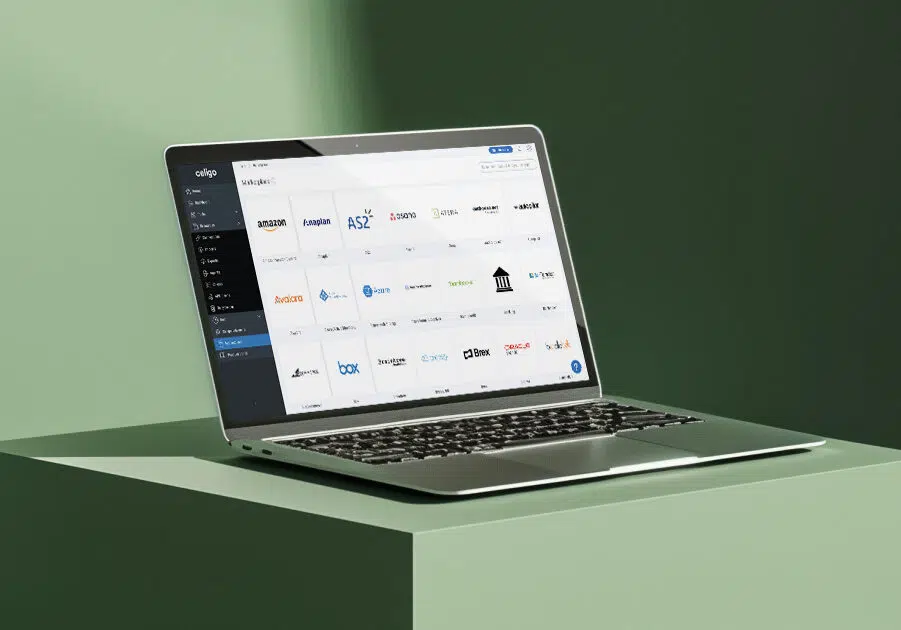
Celigo’s expansive integration marketplace has over 700 connectors, 250 integration templates, and 40 fully managed Integration Apps. Some platforms provide templates as a starting point. Celigo takes this further with fully managed Packaged Integration Processes (PIPs). These are entire business workflows like order-to-cash and employee onboarding, complete with UI-driven configuration, version control, and ongoing maintenance. These are production-ready, enterprise-grade solutions maintained by Celigo.
Enterprise-grade solutions
For large organizations, Celigo offers a Private Cloud deployment with support for DirectConnect, data residency, custom SLAs, and enterprise security standards.
Built for scale
Celigo’s integration artifacts are reusable across flows, easily exposed as APIs, and discoverable within the platform. Whether you’re automating Slack approvals or building real-time product syncs, components can be shared and scaled without rebuilding from scratch.
AI-powered integration
Celigo’s user interface comes with natural language builders, RAG-based support bots, and AI steward agents.
Exception management
Celigo is the only iPaaS to treat exceptions as first-class objects, with a 96% auto-resolution rate.
Clear, predictable pricing
Unlike usage-based models that meter by “tasks,” “actions,” or data volume, Celigo uses a straightforward pricing model based on endpoints and flows. This transparency removes friction during budgeting and lets businesses scale integrations without worrying about surprise overages.
Celigo’s strategic blend of usability, governance, automation, and business process focus makes Celigo more than just a connector. It’s a long-term integration partner for companies that want to scale intelligently.
Integration insights
Dive deeper into integration and iPaaS with these articles.