
 Salesforce
 MS Dynamics 365
 Oracle NetSuite
 SAP
SAP Walmart
 Amazon
 Shopify
 Snowflake
 Acumatica
Operationalizing agentic AI in support and commerce

Most customer-facing AI still stops at the point of interaction. It can answer a question or suggest a next step, but it does not execute the workflow behind the experience.
That limitation shows up quickly in two common scenarios: order issue resolution and guided buying.
Both require more than language generation. They require operational context, decision logic, and the ability to take action across systems. In practice, these workflows span storefront, order management, fulfillment, shipping, product data, CRM, and service applications.
See how you can operationalize both patterns with agentic AI by connecting specialized agents to the systems that already run the business.
Workflow pattern 1: Order issue resolution
A customer asks about a missing package. On the surface, that sounds like a simple support request. In practice, resolving it usually means retrieving the order history, checking the fulfillment status, validating the shipment details, determining whether the issue falls within a standard resolution path, and deciding whether it should be escalated.
In many organizations, that process still depends on a human support rep moving across systems to gather context and determine the next step. Even when AI is added, it often stops at drafting a response rather than participating in the workflow itself.
An agentic approach changes that. An AI agent can retrieve the order record, inspect fulfillment and shipping status, apply escalation logic, and create a support ticket with the right context already attached for human review. Instead of operating as a thin conversational layer, the agent participates directly in the resolution flow.
The value is not just speed. It is better triage, cleaner handoffs, and less manual work for support teams.
Workflow pattern 2: Guided buying and recommendations
The same architectural pattern applies on the commerce side.
Helping a customer choose the right product often requires more than a static recommendation engine or a generic chat experience. The interaction becomes more useful when it can incorporate live operational and commercial context: what products are relevant, what information is available, what path the buyer is on, and what action should happen next.
In this pattern, an AI agent supports the buying journey in real time by helping customers narrow options, explore relevant products, and receive personalized recommendations. Rather than operating as a disconnected front-end layer, the agent is tied into the business systems that already support commerce operations.
That matters because product selection is not just a content problem. It is a workflow problem. The more tightly the experience is connected to the underlying systems, the more useful and actionable it becomes.
Execution model: Specialized agents and orchestrated workflows
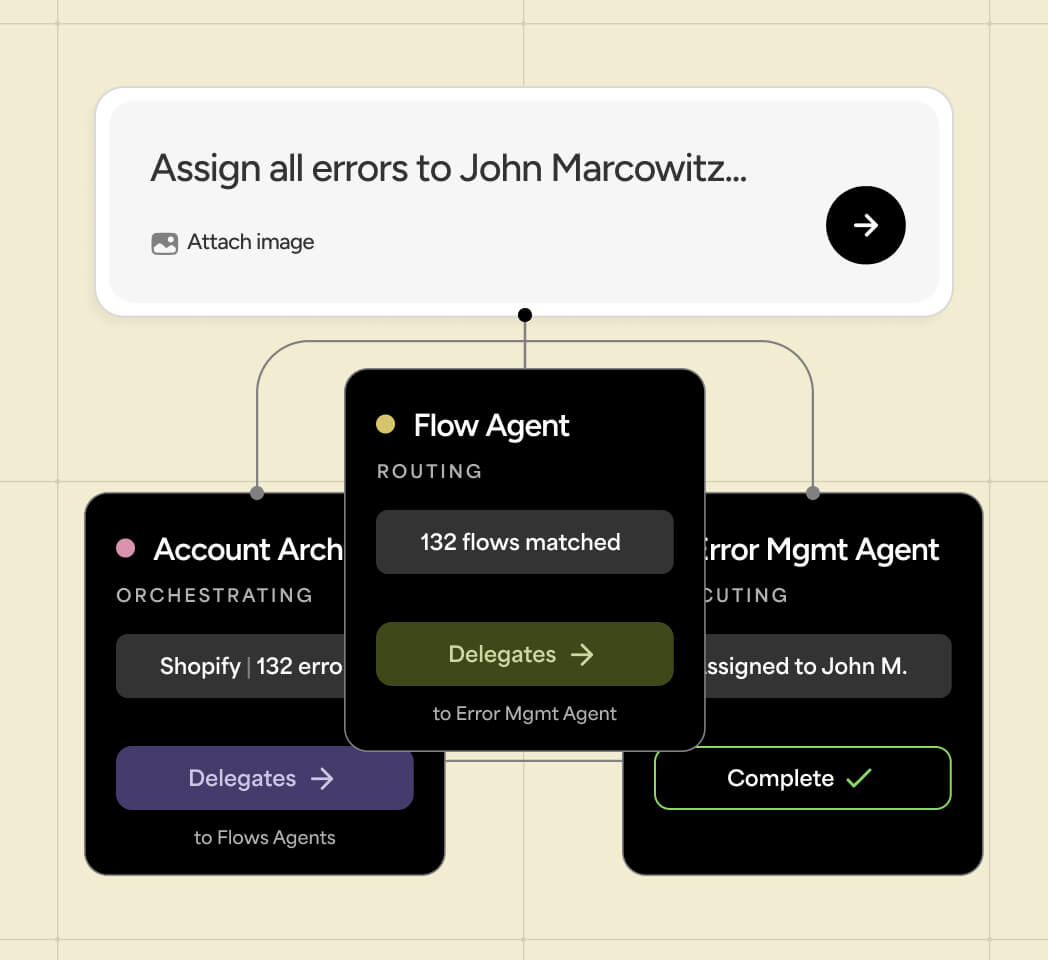
What makes these use cases work is not a single assistant. It is a set of specialized AI agents connected to business systems through APIs and orchestrated workflows.
One agent can handle service-side actions such as order lookups, shipment checks, and ticket creation. Another can support commerce-side actions such as recommendations and guided buying. Separate monitoring agents can evaluate outputs, identify weak points, and help improve results over time.
This is the shift from AI as an interface to AI as an execution layer.
Instead of generating answers in isolation, agents can interact with the applications that teams already use every day. That allows them to participate directly in real business processes across storefront, fulfillment, and service systems.
Why the architecture matters
These use cases are important because they show where enterprise AI becomes operational.
For support teams, this model reduces repetitive investigation work and accelerates escalation when human review is needed. For commerce teams, it creates more responsive buying experiences by connecting product guidance to live business context. Across both, the result is faster execution, better handoffs, and a more practical path to production use.
The opportunity is not just to improve conversations. It is to connect AI to systems of record and systems of action so it can help run the workflows the business depends on.
From assistance to execution
Order issue resolution and guided buying may look like different use cases, but they point to the same architectural pattern: AI delivers more value when it can retrieve context, apply logic, and take action across the systems already running the business.
That is where agentic AI moves beyond assistance and starts contributing to real operational execution.
→ Get a demo to see how Celigo powers agentic workflows for support and commerce by connecting AI to the systems that already run your business.
Integration insights
Expand your knowledge on all things integration and automation. Discover expert guidance, tips, and best practices with these resources.