 Salesforce
 MS Dynamics 365
 Oracle NetSuite
 SAP
SAP Walmart
 Amazon
 Shopify
 Snowflake
 Acumatica
Build a Customer 360 workflow with agentic AI

Before a customer meeting, account teams still have to manually assemble context from Salesforce, Gong, Zendesk, and product usage data. The work is repetitive: find the right account, review recent calls, scan open tickets, check adoption signals, and turn it all into something the team can actually use.
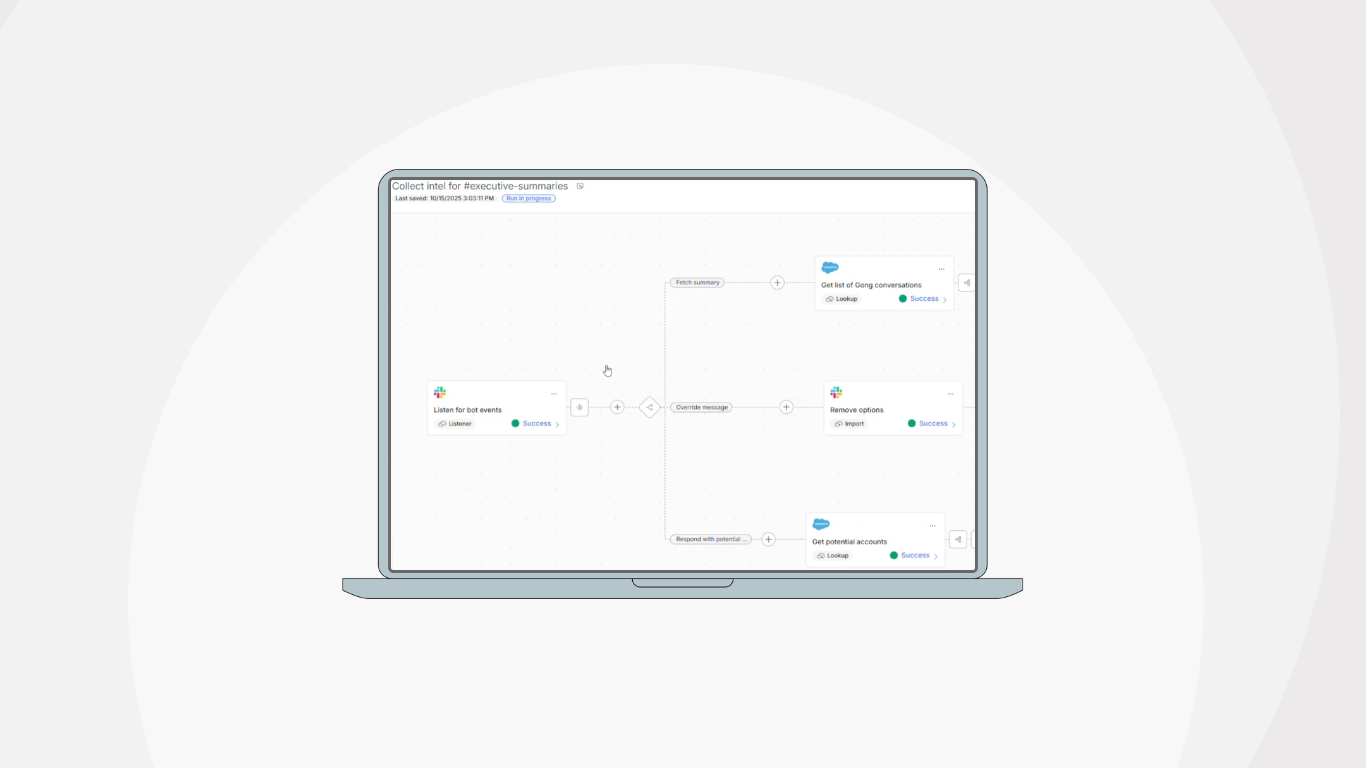
We created an agentic workflow that begins in Slack and turns live account data into a structured, branded summary delivered back to the team.
See how to operationalize this process as an agentic workflow:
Live account context from connected systems
The workflow starts in Slack, but the value comes from the systems behind it.
Celigo listens for the Slack event, inspects the payload, and routes the request to the right action. In lookup mode, it searches Salesforce for matching accounts and returns the results to Slack. Once the user selects the right record, the workflow confirms the request and begins gathering the data required for a Customer 360 summary.
That includes the latest account details from Salesforce, recent calls and transcripts from Gong, support tickets and comments from Zendesk, and product usage signals from Snowflake. Bringing those sources together matters because account prep is not a single-system problem. Relationship history, support activity, and adoption signals all shape how a team should approach a customer conversation.
Structured synthesis, not just summarization
Once the account context is gathered, Celigo sends a curated dataset to OpenAI along with the prompt, model configuration, guardrails, and the schema required for the report. The model returns structured JSON, not just free-form text.
Celigo then uses that structured output to generate a PDF in a branded template defined by sales and marketing, uploads it to a shared drive, and posts the finished summary back to Slack.
That design matters. The model handles synthesis, but Celigo controls the workflow, source data, prompt settings, output structure, and delivery steps. That makes the result more repeatable, more operational, and easier to standardize across teams.
From account research to meeting readiness
The finished brief gives the account team a working Customer 360 view: customer profile, business overview, stakeholders, usage and endpoints, contract dates, support issues, red flags, immediate priorities, and growth opportunities grounded in the underlying source systems.
Instead of spending time collecting and reconciling context, the team can move directly to interpretation and action. What used to be a manual research task becomes a repeatable process that can run whenever the team needs to prepare for a customer conversation.
Why the architecture matters
This use case works because Celigo is orchestrating across collaboration, CRM, conversation intelligence, support, analytics, LLM, and content delivery systems. The agent is not relying on one data source or one generic summary step. It is executing a multi-system workflow that retrieves the right account context, applies structured synthesis, and delivers the result back into the system where the request started.
That is what makes the pattern useful in practice. The value is not just that AI can summarize an account. It is that Celigo can operationalize the end-to-end process required to produce a usable, shareable, current account brief.
Customer 360 summaries are most useful when they are built from live system context, structured for consistency, and delivered back into the team’s daily workflow.
That is what this pattern shows: agentic AI becomes more valuable when it is orchestrated across the systems that already hold the relationship, support, and product signals teams need to act on.
→ Get a demo to turn agentic AI into real business workflows.
Integration insights
Expand your knowledge on all things integration and automation. Discover expert guidance, tips, and best practices with these resources.