 Salesforce
 MS Dynamics 365
 Oracle NetSuite
 SAP
SAP Walmart
 Amazon
 Shopify
 Snowflake
 Acumatica
Shopify SAP integration: streamline and scale your ecommerce operations


When Shopify is the engine driving demand, and SAP is the system running inventory, fulfillment, and financials, the integration between them becomes operational infrastructure. At low volume, teams can “make it work” with manual exports, spreadsheets, and a few scripts between Shopify and SAP. At scale, those same approaches create a different reality: missed sales orders, inventory inaccuracies, delayed shipments, messy payout reconciliation, and constant IT fire drills.
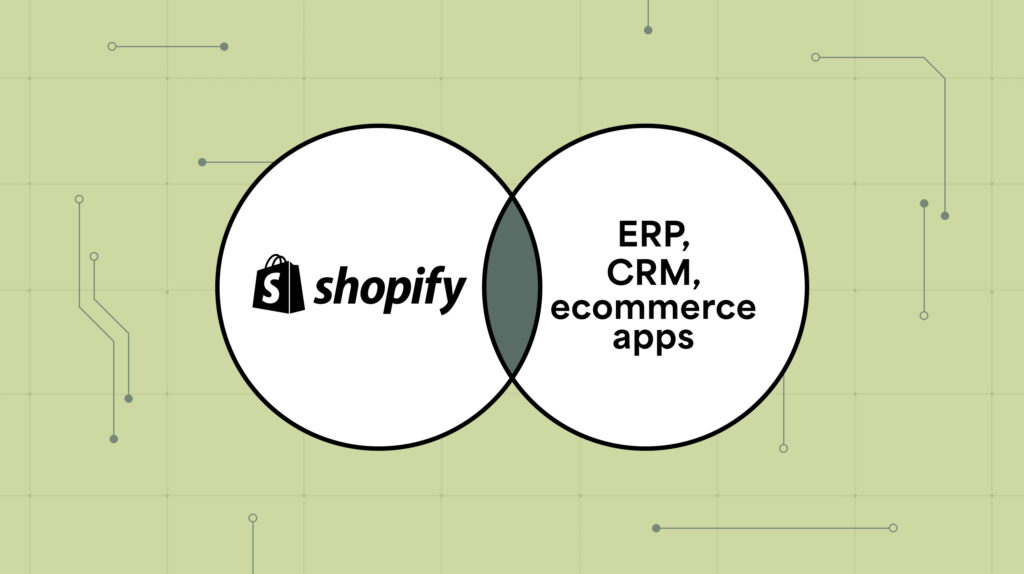
The underlying challenge usually isn’t “how do we connect a Shopify store to SAP?” It’s how to orchestrate an end-to-end commerce workflow across ERP, eCommerce, 3PLs/WMS, marketplaces, tax engines, and finance systems with visibility, controls, and the ability to evolve as the business changes.
This article breaks down why Shopify SAP integration solutions become a critical path, what typically breaks in real-world operations, the workflows worth automating, and what to look for in an integration platform built for scale.
Why Shopify & SAP become a critical path at scale
Shopify and SAP each do their jobs extremely well until growth forces them to operate as a single, coordinated system:
- SAP Business One, SAP HANA, or any of SAP’s offerings are the system of record for item master data, inventory valuation, fulfillment, invoicing, and financial posting.
- Shopify store is the front-end commerce engine capturing orders, customer context, promotions, and channel experience.
As the business scales, a few triggers expose the fragility of point-to-point connectors or legacy middleware:
- ERP system SKU and catalog complexity (variants, bundles/kits, region-specific pricing)
- Higher order volume and more frequent operational exceptions
- Multi-warehouse fulfillment and location-based inventory decisions
- More Shopify storefronts, regions, and currencies
- Returns synchronization
- Additional ecommerce channels
This is where one-off connectors and legacy middleware begin to fail. They’re often hard to adapt to changing business rules, lack centralized monitoring, and turn every change (new channel, new Shopify store, SAP module change) into a risky project. The result is slower order-to-cash cycles, increasing IT overhead, and inconsistent customer experiences.
What breaks in real-world Shopify–SAP operations
Most integration pain doesn’t show up in a clean “order sync” demo. It shows up in edge cases and exception paths that are common in scaled commerce.
Duplicate or missing transactions
Retries are necessary in real integrations but without strong rules, retries create duplicate sales orders in SAP. If failures aren’t handled correctly, orders can drop silently.
Operational impact: delayed fulfillment, customer escalations, revenue leakage, and costly manual cleanup.
Inventory drift across locations and channels
Inventory “available to sell” is rarely a simple number. It’s affected by allocations, safety stock, backorders, warehouse transfers, late receipts, and fulfillment latency. Batch updates can’t keep pace and real time data syncs without rules can conflicting data synchronization.
Operational impact: overselling, stockouts, cancellations, and constant inventory reconciliation.
Returns and refunds that don’t reconcile
Returns workflows include RMAs, exchanges, partial returns, damaged goods, restocking fees, gift cards, and multi-item orders with split fulfillment. Not ever return is the same and this has operational complexity.
Operational impact: refund errors, inventory inaccuracies, support burden, and margin leakage.
Settlement and payouts that don’t match sales
Payment settlement timing, fees, and disputes rarely align neatly with sales. Matching payouts to orders and posting fees correctly becomes harder with multi-currency, multiple payment methods, and marketplace/channel complexity.
Operational impact: delayed close, mismatched payouts, reconciliation headaches, and audit risk.
No centralized visibility or control
In point-to-point connectors, failures can go undetected until a customer complains or finance notices missing postings in erp systems.
Operational impact: fire drills, missed SLAs, and low trust in system data.
The key takeaway: these aren’t “just API problems.” They’re operational workflow problems that require seamless orchestration, governance, and operability.
The workflows to automate first
If you’re going to invest in Shopify & SAP integration, focus on the workflows that move money, inventory, and customer experience.
Order-to-cash orchestration
What to automate: Shopify to SAP (and ecommerce fulfillment systems)
A mature order flow does more than create or update sales orders or manage orders.
It supports configured seamless business logic, like:
- customer and order creation with validation
- tax, discounts, and promotion logic
- bundles/kits and variant mapping
- shipping methods and fulfillment instructions
- status updates back to Shopify (confirmed to fulfilled to shipped to invoiced)
Edge cases to design for: cancellations, backorders, partial shipments, split fulfillment, fraud holds, reshipments, and duplicate prevention.
Inventory availability and allocation
What to automate: SAP to Shopify marketplaces
Inventory sync should reflect how you actually sell:
- per-warehouse/location availability
- reserved vs. available
- safety stock rules
- channel-specific availability policies (e.g., protect wholesale)
- update cadence aligned to tolerance (near real-time where needed, scheduled where acceptable)
Edge cases: transfers, late receipts, dropship/3PL stock, preorders, and seasonal spikes.
Returns, exchanges, and refund reconciliation
What to automate: Shopify and SAP as a finance system
Returns orchestration should support:
- RMA creation and approvals
- disposition (restock, refurbish, discard)
- exchange flows (new order issuance, differential billing)
- refund triggers tied to inspection/receipt policy
- restocking fees and store credits where applicable
Edge cases: partial refunds, bundles, multi-warehouse returns, and returns after split fulfillment.
Payouts and financial posting
What to automate: Shopify payouts to SAP Finance. Finance-ready integration supports:
- payout-to-order matching
- fees and adjustments (processing fees, shipping adjustments, promos)
- multi-currency posting rules
- channel-level reporting and fee visibility
Product, pricing, and customer master data governance
What to automate: bi-directional, where appropriate
A key design decision is “system of truth”:
- SAP typically owns item master and core product identity
- Shopify may own merchandising fields and experience elements
A strong approach includes validation rules, controlled updates, and mapping that supports variants and region pricing.
Why “just connect Shopify to SAP” is the wrong frame
In scaled commerce, Shopify and SAP are rarely the only endpoints. Most businesses also rely on:
- 3PL/WMS (for picking, packing, shipping, SLAs)
- Marketplaces (Amazon and others)
- Tax engines (for real-time tax determination and compliance)
- CRM and customer systems (RevOps, support, lifecycle workflows)
- EDI partners (retailers, suppliers, distributors)
- Financial systems beyond ERP modules (reporting, reconciliation, revenue tools)
That’s why the real requirement isn’t a connector, it’s a ipaas that can orchestrate the workflow across these endpoints with consistent monitoring, governance, and change control.
Shopify–SAP integration platform requirements
When evaluating a platform for Shopify–SAP orchestration, prioritize operability and scale—not just initial connectivity.
Look for a solution that can:
- Support your SAP environment (ECC / S/4 HANA / SAP Business One) through supported integration patterns
- Provide reusable integration assets plus extensibility for your business logic
- Offer centralized monitoring: alerts, retries, detailed logs, and error queues
- Handle complex mappings and transformations
- Support enterprise governance: role-based access, audibility, environment promotion (dev/test/prod)
- Scale across multi-store, multi-brand, multi-currency, and multi-warehouse operations
- Reduce total cost of ownership by minimizing brittle custom code and ongoing maintenance load
A practical vendor test: ask for a walkthrough of duplicate prevention, partial shipment handling, return exceptions, and payout matching, not just a “successfully integrating sales order sync.”
How Celigo orchestrates Shopify–SAP workflows
Celigo is built to help teams automate and orchestrate business workflows across systems not just connect applications. For Shopify and SAP programs, that matters because the “work” is in the process rules, exception handling, and ongoing operational change. All contained in a single place, the ipaas
Here’s how teams typically use Celigo to support scaled commerce operations:
Deploy faster with reusable integration assets
Instead of starting from scratch, teams leverage reusable integration assets and best-practice patterns for common commerce workflows—reducing implementation risk and accelerating launch.
Extend workflows with low-code business logic
Scaled commerce workflows require rules: routing, filtering, enrichment, validations, and exception paths. A low-code approach makes it easier to evolve logic as your business changes (new stores, new channels, new warehouses) without accumulating brittle custom scripts.
Operate reliably with monitoring and error management
A platform approach surfaces failures quickly, supports retries safely, and provides the visibility teams need to manage integrations like operational systems—not one-off projects.
Govern change with access controls and environments
As integrations expand, governance becomes critical. Role-based access, audit trails, and safe environment promotion help teams ship changes confidently without breaking core revenue workflows.
Scale beyond Shopify and SAP without integration sprawl
Shopify and SAP are often the beginning. A platform approach makes it practical to extend orchestration to 3PLs, marketplaces, tax, CRM, and finance tools, so you can grow without multiplying point-to-point connections.
→ Request a demo to see how Celigo orchestrates orders, inventory, returns, and finance across Shopify, SAP, and adjacent systems, with centralized monitoring, governance, and reliable exception handling.
Integration insights
Expand your knowledge on all things integration and automation. Discover expert guidance, tips, and best practices with these resources.