 Salesforce
 MS Dynamics 365
 Oracle NetSuite
 SAP
SAP Walmart
 Amazon
 Shopify
 Snowflake
 Acumatica
Enterprise Shopify Salesforce integration challenges and solutions

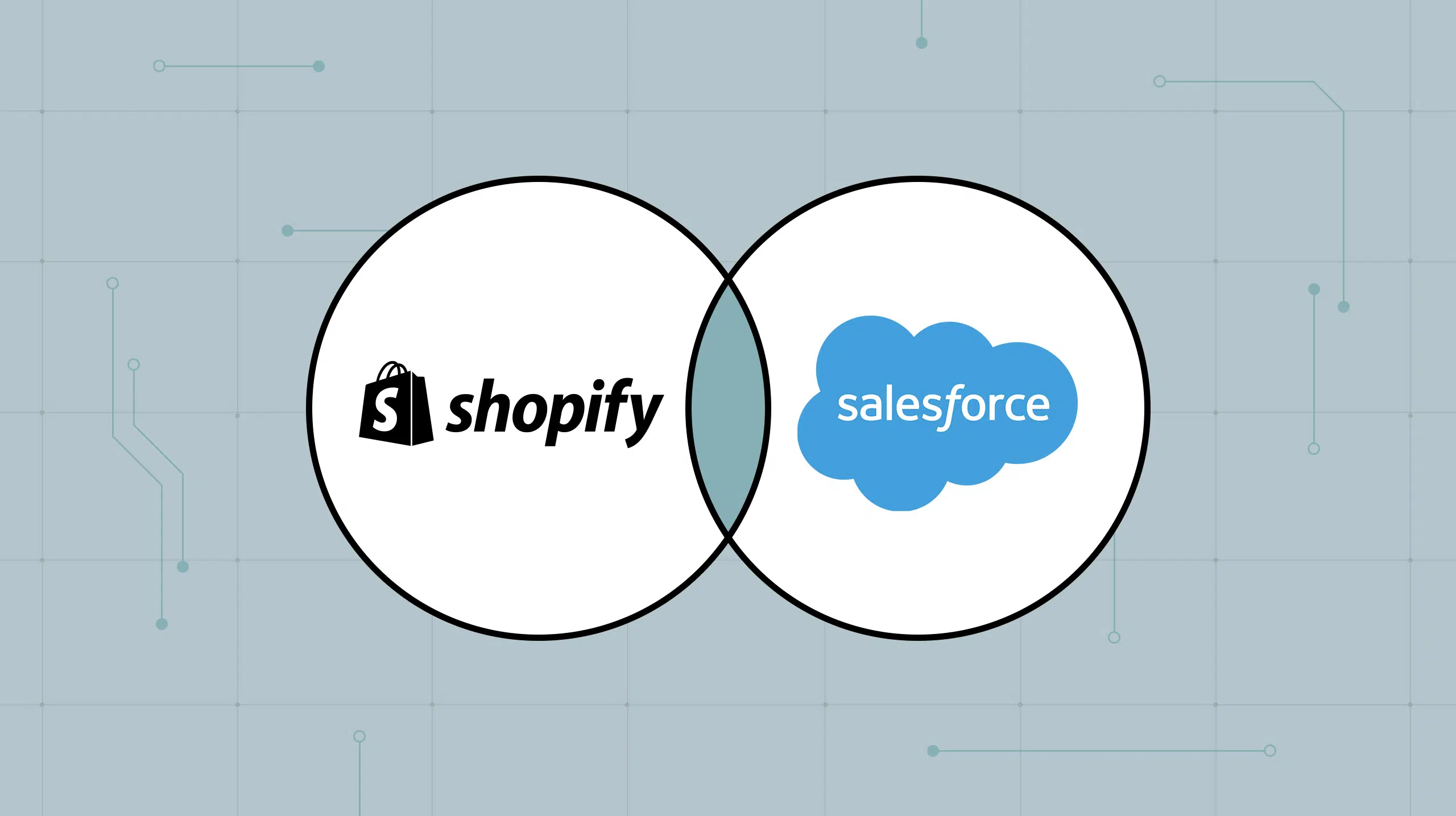
For enterprise commerce teams, integrating Shopify and Salesforce isn’t hard; it’s keeping them integrated at scale that breaks business processes. At smaller volumes, syncing customer records, orders, and inventory may seem manageable. But once transaction velocity, multi-store complexity, and cross-functional ownership come into play, those integrations become fragile and costly to maintain.
Shopify excels at capturing ecommerce transactions (orders, inventory availability, customer interactions), while Salesforce is the system of record for sales, service, and CRM workflows. But aligning these platforms across data models, teams, and operational systems reveals fundamental disconnects that custom scripts or native connectors can’t resolve.
Celigo is an intelligent integration platform designed to bridge this operational divide. Unlike brittle point-to-point APIs or one-size-fits-all iPaaS tools, Celigo delivers prebuilt commerce integrations, transformation logic, and centralized governance tailored to the needs of modern enterprise stacks.
While businesses generally have multiple integration paths, native Shopify and Salesforce connectors, custom APIs, or generic iPaaS tools each have limits. Native connectors often lack visibility, data control, and extensibility. Custom API builds may work initially, but become unmanageable as teams grow and systems evolve. And most horizontal iPaaS platforms simply aren’t designed for the real-world complexity of omnichannel commerce.
Celigo is different. It’s architected for scale, exception handling, and the orchestration of data across not just two apps, but an entire ecosystem of ERP, WMS, finance, and support platforms.
Enterprise pain points in Shopify + Salesforce integrations
For growing organizations, integrating Salesforce with Shopify is rarely a technical hurdle; it’s an operational one. While data may sync between systems in early stages, scale introduces fundamental issues of ownership, data fidelity, governance, and process complexity. Custom scripts and native connectors simply aren’t equipped to handle the nuanced challenges of enterprise-grade commerce.
Below are the core integration breakdowns most commonly seen in Salesforce–Shopify implementations at scale, especially when basic tools are pushed beyond their intended limits.
System-of-record confusion: conflicting ownership of customer/order data
Shopify and Salesforce both attempt to “own” customer and order records—but they do so with conflicting models. Shopify treats customers as transactional entities, while Salesforce CRM organizes them as accounts, contacts, or leads. Without clear ownership rules, these differences lead to duplicate records, data drift, and conflicting updates that compromise reporting, support, and personalization efforts.
Data model mismatches: Shopify lightweight vs Salesforce complex objects
Shopify’s data model is simple by design, favoring speed and usability across Shopify stores. Salesforce, on the other hand, is highly extensible and is often customized with complex hierarchies, custom objects, and validation rules. Mapping between the two (especially in B2B or multi-brand contexts) requires constant transformation logic that breaks whenever the Salesforce schema changes.
Order lifecycle fragmentation: partial shipments, split fulfillment, preorders, returns, post-purchase edits
Enterprise order management doesn’t follow a linear path. Shopify may register an order as “fulfilled,” while Salesforce shows it in progress or only partially paid. Split shipments, offline edits, and backorders widen this gap. Without orchestration between systems, support teams are left reconciling conflicting statuses manually, which damages trust and creates operational drag.
Identity resolution & duplication: guest checkout, multiple emails, B2B hierarchies
Shopify makes it easy for customers to transact anonymously or under multiple identities (guest checkouts, multiple email addresses, regional variants). In Salesforce CRM, this causes an explosion of duplicate contacts and fragmented account records. The result is misfiring campaigns, poor sales targeting, and wasted time merging records post-facto.
Performance & API limits: batch vs achieve real-time visibility, large backfills, flash sales
Custom and batch-based integrations struggle under high volume. Shopify API rate limits throttle peak-time throughput, while Salesforce API governor limits create bottlenecks during data pushes or bulk sync jobs. Enterprises trying to achieve near-real-time visibility into sales, service, or fulfillment end up with incomplete data or silent sync failures during critical windows such as flash sales or product launches.
Security & compliance gaps: GDPR, PII, field-level permissions
Shopify lacks granular permissioning. Salesforce offers complex, field-level controls. Bridging the two often leads to oversharing or underprotecting sensitive customer data, especially when personal information moves between platforms without consistent enforcement of compliance standards such as the GDPR or the CCPA.
This creates unnecessary audit risk and manual processes.
Organizational tensions: sales vs commerce vs finance ownership conflicts
Integration pain isn’t just technical, it’s political. Sales wants Salesforce to be the single source of truth. Ecommerce teams live in the Shopify store admin. Finance trusts the ERP. Without clear system-of-record boundaries and integration governance, Salesforce–Shopify integration becomes a battleground for control rather than a driver of alignment.
Common integration mistakes to avoid
- Unclear integration plan
- Poor testing
- Bad data mapping
- Neglected maintenance of data alignment issues
- Misconfigured security
- Lack of maintenance
Solving enterprise Shopify + Salesforce integration challenges
Celigo acts as the shock absorber between Shopify’s simplicity and Salesforce’s complexity, bridging operational gaps, aligning data models, and automating cross-system workflows in a way that custom code, native connectors, and legacy iPaaS platforms simply can’t.
Where other tools falter under scale, Celigo provides enterprise-grade connectivity, governance, and extensibility, helping organizations move beyond data sync and into true process orchestration.
Below, we map each pain point to Celigo’s core capabilities.
Connectivity capabilities
Pre-built connectors & templates
Celigo offers pre-built integration apps and templates designed specifically for Shopify and Salesforce, eliminating the need to start from scratch. These templates automate key commerce workflows, such as customer and order sync, inventory updates, fulfillment status, and refunds, while abstracting away brittle API calls and one-size-fits-all logic.
- Avoids reliance on fragile custom code
- Reduces implementation time
- Keeps integrations aligned as your Shopify store or Salesforce CRM evolves
Bidirectional integrations
Celigo maintains real-time, bidirectional data alignment between Shopify and Salesforce. As orders evolve, customer records are updated, or inventory levels change, Celigo ensures both platforms reflect the correct state—without the inconsistencies that plague batch syncs or basic connectors.
- Supports near-time sync via webhooks and event-based triggers
- Ensures consistent inventory, order status, and customer data across platforms
Workflow automation capabilities
Unified data model & transformation logic
Shopify’s lean schema often clashes with the complexity of Salesforce’s CRM structure. Celigo solves this with visual and low-code tools to map, normalize, and transform data between systems, handling use cases such as B2B hierarchies, multi-brand setups, and custom Salesforce objects.
- Prevents duplication and corruption across Shopify and Salesforce
- Enforces clean mappings from Shopify’s customer/order schema to Salesforce CRM models
Complex workflow automation
Beyond simple integrations, Celigo lets enterprises orchestrate complex, multi-step workflows—Shopify → Salesforce → ERP → 3PL—triggered by events or business logic.
This supports operational needs like:
- Routing orders based on warehouse region
- Handling post-purchase edits or cancellations
- Driving fulfillment and financial updates across systems
This level of orchestration is critical for commerce operations, where systems must communicate in real time rather than in isolation.
Scalability & maintainability
Celigo is architected for enterprise scale, supporting high order volumes, multiple Shopify stores, and Salesforce orgs without requiring a rebuild each time the business changes. Integrations are modular, versioned, and extensible, so they grow as operations evolve.
- Easily supports expansion into new geographies, brands, or systems
- Eliminates the tech debt of point-to-point scripts and patchwork logic
Control and governance capabilities
Monitoring, error handling, AI-assisted ops
Enterprise teams need more than just “connected systems.” Teams need visibility and control. Celigo delivers operational dashboards, detailed logs, retry logic, and AI-assisted alerts to help teams manage issues before they impact the business.
- Non-technical users can resolve integration errors without engineering support
- Integration health is visible at a glance, reducing downtime and manual intervention
Central governance
Celigo centralizes integration governance, letting teams define system-of-record boundaries, maintain version control, and reuse flows across departments or business units. This governance layer is often missing from native Shopify and Salesforce integrations, or is completely manual in custom builds.
- Prevents data conflicts and unauthorized overwrites
- Aligns sales, commerce, and IT teams on integration standards
Integration becomes the infrastructure
For enterprise commerce teams, syncing data is just the beginning. True operational leverage comes from automating the full business process across multiple systems, teams, and transaction types. Celigo powers complex workflows that are nearly impossible to execute with custom scripts or native Shopify and Salesforce connectors alone.
These are the workflows where integration becomes infrastructure, and where Celigo delivers the most impact.
Order-to-Cash (O2C): Shopify checkout → ERP posting → revenue recognition
Celigo automates the complete O2C lifecycle: capturing Shopify store orders, transforming them for ERP logic, and syncing payment, tax, and tender data. ERP systems become the financial source of truth, while sales and support maintain visibility in Salesforce CRM, with no manual reconciliation required.
Fulfillment orchestration: multi-warehouse, split shipments, 3PL coordination
Enterprise fulfillment spans internal warehouses, 3PLs, and multiple regions. Celigo orchestrates fulfillment logic, ensuring accurate inventory, shipping updates, and order status synchronization between Shopify, ERP, and Salesforce. This prevents miscommunication and reduces “where’s my order?” tickets.
Returns & refunds automation: RMA lifecycle, inventory, and financial alignment
Returns introduce massive complexity. Celigo automates the full RMA lifecycle, from return initiation in Shopify to inventory disposition in WMS, to refund authorization and financial posting in ERP. All systems are updated, aligned, and auditable.
Financial reconciliation & settlement: payments, taxes, fees, FX, gift cards
Celigo automates settlement workflows across Shopify Payments, third-party PSPs, and ERPs. Fees, taxes, FX, and gift card balances are reconciled automatically, so finance teams can track sales, validate payouts, and close books faster with fewer spreadsheets.
Multi-system order orchestration: Shopify → Salesforce → NetSuite → 3PL
Celigo coordinates end-to-end order flows across Shopify (checkout), Salesforce (CRM visibility), NetSuite (ERP fulfillment), and 3PLs (execution). Using webhooks or API triggers, Celigo ensures data is synced in near-real-time and inventory remains accurate across systems.
Customer & order visibility: deduplication, hierarchy mapping, Salesforce/Shopify alignment
Celigo enables clean CRM data by resolving customer identity across guest checkouts, B2B hierarchies, and multiple Shopify stores. Orders are summarized back into Salesforce, giving sales and support teams a unified customer context, without turning Salesforce into an ecommerce engine.
Exception-first workflows: inventory mismatches, payment/tax errors, auto-reroutes
Real-world commerce is messy. Celigo detects and routes exceptions like failed payments, invalid SKUs, and inventory mismatches. Errors are quarantined and logged, with retries and alerts that reduce manual fire drills and ensure business continuity.
Multi-system finance reconciliation: Shopify + Stripe + ERP
Celigo automates finance workflows across multiple platforms, aggregating data from Shopify, Stripe, and the ERP to match payouts with posted revenue. FX differences, fees, and transaction metadata are handled at scale, eliminating gaps between systems.
Best practices for enterprise Shopify + Salesforce integration
At enterprise scale, integration is no longer a technical task. It’s an operational strategy. While most companies start with simple API syncs or lightweight connectors, long-term success depends on adopting a governed, platform-based approach that can withstand change, complexity, and growth.
Below are best practices that leading enterprises follow when integrating Shopify and Salesforce CRM, particularly in multi-system, multi-team environments.
Define clear system-of-record ownership per object
Establishing which platform “owns” each data object (customers, orders, inventory, returns) is foundational. For example, Shopify may own the transaction and fulfillment record, while Salesforce owns the customer and opportunity.
Without this clarity, data quickly becomes fragmented, overwritten, or duplicated across systems.
Prioritize exception-first workflows over happy-path automation
It’s easy to build workflows for when everything goes right. But real enterprise operations are full of edge cases: backorders, cancellations, address changes, and tax errors. Designing for exceptions from day one reduces support overhead and makes automation more resilient.
Separate real-time vs batch workflow needs
Not all integrations require real-time sync. Trying to make everything instantaneous can lead to unnecessary API strain, cost, and complexity. Enterprises should segment workflows by urgency: real-time for order status or customer visibility in Salesforce, and batch for historical backfills or analytics updates.
Centralize integrations on a single platform for visibility & governance
Point-to-point integrations become unmanageable as systems multiply. By using a centralized platform like Celigo, teams can orchestrate data flows, apply consistent logic, and gain visibility across all workflows, from Shopify store checkout to ERP reconciliation to Salesforce CRM engagement.
Plan for multi-store, multi-brand, and multi-org scenarios
Enterprise stacks rarely operate as a single Shopify account or Salesforce org. M&A activity, regional brands, or channel-specific storefronts require integration architectures that can span multiple environments without duplication or data loss.
A scalable integration strategy accounts for this from the start.
Driving scalable Shopify + Salesforce integrations
At the enterprise level, integration is not about just moving data; it’s about enabling the business to operate with agility, accuracy, and confidence. As companies scale, brittle custom code, native Shopify–Salesforce connectors, and generic iPaaS tools quickly fall short. They can’t manage complexity, enforce governance, or adapt to evolving workflows across systems, teams, and geographies.
Celigo transforms integration from a fragile backend task into a strategic business enabler. By delivering prebuilt connectivity, low-code orchestration, and centralized control, Celigo empowers IT and operations leaders to automate processes, maintain data integrity, and support enterprise growth, without constant intervention or firefighting.
Key outcomes for enterprise teams include:
- Automation of cross-system workflows across Shopify, Salesforce, ERP, 3PL, and finance
- Unified customer and order data, ensuring trust across sales, support, and operations
- Real-time visibility into order status, inventory levels, and financial reconciliation
- Governance and control, with system-of-record clarity, error handling, and monitoring baked in
Whether you’re running a multi-brand Shopify store, a complex Salesforce CRM environment, or an integrated commerce stack with ERP and 3PLs, Celigo helps you orchestrate it all, reliably and at scale.
→ Get a demo and discover how Celigo enables enterprise teams to integrate Shopify and Salesforce efficiently, reduce errors, and scale operations with confidence.
Integration insights
Expand your knowledge on all things integration and automation. Discover expert guidance, tips, and best practices with these resources.