How to integrate Shopify with your ERP: A strategic guide for IT and operations leaders

As ecommerce organizations scale, operational complexity becomes a primary constraint. As order volumes increase and fulfillment models diversify, fragmented back-office systems turn into bottlenecks that slow finance, operations, and IT teams.
For enterprise and upper mid-market organizations, integrating Shopify with an ERP system is not simply about syncing data. It is a foundational capability for orchestrating end-to-end commerce processes across order management, fulfillment, and financial reporting. These integrations must support complex data models, multi-channel fulfillment, high transaction volumes, and strict governance requirements,while remaining flexible as the commerce stack evolves.
In this guide, we explore what ERP integration with Shopify entails at an enterprise level, why it is essential for scaling operations, and how to evaluate leading integration approaches in 2026. You’ll also see how organizations use Celigo to orchestrate Shopify, ERP, and fulfillment systems into a resilient, future-proof commerce backbone that reduces operational risk and gives IT and operations leaders full control over their integration landscape.
Why integrate Shopify with your ERP?
For enterprise commerce organizations, Shopify and the ERP play distinct but deeply interdependent roles within the technology stack. Shopify serves as the primary commerce platform,powering storefronts, checkout experiences, promotions, and customer interactions,while the ERP system acts as the operational system of record for financials, inventory, order fulfillment, and compliance. When these systems operate in isolation, teams are forced to rely on manual processes, delayed data syncs, and fragmented reporting that undermine scale.
Integrating Shopify with an ERP system enables enterprises to orchestrate critical business processes across the full order lifecycle. Orders placed in Shopify can flow seamlessly into the ERP for fulfillment, billing, and revenue recognition. Inventory updates from warehouses, 3PLs, or manufacturing systems can be reflected back into Shopify in near real time, preventing overselling and improving customer trust. Finance teams gain accurate, timely visibility into cash flow, taxes, and payouts without reconciling data across disconnected systems.
For organizations running Shopify Plus or managing multiple Shopify stores, the value of ERP integration increases significantly. High order volumes, international expansion, and omnichannel fulfillment models introduce complexity that cannot be handled reliably through manual workflows or basic Shopify App Store integrations. Enterprise ERP programs,whether built on NetSuite, Microsoft Dynamics 365 Business Central or Finance & Operations, Acumatica, or Sage Intacct,require governed, scalable integrations that align with IT standards and business controls.
A robust Shopify ERP integration also improves operational agility. Operations teams can respond faster to demand changes with accurate inventory data. Customer service teams gain end-to-end order visibility across Shopify and the ERP system. IT leaders reduce long-term risk by replacing brittle, point-to-point integrations with a centralized integration layer that supports monitoring, error handling, and change management.
Ultimately, integrating Shopify with an ERP system is about enabling growth without sacrificing control. For enterprise and upper mid-market organizations, a well-architected Shopify ERP integration creates the foundation for scalable commerce operations, consistent customer experiences, and informed decision-making across the business.
Common challenges in integrating Shopify with ERP at scale
As commerce ecosystems grow more complex, integrating Shopify with an ERP system introduces challenges that go far beyond basic data synchronization. Enterprise IT and operations leaders must account for differences in data models, increasingly sophisticated fulfillment networks, and the need to scale workflows without introducing fragility or operational risk. Below are three common challenges organizations face when operating Shopify ERP integrations.
1. Data model mismatches across systems
Shopify and ERP systems are designed for different purposes, and their underlying data models often do not align cleanly. Product structures, SKUs, pricing, customers, taxes, and inventory representations can vary significantly between a Shopify store and an ERP system such as NetSuite or Microsoft Dynamics 365 Business Central.
Without a flexible integration layer, teams are forced to hard-code mappings or manually reconcile discrepancies in the Shopify admin or ERP solution. These mismatches become even more difficult to manage as businesses introduce multiple Shopify stores, regional catalogs, or custom product logic. Over time, rigid integrations increase maintenance effort and introduce data integrity risks across the commerce platform.
2. Fulfillment complexity across channels and partners
Modern commerce rarely follows a single fulfillment path. Orders originating in Shopify may be fulfilled by internal warehouses, third-party logistics providers (3PLs), distributed WMS environments, or external channels such as Amazon FBA. Each fulfillment model introduces its own data requirements, timing dependencies, and exception scenarios.
Many organizations struggle to orchestrate these flows reliably when running Shopify alongside an ERP system. Inventory updates lag behind reality, fulfillment statuses become inconsistent, and customer service teams lack a unified view of order progress. As order volumes increase, these gaps directly impact customer experience and operational efficiency.
3. Scaling workflows without brittle point-to-point integrations
Point-to-point integrations may work for early-stage commerce operations, but they rarely scale. As enterprises add new sales channels, payment methods, geographies, or brands, each new connection introduces exponential complexity. Changes to one system often require cascading updates across multiple integrations, increasing the risk of downtime and data failures.
For IT leaders, this lack of architectural resilience becomes a major concern. High-volume order periods, such as product launches or peak seasons, expose limitations around API rate limits, concurrency, and error handling. Without centralized monitoring and governance, teams struggle to maintain reliability, troubleshoot issues quickly, or adapt workflows as business requirements evolve.
These challenges underscore why Shopify ERP integration must be approached as a long-term architectural decision,not a one-time implementation. Addressing data alignment, fulfillment orchestration, and scalability upfront is critical to building a commerce stack that can support sustained growth and operational resilience.
How to orchestrate multi-channel commerce across Shopify, ERP, and fulfillment systems
Successfully integrating Shopify with an ERP at enterprise scale requires more than connecting endpoints,it requires intentional orchestration of business processes across systems, teams, and channels. The goal is not just data movement, but controlled, resilient execution of commerce workflows that can adapt as volumes increase and architectures evolve.
Below is a strategic implementation model enterprise IT and operations leaders can use to design Shopify ERP integrations that scale reliably.
Define business requirements and process ownership
Before configuring integrations, organizations must align on how core commerce processes should operate end to end. This includes order-to-cash, fulfillment, returns, inventory management, and financial close.
Best practices include:
- Aligning stakeholders across ecommerce, finance, fulfillment, and IT to define shared outcomes
- Establishing clear process ownership and escalation paths for exceptions
- Defining systems of record for each data domain (orders, SKUs, inventory, customers, pricing)
Without this alignment, even technically sound integrations can fail to support real-world operational needs.
Configure connectors and system endpoints
Once requirements are defined, teams can configure system connections between Shopify, the ERP system, and downstream fulfillment or finance applications. At scale, this step must account for authentication management, API limits, and long-term maintainability.
With Celigo, organizations can leverage prebuilt connectors that provide managed authentication, default mappings, and support for both REST-based and flat-file ERP systems. This accelerates implementation while ensuring integrations adhere to enterprise IT standards.
Map and transform data across systems
Data rarely aligns perfectly across commerce platforms and ERP solutions. Effective orchestration requires flexible data mapping and transformation to reconcile differences in structure, naming, and business logic.
Celigo enables reusable data mappings, JavaScript-based business logic, and advanced transformation pipelines, enabling teams to normalize Shopify data into ERP-ready formats. These capabilities are critical when supporting multiple Shopify stores, regional catalogs, or custom inventory models across a global commerce platform.
Automate and orchestrate commerce workflows
At the core of enterprise integration is workflow automation. Orders, fulfillments, inventory updates, and financial events must move across systems reliably, often in near real time.
Celigo supports both real-time and batch workflows and provides built-in concurrency controls to manage high-volume order channels. This prevents API throttling, race conditions, and data duplication during peak traffic periods.
Use case: A brand selling across Shopify and Amazon synchronizes real-time inventory into NetSuite using Celigo’s prebuilt flows, preventing overselling while maintaining accurate stock levels across all channels.
Automate revenue recognition and payout reconciliation
Finance teams face growing complexity as payments flow in from Shopify, PayPal, Amazon, and other channels, each with its own fees, timing, and settlement logic. Manually reconciling these payouts into an ERP system slows close cycles and increases the risk of errors.
Celigo enables payout normalization by aggregating transaction data, mapping fees and deductions, and aligning them with ERP financial structures. This allows finance teams to automate reconciliation, improve accuracy, and accelerate month-end close processes.
Monitor, govern, and optimize integrations
As integrations scale, visibility and control become non-negotiable. Enterprise teams require centralized monitoring, proactive alerting, and auditable execution across all commerce workflows.
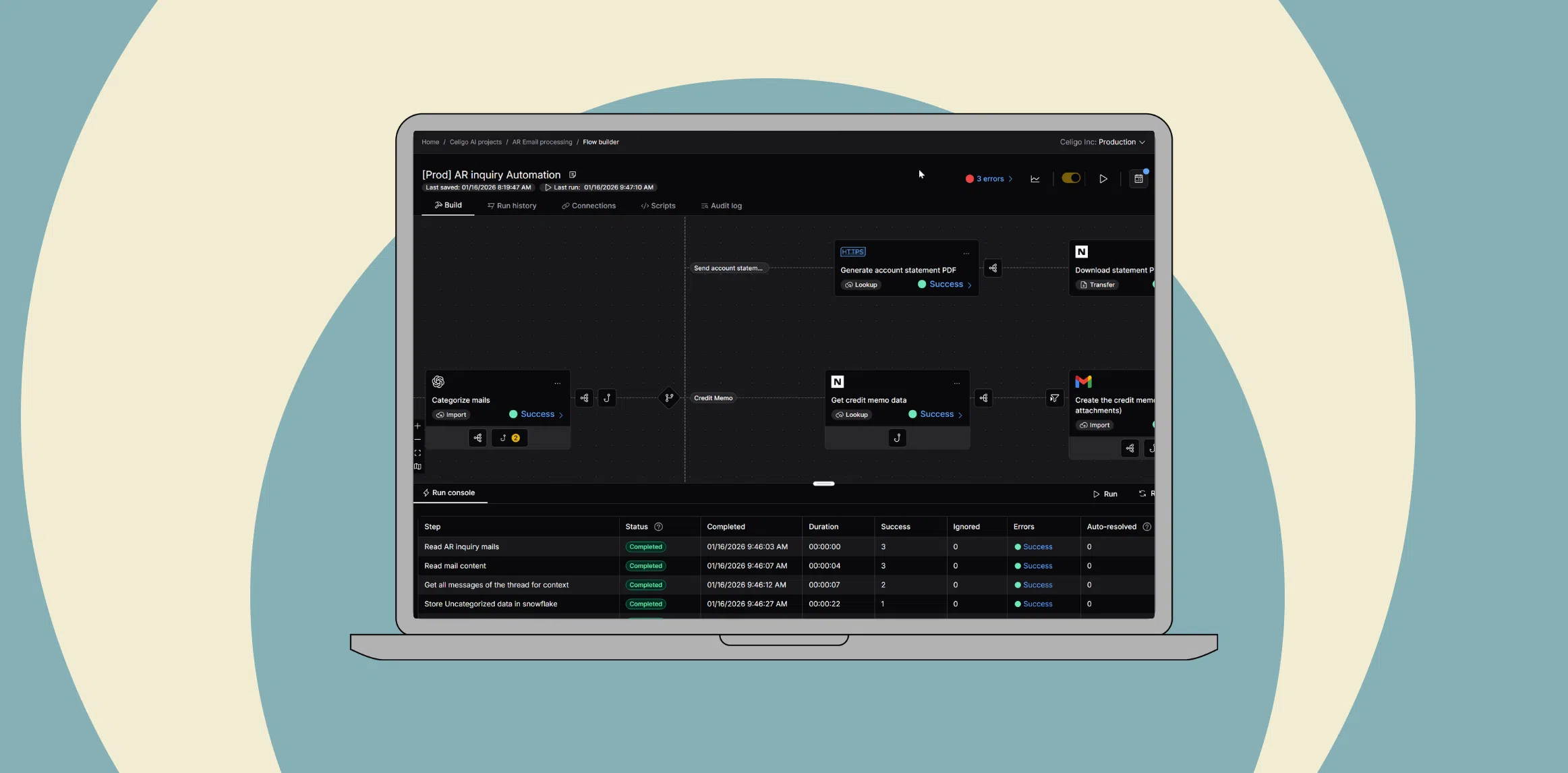
Celigo provides AI-powered error management, alerting, and audit trails that give IT and operations teams full lifecycle visibility into their integrations. This governance layer ensures issues are detected early and resolved without disrupting downstream systems.
Use case: Retail brands using Shopify POS route B2B and in-store orders into their ERP system to ensure accurate revenue tracking and consolidated financial reporting.
Future-proof for new channels and geographies
Commerce stacks are constantly evolving. Enterprises must be able to add new sales channels, onboard 3PLs, or expand into new regions without redesigning their integration architecture.
Celigo supports cloned flows, dynamic routing, and system-level reusability, making it easier to extend existing integrations as the business grows.
Use case: Enterprises supporting split fulfillment across Shopify, Amazon MCF, and a 3PL dynamically route orders through Celigo, tracking updates and exceptions across all systems without rebuilding workflows from scratch.
Top ERP systems to use with Shopify
Enterprise and upper mid-market organizations running Shopify require ERP systems that can handle financial complexity, high transaction volumes, and multi-entity operations. Regardless of the ERP selected, the critical success factor is how well it integrates into the broader commerce ecosystem.
Celigo’s iPaaS serves as the middleware layer that connects Shopify with leading ERP platforms, supporting both prebuilt and custom integrations while eliminating brittle point-to-point connections.
NetSuite ERP
NetSuite is a core ERP choice for many Shopify Plus and enterprise merchants. Celigo’s Shopify–NetSuite Integration App automates end-to-end order-to-cash workflows, including order import, inventory synchronization, fulfillments, refunds, cancellations, and billing. With prebuilt flows and configurable logic, teams can scale operations while maintaining governance and financial accuracy.
Acumatica
For growing and enterprise organizations seeking flexibility and scalability, Acumatica is a strong ERP option. Celigo’s Shopify–Acumatica Quickstart Bundle accelerates deployment with predefined mappings and workflows, enabling teams to synchronize orders, inventory, and customers while retaining control over business logic and exceptions.
Microsoft Dynamics 365 Business Central or Finance & Operations
Microsoft Dynamics 365 is commonly used by global and multi-entity organizations. Celigo provides out-of-the-box connectors and customizable workflows to integrate Shopify with Dynamics 365, supporting order management, inventory updates, and financial synchronization across regions and business units.
Sage Intacct
Sage Intacct is well-suited for finance-driven organizations that require strong revenue recognition and reporting capabilities. Celigo enables Shopify order and transaction data to flow into Intacct with accurate fee handling, deferred revenue logic, and reconciliation, helping finance teams close faster and with greater confidence.
Oracle Fusion Cloud ERP
For large-scale enterprises with complex financials and compliance requirements, Oracle Fusion Cloud ERP offers robust capabilities. Celigo supports integrations between Shopify and Oracle Fusion to manage high transaction volumes, multi-country operations, and advanced financial workflows without custom code.
When evaluating ERP integration methods, enterprises should prioritize scalability, governance, extensibility, and the ability to support future channels and regions without re-architecting their integration landscape.
How Celigo supports Shopify ERP integration at scale
ERP integration with Shopify is the foundation for scaling commerce operations, but long-term success depends on the architecture that supports it. As commerce stacks evolve, adding new channels, fulfillment partners, geographies, or brands, Celigo acts as the connective tissue that keeps systems aligned and resilient.
Celigo enables enterprise brands to:
- Automate end-to-end commerce workflows with prebuilt, configurable flows
- Govern integrations centrally with monitoring, alerting, audit trails, and role-based controls
- Extend integrations using reusable mappings, business logic, and dynamic routing
- Support real-time and batch synchronization with built-in concurrency controls for peak volumes
During high-demand periods such as product launches or holiday peaks, Celigo’s governed workflows and throughput controls ensure business continuity without sacrificing performance or data integrity. As integration complexity increases, Celigo provides a future-proof backbone that connects Shopify, ERP systems, fulfillment networks, and financial platforms in a single environment.
Celigo’s Shopify integration helps organizations synchronize key data and automate ecommerce processes across their entire commerce stack, enabling teams to move faster without increasing operational risk.
As intelligent automation becomes core to enterprise operations, Celigo brings integrations, business logic, and AI-powered capabilities together in one platform.
→ Book a demo to see how you can automate and scale your Shopify operations.