A guide to quantifying Celigo’s platform benefits
 Updated Jul 15, 2025
Key takeaways from Forrester’s Total Economic Impact analysis

Introduction
In today’s complex digital landscape where businesses rely on hundreds of applications, the real question isn’t whether to invest in an iPaaS — it’s how to choose one that best fits your integration strategy while understanding the true long-term cost.
A common mistake buyers make is focusing only on the upfront subscription fee. But that’s just one piece of the puzzle. The real cost includes hidden expenses — like costly developers, long setup times, and ongoing IT intervention for error resolution — all of which can add up fast and impact your bottom line. That’s not the case with Celigo. Our customers consistently laud us for saving costs by “cutting the workload in half,” “allowing business users to automate and manage integrations,” and “providing one place to find and resolve errors.”
To quantify such platform benefits, Celigo commissioned a Forrester Total Economic Impact (TEI) study, analyzing how organizations benefit financially from the platform. This guide will walk you through Celigo’s platform benefits, how to measure them in dollars, and how they translate into tangible cost savings for your organization.

Forrester’s TEI Framework
Forrester interviewed five IT leaders at four organizations using the Celigo integration platform to obtain data about costs, benefits, and risks. To analyze the financial impact of Celigo’s iPaaS platform, Forrester constructed a composite organization representative of these interviewees.
This composite organization, a global enterprise with $200 million in annual revenue and 500 employees, was developed by analyzing key characteristics and commonalities across the interviewed organizations. This approach allowed Forrester to create a model that reflects the typical experiences and challenges faced by companies leveraging Celigo’s integration platform.
Build benefit
Faster integration setup → Lower development costs
How legacy iPaaS tools handle building
Legacy iPaaS platforms demand months of planning and specialized developers just to get basic integration setup ready. Some can take close to a year to go live, a costly delay in today’s competitive market. They also require businesses to scope the implementation prior to deployment, which can be complex.
How Celigo addresses this challenge
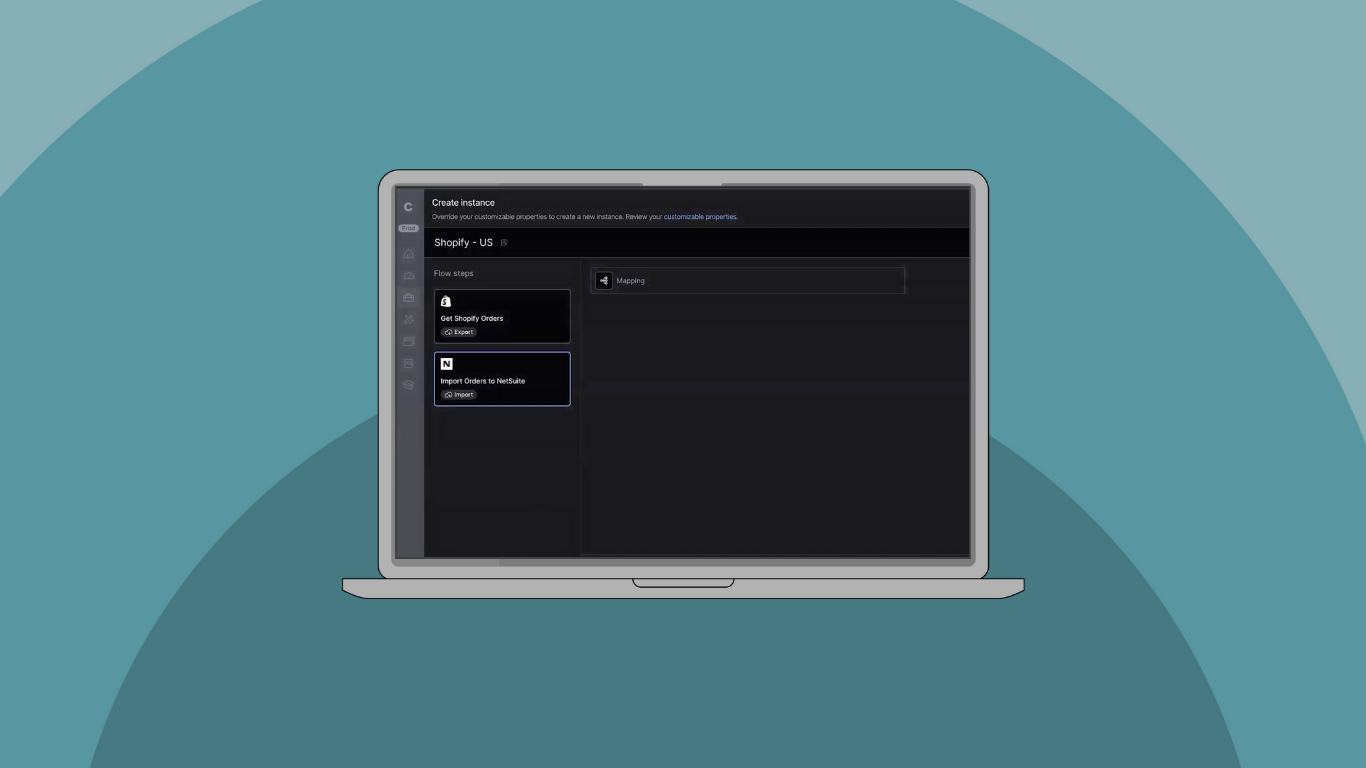
On the other hand, Celigo’s low-code yet robust platform reduces this timeline to weeks, enabling businesses to move faster and stay competitive. The platform offers:
- An AI-driven, low-code platform that empowers business users to build integrations without extensive IT support.
- Plug and play prebuilt connectors and templates with embedded business logic that automate entire business processes end-to-end.
- Robust developer tools that help technical users handle complex integrations more efficiently.
- A fully elastic infrastructure that is available and ready to go on day one.
Cost savings with Celigo: A comparative breakdown
Forrester’s analysis postulates that a composite organization completes 20 integration projects in Year 1, with demand growing as success drives adoption.
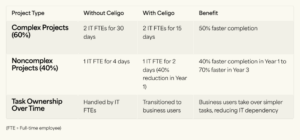
The result of the study shows that Celigo helps avoid integration development costs worth $457,698 over 3 years.
Maintenance benefit
Reducing error resolution effort → Lower maintenance costs
How other iPaaS tools handle maintenance
Most of the iPaaS platforms out there lack centralized error management. Businesses must build error-handling capabilities into every application they integrate, making the process cumbersome and inconsistent.
If you are a business user, you will also need deep technical knowledge of every application to build it. Moreover, identifying the root cause of an error often takes hours, followed by additional hours to resolve it.
How Celigo addresses this challenge
Automation reduces errors at the source
By automating manual processes, Celigo eliminates most opportunities for human error, ensuring smoother operations.
AI/ML-powered error management
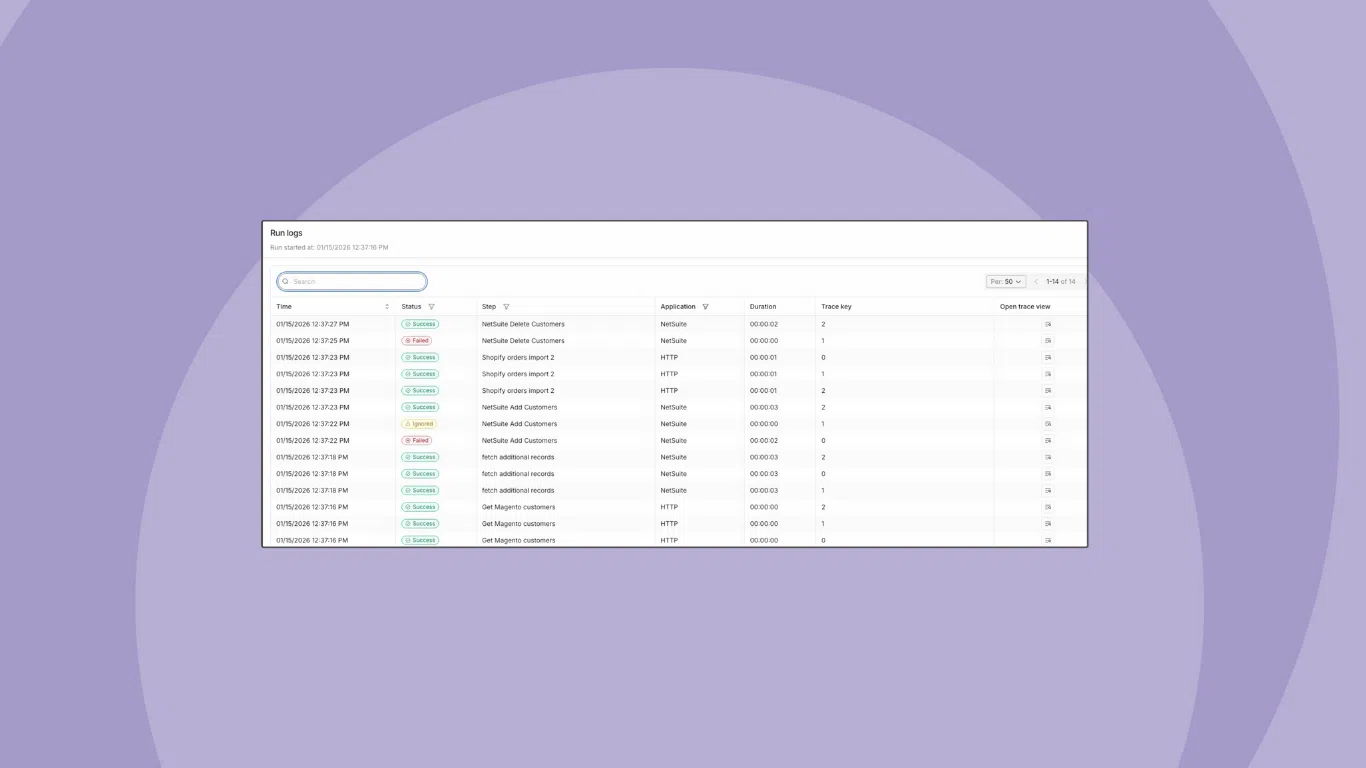
- Celigo’s platform processes 500 million errors monthly, automatically resolving 426 million — achieving a 95% resolution rate.
- Advanced error classification helps teams quickly identify root causes.
- Features like error tagging, filtering, and sorting enhance team coordination, enabling faster resolution by directing critical issues to the right team members.
- Celigo allows businesses to offload routine error handling to non-IT users, freeing up IT teams to focus on critical issues.
Data from the TEI analysis reveals that Celigo reduced data errors by 10% reduction in Year 1, increasing to 50% by Year 3 as more integrations were implemented. Plus, the time required to resolve errors was cut by 83%, thanks to Celigo’s dashboard and AI/ML capabilities.
Cost savings with Celigo: A comparative breakdown
Here’s a table highlighting the benefits of Celigo versus without it:
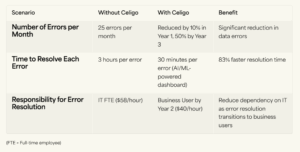
The result of the study shows that with the Celigo platform, the composite organization experiences a $105,000 reduction in the cost of resolving data errors over three years.
Efficiency benefit
Boosted employee productivity through automation
Manual workflows and repetitive tasks drain employee productivity and limit their ability to focus on strategic priorities. Celigo enables employees to redirect time from mundane data management activities to strategic initiatives, reducing cognitive load and enhancing overall organizational efficiency.
Forrester’s analysis found that 50% of this saved time is redirected to value-generating tasks, helping organizations unlock greater efficiency and improve decision-making.
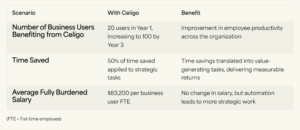
Employee productivity, more time allocated to strategic tasks, and a shift towards higher-value work saves the composite organization $252,000 over three years.
From build to maintenance
How Celigo’s benefits save money at every step
When choosing an iPaaS, it’s not just about how much it costs to build integrations — it’s about the ongoing maintenance costs that often go unnoticed. Legacy platforms may seem promising upfront but leave you with hidden expenses: longer implementation timelines, costly developer hours, scattered error management, and long error resolution times that drain IT resources.
With faster integration timelines, prebuilt connectors, and automation-first design, Celigo drastically reduces upfront development efforts. But the real difference lies in its long-term value: AI-powered error management and the ability to empower business users, not just IT, to maintain integrations. This translates to lower maintenance costs, and the freedom for IT to focus on innovation instead of firefighting.
When it comes to integrating your business processes, consider the long-term economic impact. Celigo isn’t just a smart choice — it’s the cost-effective, future-proof choice.
Celigo’s iPaaS solution transforms businesses’ operations and ensures an immediate and significant ROI. As one VP of IT said in the TEI analysis, “The ROI with the Celigo platform is instant. You don’t have to wait 10 years to see savings. It’s a big win for our organization.”
→ Download the full The Forrester Total Economic Impact™ of the Celigo Integration Platform