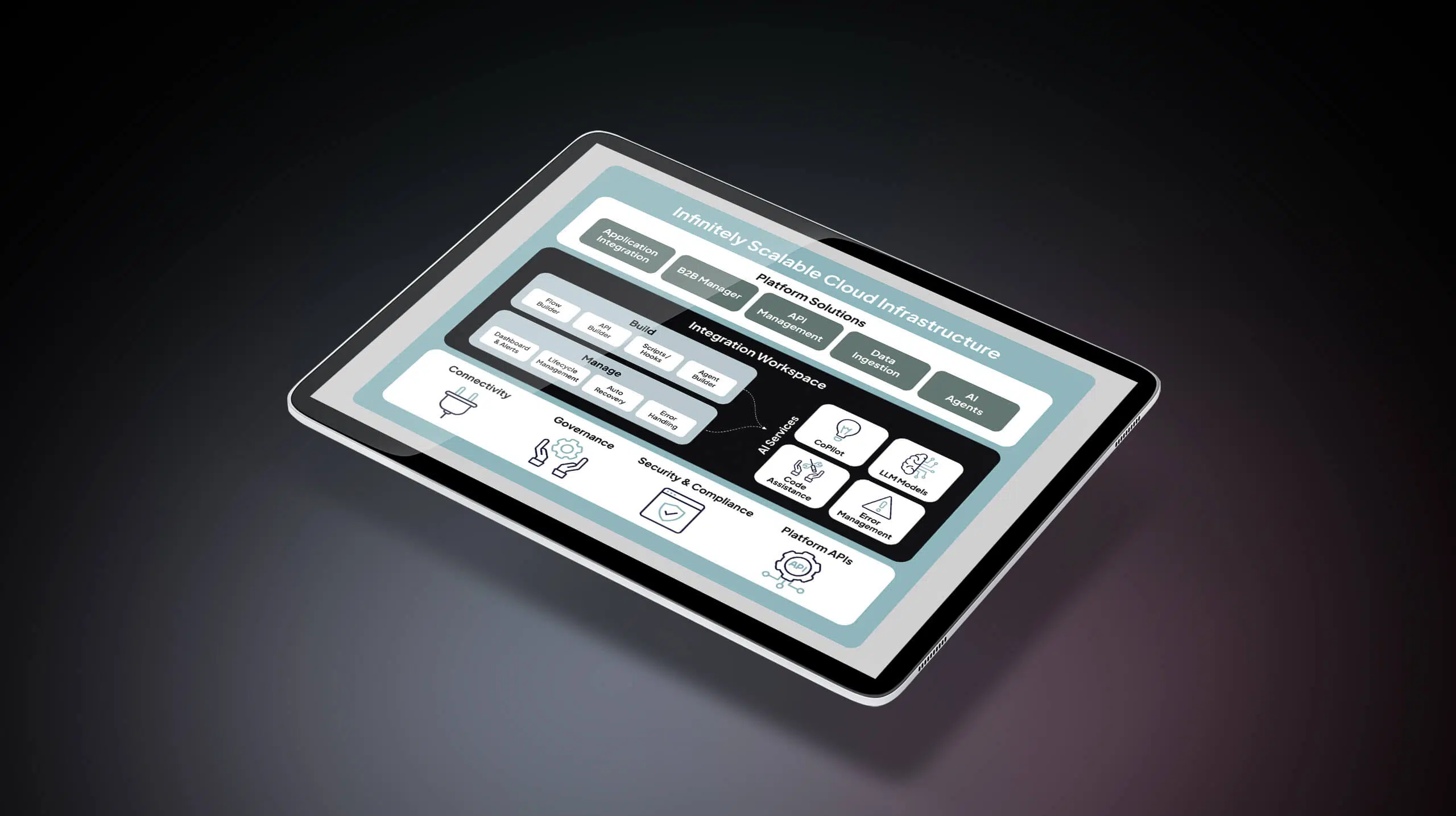
Recently, I had the privilege of leading the Celigo AI Summit, where I hosted a session on one of the biggest questions facing every business today: how to operationalize AI.
The energy was incredible. Leaders from across industries shared their breakthroughs and frustrations as they worked to bring AI from concept to scale. And one message came through loud and clear: we’ve officially moved past the “if” and deep into the “how.”
Nearly every organization represented is already doing something with AI, whether it’s early pilots to production deployments. The challenge isn’t whether to use AI anymore, it’s how to make it work at scale, across real workflows, without getting stuck in proof-of-concept limbo.
The state of AI implementation in operations
When I asked attendees where they are on their AI journey, the results told a clear story. 46% of participants said they’re still experimenting with AI, while 40% reported they’re actively implementing it in production environments. However, only 11% are seeing measurable ROI.
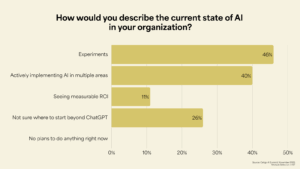
That means the vast majority of organizations are still figuring out how to turn AI experimentation into a coordinated strategy.
Several attendees shared stories of “shadow AI” projects–small, unsanctioned experiments popping up across departments. One IT director described a marketing team quietly piloting a generative tool without oversight. That pattern came up repeatedly–proof that interest is spreading faster than governance.
What’s encouraging is that many of those same leaders are now trying to centralize these efforts. One healthcare operations leader put it best: “We’re past pilots. We’re now figuring out our playbook.”
However, as leaders try to institutionalize AI usage, they encounter the issue of change management. Several attendees shared how projects stalled, not because of poor models, but because employees didn’t understand why the change was happening or how it helped them.
In response, AI leaders are stepping up. An attendee from a manufacturing company described running “AI enablement days” to demystify their tools.
Celigo’s own teams succeeded when we paired automation launches with transparent training sessions and “explainability dashboards,” so teams could see why AI made certain recommendations. For example, our RevOps team used AI + Celigo to automate pipeline rollups, fill in missing CRM data, and flag risks in real time, without more meetings or spreadsheets.
If there’s one message that came through loud and clear, it’s that change management is make-or-break. Leaders need to consider how to create the structures and incentives to help people to trust, adopt, and consistently use AI.
The AI ROI dilemma for IT and operations leaders
When we asked how teams are currently measuring AI success, 79% said “time saved” was their primary metric. 32% were still defining success. Only 14% cited measurable business outcomes like revenue growth.
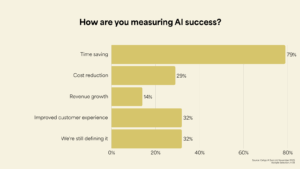
That gap is telling. Operational efficiency is a start, but it doesn’t capture AI’s full value, such as decision velocity, error reduction, or new opportunities unlocked.
One attendee, a VP of operations, shared that they initially measured AI value purely by hours saved, but have since layered in “business impact per workflow” as a metric—capturing where automation directly drives measurable outcomes. That’s the shift we need to measure AI ROI beyond surface-level efficiency gains.
One thing we’ve seen across Celigo customers is that ROI follows clarity–specifically, when teams define clear before-and-after benchmarks. Our customers are beginning to tie workflow automation data directly to financial KPIs, which is a practical way to bridge the ROI gap.
To truly capture ROI, companies need an infrastructure that connects AI to the systems, data, and workflows where decisions actually happen. That’s where most initiatives stall.
When teams move from experimenting with isolated use cases to integrating AI directly into how work gets done, they start to see compounding value: faster decision cycles, cleaner data flows, and measurable outcomes that ladder up to strategic goals.
Avoiding pitfalls in your enterprise AI strategy by prioritizing integration
A recurring issue that came up was “AI sprawl.” Companies are purchasing multiple AI add-ons from different SaaS vendors.
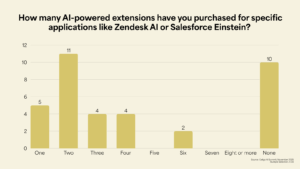
When we asked participants how many AI-powered extensions their organizations had purchased over the past year, a number indicated that they’d bought three or more. One attendee from a retail company said their SaaS spend on “AI-enhanced” tools had tripled in six months—yet all of them used the same LLM. It was a collective “aha” moment in the room.
We’re seeing a shift from “more AI” to “smarter AI.” In enterprise environments, the data that forms useful context often spans multiple systems. The challenge is to bring all those systems together into a single, repeatable pipeline that not only consolidates data but continuously delivers the right context to your AI systems at the right time. This is where integration becomes critical: by consolidating these point solutions through a unified platform like Celigo, companies can maximize the value of their existing AI infrastructure instead of multiplying costs.
A similar pitfall is “AI for AI’s sake.” The crowd’s reaction made it clear that many organizations are still navigating this challenge. We’ve all seen it: projects that start with the technology rather than the business problem.
One finance leader in attendance shared a painful but valuable lesson. Their company built a chatbot to handle customer service, but it failed because it didn’t integrate with the core case management workflow. AI was the easy part. Integration was where things fell apart.
The importance of integration was one of the biggest takeaways from the summit. And it’s also one that aligns deeply with Celigo’s mission.
For AI to create real value, it has to be embedded into existing workflows and connected across systems.
During the session, my colleague Tony Curcio made a point that really resonated: “We’re not adding AI as another layer—we’re weaving it into the flows themselves, where the work already happens.”
That comment sparked a lively discussion about what that actually looks like in practice.
Several attendees talked about the friction that comes when AI is tacked onto tools as an afterthought. Tony and I shared how we’re addressing that by building AI directly into the Celigo integration fabric, so that it’s part of how work gets done every day.
You’ll start to see this come to life across the platform. For example:
- AI-assisted integration mapping now helps users build integrations faster by automatically recommending field mappings and validating them for consistency.
- AI-powered error detection and remediation now identifies likely failure points or schema mismatches before they cause issues, and suggests fixes proactively.
Tony also offered a glimpse of what’s next: autonomous integration management. As he put it, “We’re heading toward a future where integrations manage themselves—AI detects changes, predicts failures, and self-heals before operations are impacted.”
What AI success looks like
As Tony and I wrapped up, we both reflected on how much of Celigo’s progress in AI comes from collaboration with our customers. It’s inspiring to see how many leaders are committed to doing AI right.
We’re seeing a shift from isolated tools to connected intelligence, where AI is embedded directly in your operations. At Celigo, that’s been our focus from the start: helping IT and operations leaders unify workflows and automate intelligently, so AI delivers measurable business outcomes.
Whether your organization is experimenting with AI, scaling, or trying to make sense of all the moving parts–I’d love to continue the conversation.
👉 Book a demo and let our team know that you’re interested in learning how Celigo can help you operationalize AI.