OpenAI App SDK and AgentKit: Why integration still matters
 Updated Mar 26, 2026

The release of the OpenAI Apps SDK and OpenAI AgentKit marks a major step toward bringing conversational AI into everyday applications. Together, they give developers new ways to embed intelligent experiences directly into their products, automate tasks, and connect prompts with actions.
But while the new tools make it easier to build AI-powered apps, they don’t solve the hardest part — connecting them to your business.
To deliver measurable ROI, AI needs to work across your entire tech stack, every system, every workflow, every dataset. Until that happens, even the most advanced AI agents or OpenAI integrations will be limited to isolated experiments rather than enterprise transformation.
What Is the OpenAI Apps SDK?
The OpenAI Apps SDK lets you bring your product directly into ChatGPT so users can summon it by name, discover it at the right moment, and use your interactive UI without leaving the conversation.
With the SDK, developers can:
- Build chat-native interfaces (maps, forms, dashboards, playlists) that run inside ChatGPT
- Adapt to conversation context so your app responds naturally to user intent
- Connect to your backend and manage auth, permissions, and sessions securely
For example, when a user says “Spotify, make a 60-minute upbeat playlist,” the Spotify app appears in ChatGPT’s interface and returns an interactive card with previews of each song and one-click actions.
The user refines it conversationally (e.g., “make it clean) and saves the final playlist to their account.
It’s a powerful leap forward for OpenAI integrations, giving developers the flexibility to infuse their applications directly into a natural language interface.
What is OpenAI AgentKit?
OpenAI AgentKit is a low-code framework that helps developers create AI agents — specialized assistants capable of performing tasks through natural language commands.
It enables teams to visually connect prompts, guardrails, and APIs into multi-step OpenAI workflows that operate with autonomy.
Key capabilities:
-
Prompt and guardrail builder: Visually define how agents interpret and respond to user inputs
-
API and action connectors: Link agents to applications and APIs for data retrieval and execution
-
Low-code orchestration: Build multi-step workflows without heavy coding
-
Model context protocol (MCP) integration: Securely connect to supported systems and data sources
-
Embedded controls: Manage how and when agents act across different contexts
However, its reach is limited to the apps and APIs already supported within its ecosystem. If your business depends on specialized applications or APIs not exposed through OpenAI AgentKit, you’ll quickly hit a wall, making integration essential to extend its impact beyond those boundaries.
OpenAI continues to expand AgentKit’s capabilities, adding new ways for developers to connect agents and automate tasks, but even as the ecosystem grows, challenges like cross-system orchestration, governance, and secure data access remain.
Enterprise-grade AI requires more than agentic power — it requires the ability to integrate, monitor, and govern those agents across the full business landscape.
The limits of agent builders
-
Limited orchestration: The OpenAI AgentKit expands access to AI but lacks the orchestration needed to coordinate hybrid workflows that mix deterministic automation with agentic steps
-
Missing observability: Without centralized oversight, teams can’t monitor AI activity, trace actions, or ensure reliable performance across systems
-
Weak governance: There’s no native mechanism to enforce guardrails—meaning an agent, or even the user invoking it, could update systems or fields beyond their authorization
-
Fragmented connectivity: These tools operate only within supported apps and APIs, leaving gaps where custom or specialized endpoints are required
-
Experimental by design: SDKs and agent builders work best for prototypes or isolated use cases, not for enterprise-grade, governed, and scalable automation
In short, to make AI operational, you’ll need a platform that provides end-to-end connectivity, control, and compliance across your systems and workflows.
Why you still need an integration platform
The new wave of AI builders and SDKs will accelerate your ability to prototype and prove out key use cases in exciting ways. As you scale these into production, don’t forget the need for:
-
Connectivity: Getting your AI to talk to every app, API, and data source
-
Orchestration: Managing complex workflows that blend automation and AI
-
Observability: Monitoring performance, tracing outputs, and ensuring compliance
-
Optimization: Removing unnecessary AI steps to reduce cost and risk
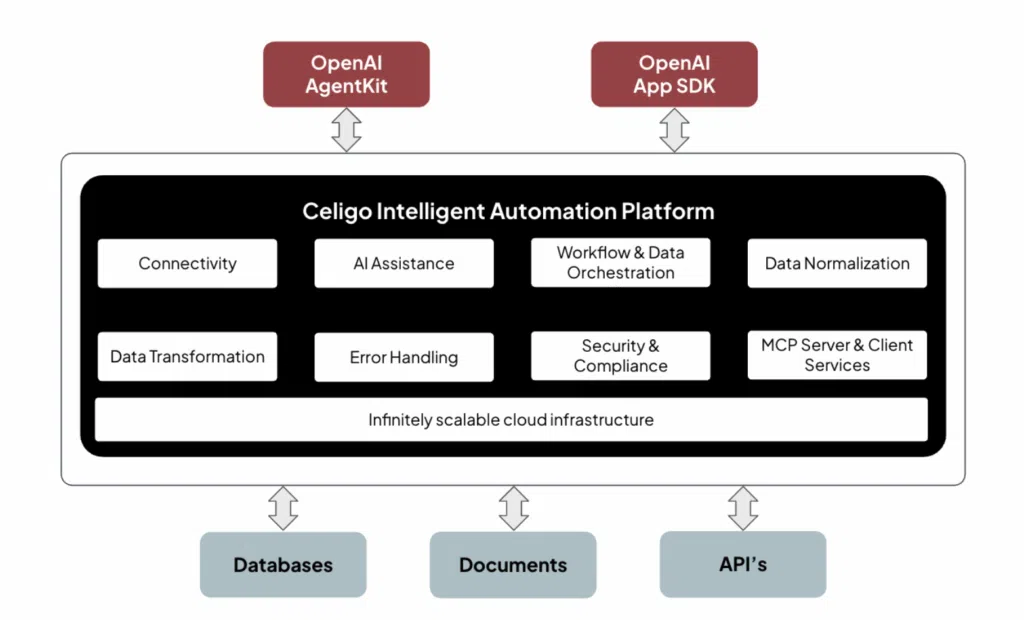
This is where Celigo’s intelligent automation platform plays a critical role.
“According to Gartner, by 2028, 70% of organizations building multi-LLM apps and AI agents will use integration platform capabilities for orchestration and data access — up from less than 5% in 2024.”
An integration platform ensures AI agents and SDK-based applications have the clean, structured, and contextual data they need to perform securely and efficiently. It’s the connective tissue that transforms fragmented AI experiments into reliable, scalable AI workflows that deliver business value.
How to operationalize OpenAI integrations
Celigo provides the unified foundation to connect OpenAI Agents built using OpenAI AgentKit with the rest of your business.
With Celigo’s Intelligent Automation Platform, you can:
-
Feed OpenAI models the right data from every system — ERP, CRM, marketing, support, and beyond
-
Orchestrate hybrid workflows that combine traditional automation and AI-driven steps for precision and cost efficiency
-
Enforce governance and security, with centralized monitoring, logging, and compliance controls
-
Scale seamlessly, ensuring reliability even as AI use grows across teams
Organizations use Celigo to build AI workflows that deliver measurable ROI:
-
Knowledge bots that surface insights across systems to answer employee questions instantly
-
Personalized customer experiences powered by data from billing, support, and product usage
-
Predictive revenue intelligence that combines CRM and finance data to improve retention and upsell
Rapid innovation is possible with the recent OpenAI announcements, and there will certainly be more to come. Companies that are able to operationalize all of this will build connected ecosystems where every process, system, and decision is grounded in intelligence and context.
Ready to connect your AI to your business?
Operationalize your OpenAI Agents with Celigo and bring your AI agents to life across your enterprise.
FAQs
Integration insights
Expand your knowledge on all things integration and automation. Discover expert guidance, tips, and best practices with these resources.