Celigo vs MuleSoft: 2026 Comparison
 Updated Jan 28, 2026


Integration needs have changed. Today’s teams expect more capabilities, ease of use, and enterprise-grade reliability, for less effort, resources, and long-term cost.
While MuleSoft has been around longer and remains a well-known iPaaS, many buyers are choosing Celigo instead. Here are some of the common reasons we hear:
- As organizations modernize their tech stacks, buyers are questioning whether MuleSoft can keep up with the speed and scale needed.
- Since becoming part of Salesforce, MuleSoft’s roadmap has increasingly focused on Salesforce-centric use cases.
- A recent drop from a “Leader” position in a well-known analyst assessment has also raised concerns about product direction and the pace of innovation.
If you are a buyer evaluating both solutions, this comparison will dive deeper into the differences – and what those mean in day-to-day reality.
Key takeaways:
Celigo is a strong fit if you:
- Need to scale from simple to complex integrations to agentic workflows across your tech stack, including ERPs, CRMs, Storefronts, RevOps, and Data Warehouse
- Single platform and UX for any type of integration, including application integration, APIM, EDI/B2B, data ingestion, and AI Agents.
- Empower teams, IT or non-IT, to build and maintain integrations
- Want predictable pricing that won’t increase as data volume and automation scale
MuleSoft is a strong fit if you:
- Have a large, dedicated integration team with deep MuleSoft expertise
- Require strict, API-centric governance for highly complex enterprise environments
- Are you operating within a Salesforce-centric or legacy-heavy architecture where API abstraction is the primary goal
Celigo vs MuleSoft: Key differences at a glance
| Category | Celigo | MuleSoft |
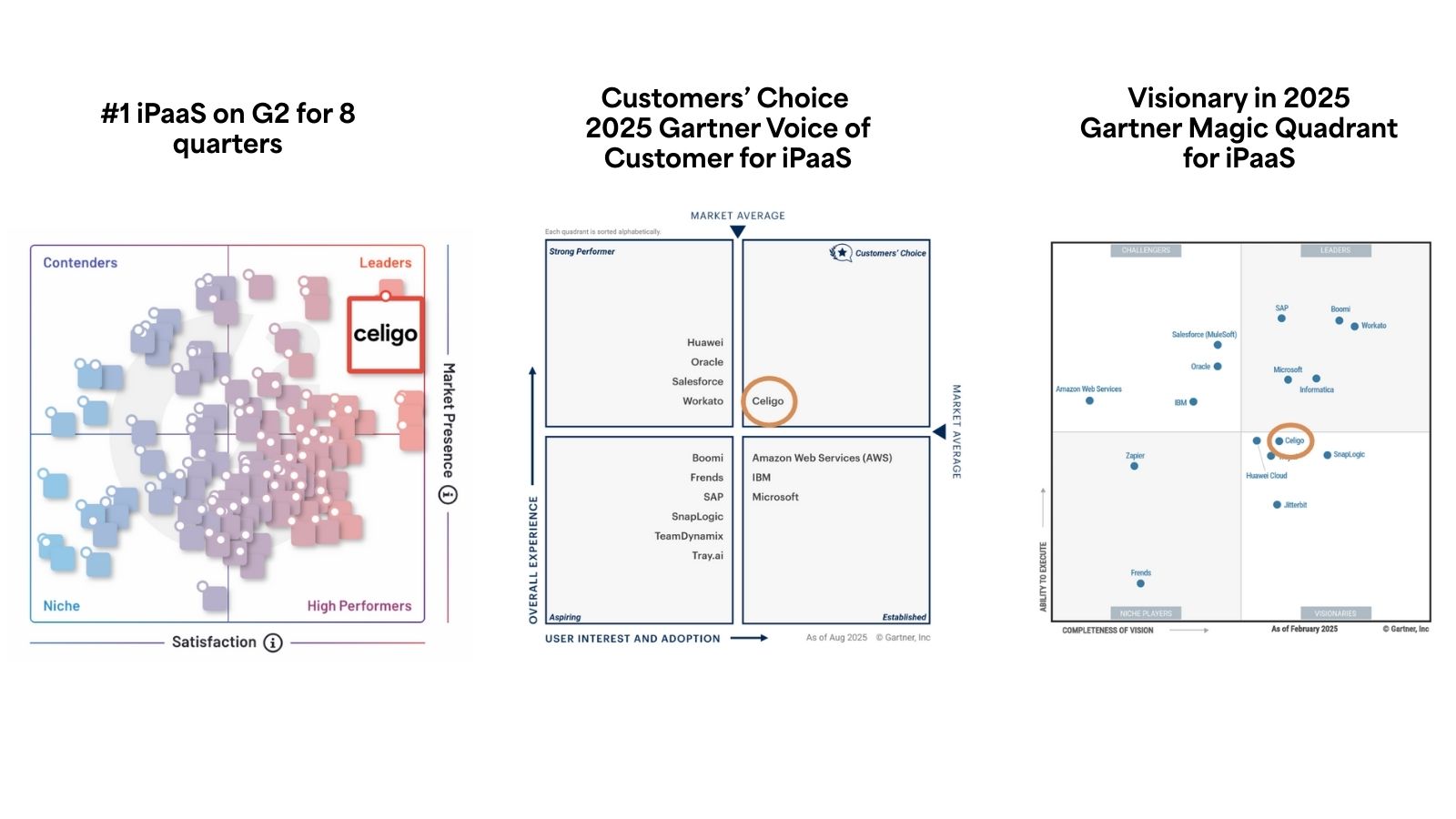
| Industry recognition | #1 ranked iPaaS on G2 (8 quarters)
Only “Customer’s Choice” iPaaS in Gartner VoC quadrant (Top Right) |
#7 on G2
“Strong Performer” in Gartner VoC (Top Left) |
| Target market | Fast-growing and enterprise companies | Large global enterprises |
| Built for | Both IT and business users with guardrails | Specialist developers |
| Prebuilt connectors & templates | ~1,000+ connectors
Templates are a combination of flows that cover 70 to 90% of the use case end-to-end |
~300 connectors
Templates cover basic flow skeletal, requires connectors, environments, and runtime to be preconfigured |
| API management | Full lifecycle API management to build, publish, secure, and manage APIs | Full lifecycle API design, publish, and governance |
| Error handling | Autonomous, AI-powered error resolution built in | Manual, custom-built per flow |
| Typical implementation time | Weeks to a few months | 6 -8 months; often longer for API-led, multi-layer implementations |
| Resources needed | Small, cross-functional team | Multiple specialists across Dev, DevOps, QA |
| Pricing model | Flat-rate pricing based on endpoints and flows | Consumption-based: vCores, flows, API calls, messages, throughput |
| Total cost of ownership | Predictable and lower over time | Often 2–3× subscription cost |
| In a nutshell | Modern iPaaS built for power + usability, offering AI-driven automation, business-user enablement with governance, and predictable TCO for companies of all sizes. | API-led integration platform built for global enterprises needing strict governance and lifecycle control; powerful but complex and highly dependent on 2-4 experts |
The big differences between Celigo and MuleSoft
General overview
Celigo
What it is: Celigo is an intelligent automation platform that enables teams to build, operate, and scale powerful automation across the enterprise effortlessly. Over the years, it has evolved to support everything from predictable workflows to fully agentic automations across any application.
Key Capabilities
- Low-code/no-code interface, AI-assisted flow builder with a robust foundation underneath
- Built-in autonomous exception handling, elastic scaling, and load balancing
- 100% multi-tenant cloud architecture, with support for private cloud and on-premise connectivity
- Endpoint-based pricing, no surprises
- Supports iPaaS, API, EDI, and data ingestion
MuleSoft Anypoint
What it is: MuleSoft is a first-generation, developer-centric integration platform (iPaaS) focused on API-led connectivity, designed to help organizations build reusable APIs, manage integrations, and automate workflows across complex environments.
While Celigo expanded to integrate 1000s to applications, MuleSoft has become closely aligned with the Salesforce ecosystem after its 2018 acquisition.
Key characteristics:
- 3-layer API architecture to build APIs in layers (System, Process, and Experience APIs) to promote reusability and modular integration design
- Anypoint Exchange for reusable assets
- Anypoint Code Builder for guided API and integration development
- Provides tools like DataWeave (proprietary language) for transformations
- Consumption-based pricing based on vCores, flows, API calls, and more
The difference between approach to integrations
Celigo and MuleSoft can both get the job done, but they demand very different levels of effort from the teams using them. That difference stems from what each platform was originally designed for.
MuleSoft was built for a time when integration was owned entirely by specialized IT teams. Its ESB-based foundations give developers deep control, but also require them to design, operate, and maintain much of the integration machinery themselves.
Celigo takes a different approach. It was designed to support enterprise-grade capabilities with ease of use, reliability, and speed. Instead of having teams do everything from scratch, Celigo embeds common integration patterns directly into the platform. Prebuilt connectors, reusable flows, and native error management reduce the amount of custom work required and shift effort away from infrastructure toward outcomes.
The difference isn’t in capability, but in responsibility.
Why modern teams are picking Celigo over MuleSoft
Modern IT teams are increasingly realizing they need platforms that can deliver more scalable and robust projects with the same resources. Celigo supports this shift across the integration lifecycle—from building and managing integrations to scaling across new use cases and patterns— all while keeping ownership costs predictable. Let’s look at some of the key reasons:
Enterprise-grade integration without complexity
Because what once felt powerful now feels heavy.
Celigo is built on a powerful enterprise-grade foundation that supports a broad range of integration needs—from application and data integration to API management, B2B/EDI, and emerging agentic workflows.
- Developer tools like JavaScript hooks, JSON/XML support, custom scripting, reusable modules, and API access
- Instance-wide orchestration, which allows flow to trigger or reference another flow to build complex, multi-step business processes
- High-volume, cloud-native performance with automatic scaling and concurrency management even for billion-record workloads
MuleSoft can support complex use cases, but its multi-layer API and code-intensive approach often add architectural overhead and technical debt.
For many modern teams, that flexibility creates more effort than value.
Bottom line: MuleSoft’s complexity slows time-to-value. Celigo delivers enterprise capability faster, without the extra weight.
Enable teams in days without having to hire specialists
Because longer ramp-up times don’t just slow integration projects, they slow the business.
Celigo is designed to enable both IT and business users to build integrations using a low-code interface, an AI-assisted flow builder, reusable assets, and 1000s of prebuilt connectors and templates. Teams can become productive in days, not months.
MuleSoft’s complexity often requires more than general IT skills. Successful implementations typically depend on specialists across development, DevOps, and QA. Without that expertise, even what seems like simple use case projects can take months or fail outright in some cases.
Bottom line: Without dedicated MuleSoft expertise, integration projects carry real risk. Celigo removes that risk and helps teams go live in weeks.
Lower maintenance vs MuleSoft turns it into a project of its own
Because teams want to prioritize time to deliver new projects, not firefighting integrations.
Celigo is designed to keep integrations operating with low maintenance and minimal intervention from the team:
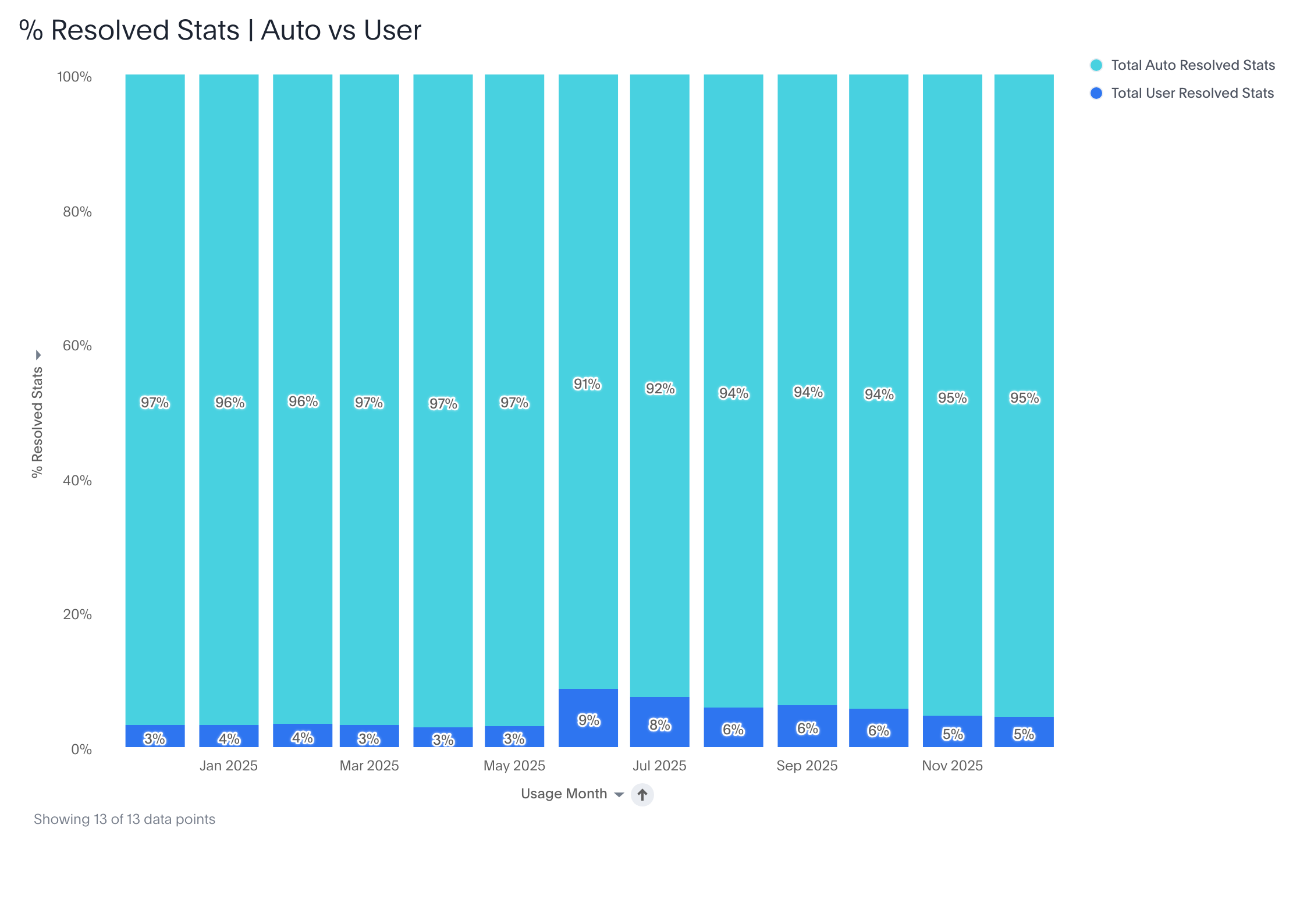
- Built-in error handling framework auto-resolves 95% of errors without any human intervention. IT needs to step in for critical errors only
- Built-in elastic scaling and load balancing handle any increase in volume behind the scenes, with no need to provision resources manually
- Automatic upgrades ensure there is no upgrade activity that you have to perform to use the latest version
With MuleSoft, the onus is on teams to design a foolproof exception handling logic in every flow – adding checkpoints, retry logic, digging through lines of code to troubleshoot. MuleSoft also releases version upgrades 2-3 times a year, which requires significant rework and can take 6 to 12 months.
Bottom line: Celigo keeps maintenance lightweight; MuleSoft often pulls teams into ongoing operational work.
Customer-centric, long-term partnerships
Because teams shouldn’t have to figure things out on their own, success is a shared responsibility
At Celigo, customer success is a priority from the very first integration through ongoing growth.
- Dedicated onboarding specialists and account managers to support adoption and long-term success.
- Multiple support options like Celigo University, Builder’s Hub, and The Connective community, providing on-demand learning and peer collaboration.
- Consistently rated #1 on G2 for iPaaS, achieving a perfect ‘Satisfaction’ score of 100, compared to MuleSoft’s 51
- Only vendor recognized as the 2025 Gartner® Peer Insights™ Customers’ Choice for iPaaS.
With MuleSoft, customer success is largely customer-owned. Teams often report slow support response times and limited hands-on assistance, which increases reliance on internal specialists or external partners to resolve issues and keep integrations running.
Bottom line: Celigo treats success as a partnership, while MuleSoft often expects customers to manage it on their own.
Everything comes at a cost with MuleSoft
Because you do not get what you see, surprises at renewal are the norm
With Celigo, the cost of ownership stays predictable and ROI is high
- Pricing based on endpoints and flows, no usage spikes or surprise overages.
- Intuitive UI, OOTB templates, and built-in error handling help customers reduce build effort by ~70% and ongoing maintenance hours by up to 50%.
- No need to hire full-time MuleSoft experts
With MuleSoft, costs compound over time.
- Multiple consumption components, such as flows, messages, and data throughput, difficult to estimate upfront
- All overages are charged at a premium (~150%) as a penalty
- Discounts and free services make the upfront price lower, but the total cost of ownership (TCO) typically doubles with additional expenses like
○ Developer resources: $150K–$200K annually
○ Training: ~$10K per developer (3 to 4 months)
○ Services: ~100K for simple use case
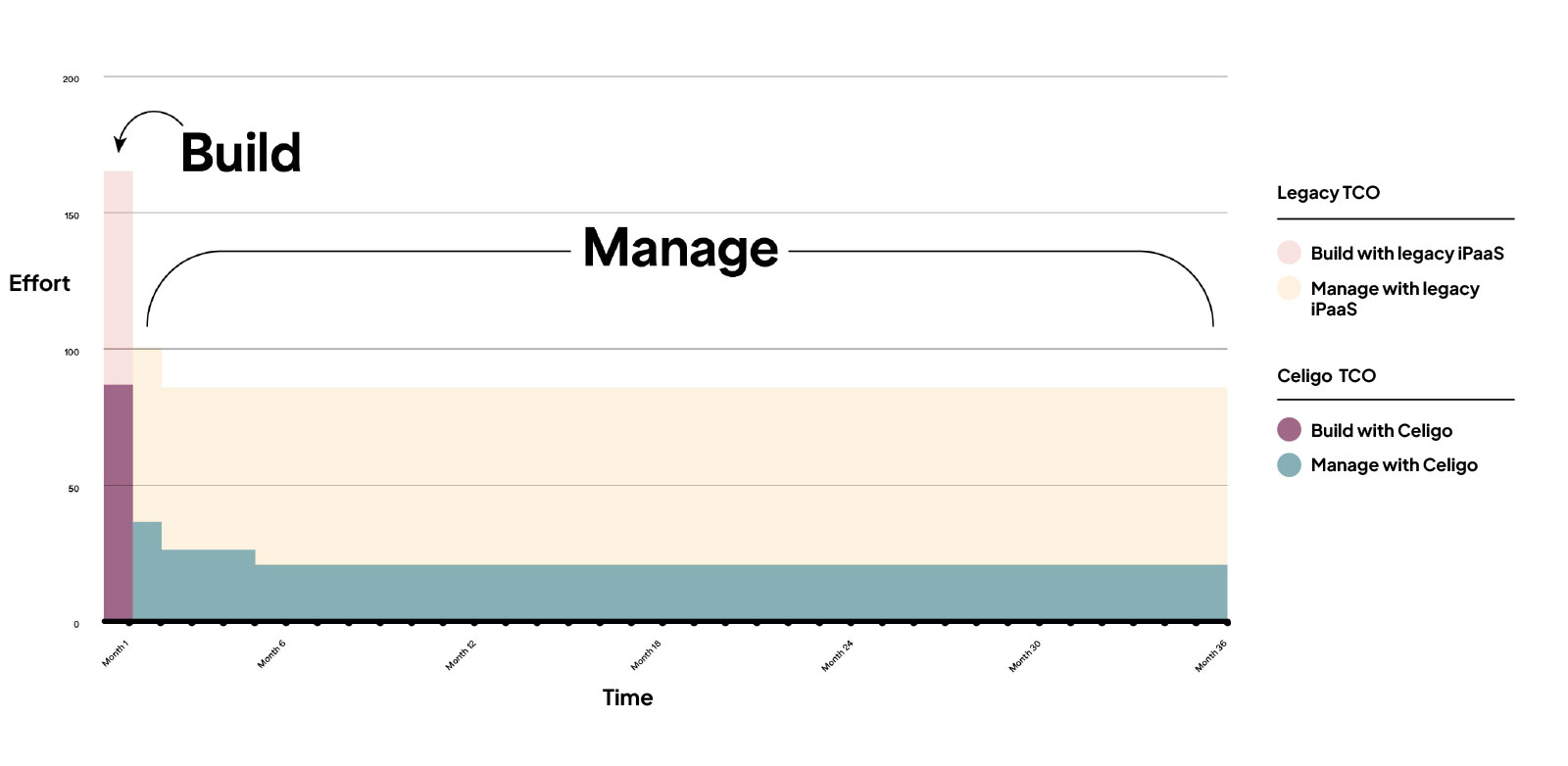
Bottom line: Celigo is a platform that scales without hidden fees, doesn’t require a growing integration team, and delivers predictable TCO your CFO will actually like.
Customer story: Migrated from MuleSoft to Celigo
$350M+ global brand replaced MuleSoft to support critical growth phase.
They were using MuleSoft alongside Celigo to manage integrations across ecommerce, ERP, and logistics systems. When trying to scale aggressively, their CIO and CTO realized MuleSoft is a bottleneck rather than an enabler.
Where MuleSoft fell apart
- Poor integration with core systems: “It’s not as straightforward to integrate with most of our other systems compared to Celigo.”
- Too complex: “If you try to integrate Amazon using MuleSoft, I think you need a PhD degree.”
- Longer implementation: “We are in the growth phase and can’t afford to spend months building out integrations.”
- Dependency: “We needed highly skilled MuleSoft developers, and finding resources wasn’t easy.”
Long build cycles, heavy maintenance, limited real-time visibility, and a $400K+ annual platform cost. That’s when they decided to replace MuleSoft entirely.
They chose Celigo for
- Low-code/no-code, manageable by a small internal IT team
- Flexibility to quickly add or modify integrations as the business evolves
- Pre-built connectors for key systems like NetSuite, Shopify, and the 3PLs, provided real-time visibility
- Lower TCO
- Today, they are successfully live with 38 endpoints across NetSuite, Shopify, AmazonAWS, Gorgias, Walmart, Slack, eBay
“Celigo enables us to move fast, which is critical for a private equity-backed company like us. They aligned with our roadmap. We were able to deploy 185 flows in less than a year—unheard of at this pace.” – CIO
Migration path from MuleSoft to Celigo
For teams moving from MuleSoft to Celigo, it isn’t just a migration but a reset in how teams operate. Fortunately, switching doesn’t have to be disruptive.
Customers have followed this proven migration path:
- Inventory flows and endpoints → Classify by risk and volume
- Pilot a high-impact flow (e.g., order sync) → Validate Celigo’s error handling, MTTR, and SLA alignment
- Run in parallel → Use alerting to compare MTTR, data quality, and operational overhead side-by-side
- Train teams → Cover retry, assignment, and resolution workflows; finalize operational runbooks
- Cut over → Decommission legacy connectors and flows with confidence.
Next steps: Choosing the right platform for your business
MuleSoft may be the right fit if you’re managing a large, developer-heavy hybrid environment and prefer custom-built API-centric integrations.
Ask yourself:
- Do you already have MuleSoft expertise in-house, or are you prepared to hire and retain specialized developers across integration, DevOps, and QA?
- Will integrations be owned entirely by IT, or would you like business teams to manage day-to-day workflows and issues?
- Are you comfortable with consumption-based pricing, where costs are tied to flows, messages, throughput, and other usage metrics?
If not, if you’re looking for a single intuitive platform that every team can use to build and manage powerful integrations with predictable pricing, Celigo is your best bet.
→ Book a demo to see how Celigo can be a fit for your use case and business needs.