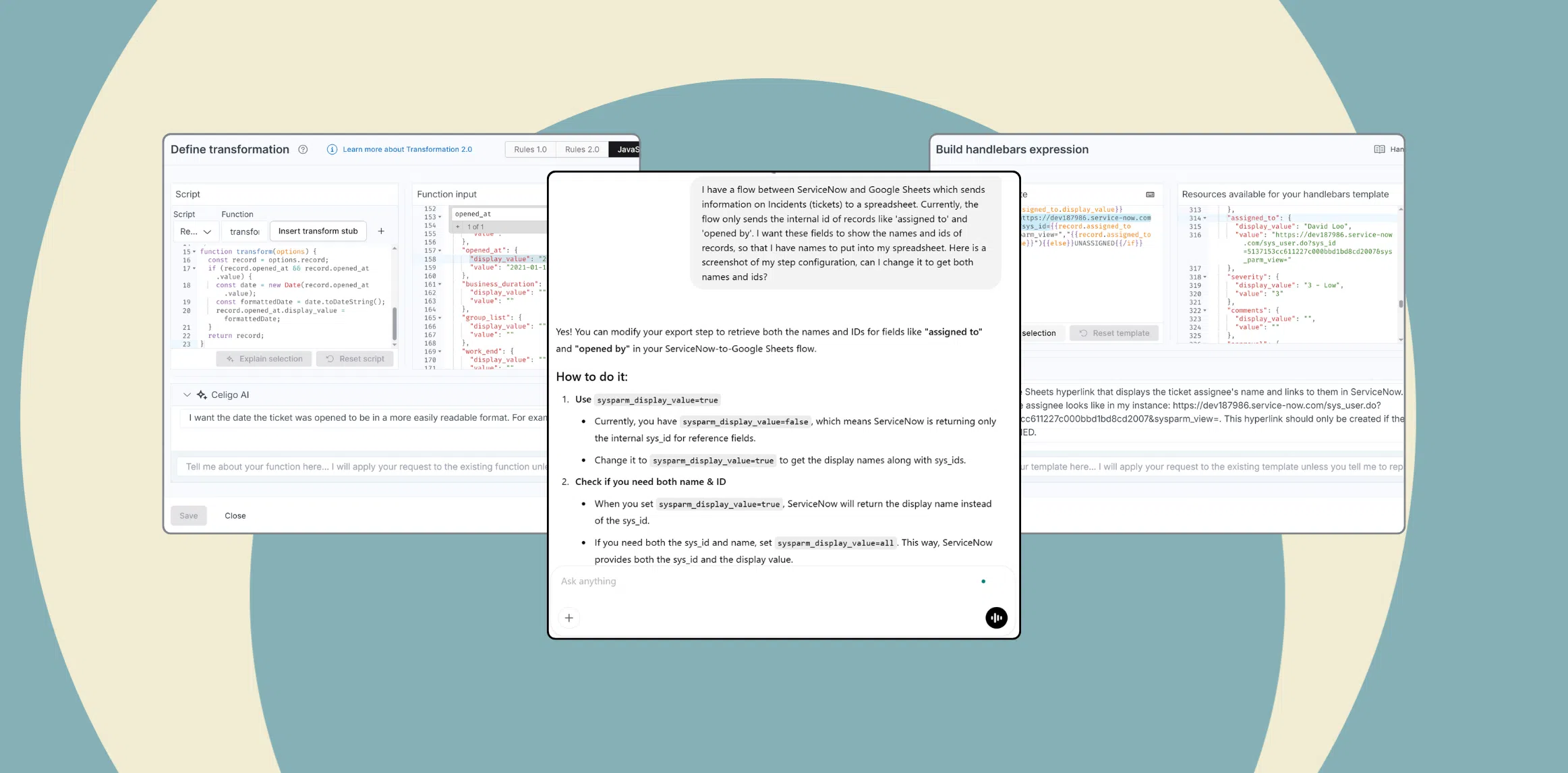
Celigo vs Boomi: Why modern IT leaders are choosing Celigo (2026 comparison)
 Updated Dec 9, 2025


Boomi and Celigo are both established iPaaS providers, but their design philosophies and how they fit into modern IT strategies differ significantly.
If you’ve used Boomi, you already know the common challenges:
- Heavy reliance on IT, leading to integration backlogs and limited scalability
- Opaque, usage-based pricing that can cause unexpected cost spikes
- Limited flexibility for business technologists to self-serve
That’s why modern IT organizations are making the switch to Celigo.
Celigo’s platform is built for today’s hybrid integration teams: powerful enough to handle mission-critical complexity, yet intuitive enough for cross-functional teams to build and manage automations with confidence.
Key takeaways:
Celigo is the best iPaaS platform for you if you:
- Are a fast-growing organization looking for an AI-forward iPaaS that scales as you do.
- Want business and IT teams to collaborate under clear governance and control.
- Prefer built-in features over heavy coding, such as Celigo’s native AI-powered error handling that automatically resolves up to 95% of issues.
- Value predictable, flat-rate pricing that scales without unexpected overages.
- Want a true partner that’s customer-centric and supports you throughout
Choose Boomi if you:
- Are a $10B+ enterprise with a large IT staff aligned to Boomi’s complex, developer-centric model.
- Have mostly on-prem and legacy systems
The big differences between Celigo and Boomi
While both Celigo and Boomi are iPaaS platforms, their core design philosophies differ. Boomi was initially built for IT-led integration projects in enterprise environments.
Celigo, on the other hand, was designed to support both IT teams and business users, with an emphasis on usability, scalability, and prebuilt solutions for common business processes.
Let’s explore each in depth.
Who they’re built for
- Boomi was built more than two decades ago, in an era when integrations were entirely IT-led. Its legacy architecture still reflects that approach — requiring specialized skills, long implementation cycles, and ongoing maintenance.
- Celigo was designed for hybrid integration environments where both IT and business teams share responsibility. Its low-code platform, prebuilt connectors and templates, and AI-assisted tools help teams deploy faster, ensure reliability, and scale integrations without complexity.
How errors are handled
Boomi requires IT teams to manually build and maintain error-handling logic. Each integration is an ongoing engineering commitment.
Celigo treats exception management as a core platform capability, not a custom add-on. With AI-powered error classification, auto-retries, and role-based routing, Celigo resolves up to 95% of errors automatically.
This gives data stewards the ability to manage issues in real time, reduces IT dependency, and lowers operational overhead compared to Boomi’s manual, developer-led approach.
Pricing and scale
Boomi’s 2025 pricing changes introduced connector capacity and message caps, leading to 50-100% price increases at renewal in some cases, often without corresponding value.
Celigo offers simple, transparent pricing based on endpoints and flows, with no volume-based overages, designed to scale with integration needs.
Celigo
Celigo is an intelligent automation platform that unifies everything from predictable workflows to fully agentic automations, all in one place. It’s designed to empower both IT and business teams to build, operate, and scale automation across the enterprise effortlessly.
Key differentiators:
- One platform for every workflow — unify application integrations, data pipelines, APIs, B2B/EDI flows, AI workflows, and autonomous agents in a single governed environment.
- Build powerful workflows effortlessly — accelerate development with AI-assisted design and 1,000+ prebuilt connectors that make automation accessible to everyone.
- Operate with confidence and efficiency — Celigo’s AI-driven operations and proven runtime reliability keep automations running 24/7, automatically resolving 95% of errors at scale.
- Empower every team — enable both IT and business users to collaborate securely and manage automations with shared visibility and control.
- Evolve seamlessly from automation to autonomous agents — seamlessly evolve from predictable workflows to fully agentic operations as technology matures.
Most customers who chose Celigo over Boomi highlight these as the key reasons. They realize the overhead that comes with Boomi in terms of building complexity, inability to hand off to business users and overall maintenance of the platform.
Boomi
Boomi is a first-generation, developer-centric iPaaS that has added a few low-code capabilities over the years. However, many customers still report complexity, dependency on IT resources, and overall high TCO that slows them down.
Boomi’s recent pricing changes (connector caps, message-based billing, and all-inclusive bundling) have introduced cost opacity, particularly for buyers who don’t utilize the full suite of offerings.
Key characteristics:
- Highly flexible and powerful, but built primarily for developers
- Broad platform (API, EDI, workflow), yet pricing and limits complicate planning
Here’s how the two platforms differ when it comes to the factors that matter most to modern IT: speed to deploy, governance, and scale.
Celigo and Boomi integration platforms compared
|
Category |
Celigo |
Boomi |
|
G2
|
#1 ranked iPaaS on G2 (7 quarters) The only “Customer’s Choice” iPaaS in Gartner VoC quadrant (Top Right) |
#4 in G2
“Aspiring” in Gartner VoC (Bottom Left) |
|
Target market |
Mid-market to enterprise; lean IT + business ownership |
Large enterprises with deep IT resources |
|
Ease of use |
Low-code, visual builder with support for both business and technical users Built-in guidance, error explanations, and AI-assisted features reduce the learning curve |
A developer-centric interface usable by IT only. Despite trying to add low-code features, it inherently remains complex with a steep learning curve, requiring Boomi specialists |
|
Training |
Ramp up in weeks, free Celigo University, Live training and many other resources available |
Ramp up can take months, in most cases you have to hire Boomi proficient resource to follow best practices (additional ~150K cost) |
|
Error handling |
AI categorization + auto-retries; ~95% auto-resolution |
Manual design + IT involvement; slower triage |
|
AI |
Embedded AI assistant, AI-driven error handling, and support for LLMs, vector databases, and agentic workflows for real-time AI use cases |
Agentstudio/agentic-AI concept, but fewer customer-validated outcomes |
|
Prebuilt connectors and templates |
1,000+ prebuilt connectors, templates, and integration flows, including deep support for ecommerce, ERP, and EDI Prebuilt Integration Apps accelerate end-to-end processes such as order-to-cash (O2C) and quote-to-cash (Q2C) |
~250 prebuilt connectors for integration, templates are simple flows with narrow depth |
|
Broad integration coverage |
Native support for API, EDI/B2B, application, and data integration patterns within a unified platform |
Supports API, EDI, and data integration, but across separate modules and acquired tools |
|
Governance |
Environments, RBAC, audit, promotion; hand-off to business under IT guardrails |
Governance exists but remains IT-first and specialist-heavy |
|
Pricing |
Transparent endpoints + flows; no message caps |
Connector capacity + message caps |
Celigo: Best for modern IT Teams
What it is
Celigo is an intelligent automation platform that enables teams across enterprises to build powerful workflows effortlessly, operate with unparalleled efficiency, and unify workflows from the predictable to the fully agile in a single platform.
Who it’s for
Celigo is built to empower every team, beyond IT, to build and manage revenue-critical workflows, where metrics such as MTTR (mean time to resolve), TTV (time to value), and financial accuracy drive business outcomes.
Why teams pick Celigo
Power to build any integration
Celigo combines enterprise-grade capability with a faster, more intuitive experience for building and scaling automation. Beneath its approachable UI is a flexible platform that supports complex use cases, from multi-system ERP workflows to modern, API-led architectures.
Customers often describe being surprised by the depth of functionality and how quickly they can get up and running.
A customer who migrated from Boomi to Celigo re-built 22 endpoints and 92 flows across ERP, CRM, marketplaces, storefronts, and EDI, going live in under six months at half the cost.
Enable builders across IT and business
Modern IT leaders want to scale integration faster without becoming the bottleneck. Celigo enables that balance by giving IT full governance while empowering business users to automate safely.
With AI assistants at every step, over 1,000 prebuilt connectors, ready-to-use templates, and reusable components within a simple, visual interface, every team can confidently build their own workflows.
Operational efficiency to ensure everything runs smoothly
Most integration platforms focus on the build phase, but overlook what comes next: maintenance. Celigo is built with that reality in mind.
Error handling: Celigo’s AI-powered error management automatically resolves up to 95% of issues, needing IT intervention only in critical errors. Real-time dashboards highlight trends and streamline triage for both IT and business users, helping teams resolve problems quickly.
Auto scaling: Built-in auto-scaling ensures the platform adapts dynamically to workload spikes in comparison to platforms like Boomi, which lack auto-scaling capabilities. You have to either overprovision or constantly monitor to avoid failure during any spike.
AI capabilities
AI-enabled error and exception handling
Celigo integrates intelligent automation into its exception management framework, helping teams detect, categorize, and resolve integration errors more efficiently. Features such as auto-retries and built-in classification logic enable users to address many exceptions without writing custom error-handling code.
Compared to Boomi, where exception handling is often configured on a case-by-case basis, Celigo emphasizes standardized, built-in processes. This approach supports data stewards directly and reduces reliance on developers to manage exceptions across integrations.
Celigo AI CoPilot accelerates the builder experience
Celigo offers an embedded AI assistant, Copilot, which provides contextual support throughout the platform.
Copilot is integrated into the builder interface and helps users by:
- Generating code in JavaScript, SQL, and Handlebars
- Explaining error messages in plain language
- Auto-generating flow documentation and OpenAPI specifications
- Providing in-context tips and recommendations while building flows
These capabilities assist both technical users and business technologists. By reducing the learning curve and improving productivity, Copilot enhances the user experience across a wide range of integration scenarios.
While AI assistants are increasingly common in the iPaaS space, Celigo’s implementation is embedded directly in the builder rather than delivered as a separate tool.
One platform for every integration need
Celigo is built to support the full spectrum of integration and automation use cases, including application and data integration, B2B/EDI supply chain workflows, API management, and AI-driven autonomous agents.
B2B and EDI workflows
Celigo supports electronic data interchange (EDI) for organizations that need to exchange standardized business documents with trading partners. The platform offers tools for managing EDI document flows, including support for common formats such as X12 and EDIFACT, as well as protocols like AS2 and SFTP.
Prebuilt templates are available for typical transaction types such as purchase orders (850), invoices (810), and advance ship notices (856). These features help reduce manual processes and improve consistency across the supply chain and partner operations.
API management
Celigo includes API management (APIM) capabilities that allow users to build, publish, secure, and manage APIs directly within the integration platform.
The API Builder provides a visual, low-code interface that enables users to design and expose custom RESTful APIs without writing server-side code or managing backend infrastructure. APIs are backed by integration flows, making it easy to trigger business processes in real time from external systems.
Celigo’s APIM features are suited for organizations that need to expose integration logic as APIs for internal development, partner integrations, or custom application extensibility, all without requiring a separate API gateway.
AI agents
With Celigo, teams can design and run every kind of workflow — from rule-based automations to intelligent, agentic processes, all in one unified platform. Whether you’re automating a predictable business process or deploying an AI agent that makes real-time decisions, Celigo gives you a single environment to build, test, and govern everything together.
Using Agent Builder, teams can create AI workflows that analyze data, reason with context, and take autonomous action across systems, using the same visual tools, governance, and observability that power traditional automations. Every agent operates transparently, with full visibility into how it makes decisions and which data it uses, ensuring trust and control at scale.
Celigo also connects seamlessly to large language models and vector databases such as OpenAI, Google Gemini, and Pinecone, enabling agents to interact with real-time business data, not static snapshots. This keeps AI grounded in truth and aligned with enterprise data governance.
With Celigo, you can:
- Build deterministic and AI-driven workflows side by side in one governed platform
- Ground AI agents in trusted, live data from across your systems
- Maintain transparency and control through built-in observability and auditability
Unmatched customer experience, consistently rated #1 iPaaS on G2
Celigo continues to support customers after go-live through guided onboarding, regular enablement programs, and resources that help integrations grow with the business.
This ongoing investment in customer success has led to top customer experience rankings on G2.
Celigo cons
- Not a white-label embedded iPaaS. Product teams needing fully embedded branding may prefer purpose-built white-label tools.
Boomi: Powerful, enterprise-oriented but developer-heavy
What it is
Boomi offers a broad iPaaS portfolio spanning API, EDI, workflow automation, and more. Long positioned as a developer-first platform, it’s now private-equity-owned (since 2021) and has introduced multiple pricing shifts.
Customers often cite Boomi’s flexibility and broad product offerings, but also report complexity, UI friction, and performance concerns, especially during volume spikes or when working with Windows-based workloads.
Who it’s for
Large IT organizations with the resources to manage complex integrations and budget to hire specialists — especially those prioritizing hybrid/on-prem patterns.
Boomi pros
- Enterprise suite: API, EDI, and Flow tools in one ecosystem
- Hybrid/on-prem strength, ideal for mostly on-prem legacy environments
Boomi cons
- Developer-centric user experience: complex UI, steep learning curve; expensive specialist dependency; “too many clicks” UX complaints.
- Pricing/renewals: Connector capacity/message caps, hidden layers (instances, environments, premium connectors), and 50 to 100% price hikes frustrate customers.
- Lack standard iPaaS features: Platform-level exception handling so developers don’t have to code error handling into every workflow, and auto-scaling storage capacity so workflows don’t stop working during peak times.
Celigo vs. Boomi: Use case comparison
Order-to-cash (ecommerce)
Stack: Shopify / Amazon / 3PL → ERP → BI
Key metrics: Order latency, error recovery time, write-off rate, CSAT
- Celigo: Offers prebuilt O2C flows for orders, fulfillments, and payouts, with built-in triage and accurate finance reconciliation. Teams handle peak events (e.g., Black Friday) with autoscaling and paginated processing for large payloads. Domain owners can resolve record-level issues directly — no IT bottlenecks.
- Boomi: Requires custom error handling and ongoing development. Customers report backlog issues during periods of high volume. Troubleshooting often involves pulling raw error files and manual reruns.
Quote-to-cash (SaaS)
Stack: Salesforce / HubSpot → Billing → ERP / Data Warehouse
Key metrics: DSO, invoice accuracy, time-to-value (TTV)
- Celigo: Smart mapping previews, automated retries, and clean finance handoffs help reduce DSO and reconciliation errors. Accelerators reduce deployment time for RevOps teams.
- Boomi: Offers strong capabilities but typically requires developer involvement for changes. Users cite slower rollouts and dev friction.
Supply chain / EDI
Stack: Retail trading partners → ERP / WMS
Key metrics: ASN/PO accuracy, chargebacks, SLA adherence
- Celigo: Modern EDI solution that enables businesses to seamlessly exchange purchase orders, invoices, and other documents with trading partners through automated workflows, built-in compliance, over 300 prebuilt trading partner connectors, and a centralized dashboard for complete visibility and control.
- Boomi: A Legacy EDI solution that requires specialized resources to maintain, often requires custom development per trading partner, a large library of trading partners, dashboards, and reporting.
Migration from Boomi to Celigo
For many teams, moving from Boomi to Celigo isn’t just a migration but a reset in how IT operates. Switching doesn’t have to be disruptive.
Customers have followed this proven migration path:
- Inventory flows and endpoints → Classify by risk and volume
- Pilot a high-impact flow (e.g., order sync) → Validate Celigo’s error handling, MTTR, and SLA alignment
- Run in parallel → Use alerting to compare MTTR, data quality, and operational overhead side-by-side
- Train teams → Cover retry, assignment, and resolution workflows; finalize operational runbooks
- Cut over → Decommission legacy connectors and flows with confidence
Schedule a demo with Celigo
If you’re managing a large, developer-heavy hybrid environment and prefer custom-built integrations, Boomi may be the right fit.
But if you’re looking for a single intuitive platform that every team can use to build and manage powerful integrations —from classic application and data integration, to B2B supply chain flows, API management, and autonomous agents, Celigo is your best bet.
FAQs
Integration insights
Expand your knowledge on all things integration and automation. Discover expert guidance, tips, and best practices with these resources.