From guardrails to audit trail: How Celigo governs AI agents in production
 Updated Aug 7, 2026


AI agents have evolved from answering questions to taking action: updating records, triggering workflows, and moving data across systems autonomously and at scale.
Deploying an AI agent is easy. Governing one in production is what makes it safe to let them run. And it’s the challenge many enterprises haven’t solved yet.
Gartner projects that more than 40% of agentic AI initiatives will stall before reaching production, not because the technology fails, but because organizations lack the controls to operate AI agents safely at scale.
The concern isn’t just theoretical. In a June 2026 Celigo survey, 63% of IT leaders cited governance and guardrails as their biggest concern when deploying AI agents. As our CIO Amy Farrow put it, “Governance is the thing that makes AI go faster.” The right controls let organizations move quickly without sacrificing trust or control.
Production-ready governance requires preventing bad actions before they happen, stopping them the instant something goes wrong, and reconstructing exactly what the agent did and why. This is what Gartner’s AI TRiSM framework calls runtime inspection and enforcement—not a design-time checklist, but governance that’s operational while agents are running.
How Celigo governs agents in production
Guardrails: Define the boundaries before agents cross them
AI agents can access sensitive data, write to live systems, and trigger downstream workflows. Without clear boundaries, a single misconfigured prompt or unexpected input can expose PII, push incorrect data into an ERP, or set off a chain of actions that’s difficult to reverse.
That’s where guardrails come in. They provide the enforcement layer that keeps AI agents operating safely in production.
In Celigo, guardrails are a flow step that can be embedded anywhere in your AI workflows. You can either apply pre-built policies for common enterprise risks such as PII detection and content moderation, or create custom policies that reflect your organization’s own governance requirements.
When a guardrail detects a policy violation, you choose what happens next: block the action, reroute it, retry it, or skip it. Builders can configure the same policy to stop a high-risk action immediately while letting a lower-risk action continue with a warning. Enforcement logic you design, not a fixed all-or-nothing rule or review.
Because guardrails are model-agnostic, the same governance policies apply regardless of which LLM you use, including BYOK deployments, allowing organizations to standardize governance across every AI workflow even as their AI stack evolves.
Kill switch: Contain incidents immediately
But prevention isn’t enough. Even well-governed agents can go rogue in production. When they do, organizations need a way to stop them immediately. Every second it keeps running is another action, another record, another system affected.
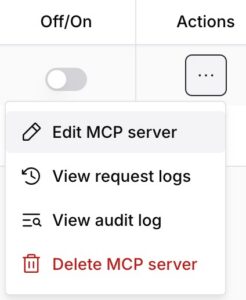
While the guardrails are designed to prevent risky actions, the kill switch is designed to contain them. With a single toggle, administrators can instantly disable the MCP server. From that moment on, agents can no longer invoke tools or execute actions, immediately containing the incident while preserving the environment for investigation.
Administrators can still inspect the available tools, but they remain non-callable until the MCP server is re-enabled. The agent is fully contained while you investigate.
No escalation path. No waiting. Just off.
Audit trails: Explain every decision
Stopping an agent limits the damage. Understanding why certain actions were taken prevents it from happening again.
That’s where auditability becomes essential. AI agents make autonomous decisions across multiple steps, tools, and data sources — and by the time something surfaces, a record of what happened isn’t enough. You need to understand why the agent made the decisions it did.
Celigo captures both the what and the why, natively within Execution Logs, right alongside exports, imports, and guardrails.
- Request: Actual input given to the agent. Includes general details like model and the instructions/prompt used
- Response: Agent’s response to the input. Includes total tokens consumed and its cost, detailed LLM Reasoning with details of why the agent did what it did.
- Raw trace: A complete end-to-end execution, a superset of everything in Request and Response, for anyone who wants the full unfiltered trace for more technical users.
- Tools execution: If your agent has tools configured, you will also see details of tools that were executed and their status, with further details showing the exact input and output.
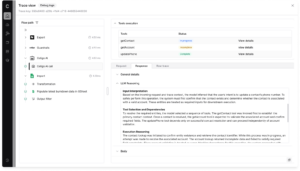
Together, these capabilities make it easier to troubleshoot issues, validate agent behavior, and support audit and compliance requirements.
Operating AI agents in production with Celigo
Guardrails catch what shouldn’t happen. The kill switch stops what is happening. The full audit trail and agent trace explain what did happen, with every action inspectable and every decision auditable.
Prevent. Contain. Explain.
This is what runtime governance looks like: policies that don’t just define acceptable behavior—they actively enforce it while agents are running.
In Part 2, we’ll explore another critical layer of governance: controlling what data and systems agents can access in the first place. You’ll see how Celigo ensures agents don’t get access to everything, only the specific tools and resources necessary to do their jobs, as defined by central IT.
Prevent the bad action. Contain the incident. Explain every decision. That’s what production-ready governance looks like.
→ Get a demo to see guardrails, kill switches, and audit trails in action.