
A Retailer’s Framework for Operationalizing AI

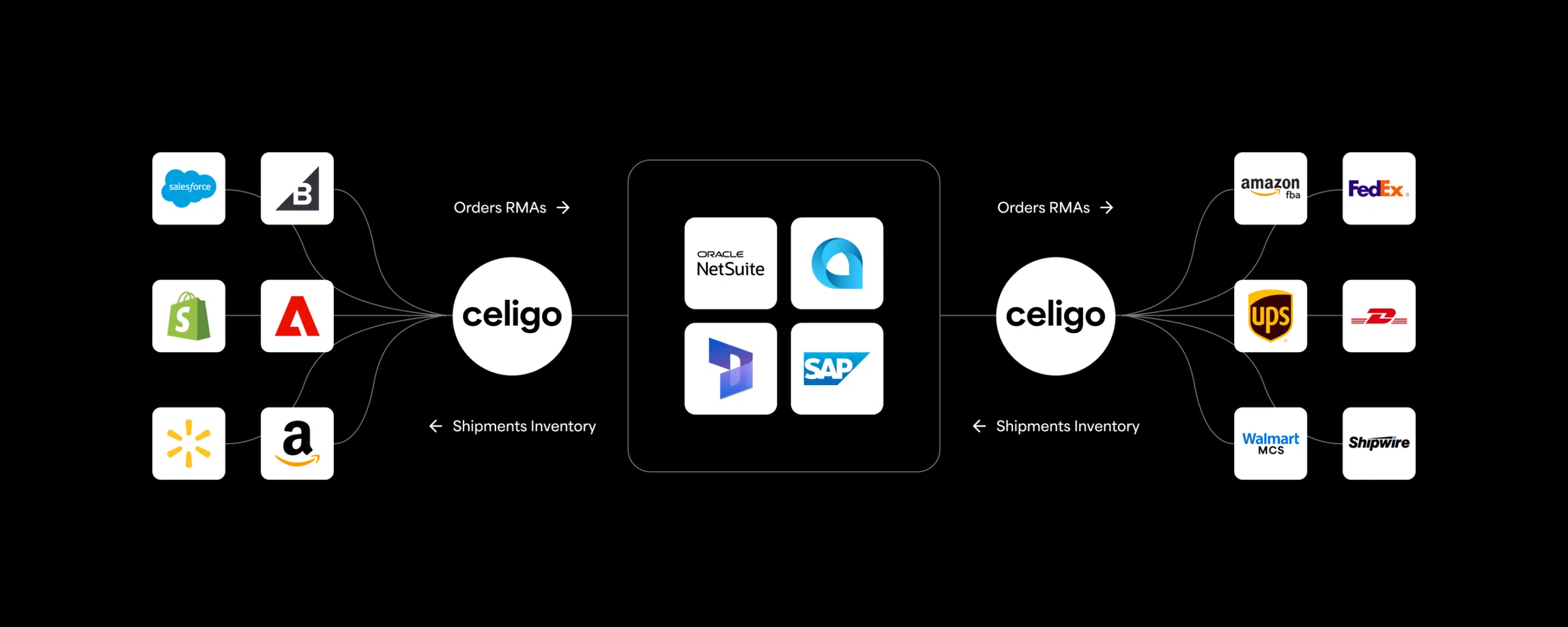
AI readiness looks different for every retailer. It depends on what data you have access to, and what condition that data is in.
But one pattern is consistent across the ecommerce organizations. AI success hinges on whether your underlying systems are connected and trustworthy.
Recent research from Celigo and MIT underscores just how foundational this infrastructure question really is.
- 1 in 3 retail/consumer goods firms have centralized ownership of AI
- The majority of retail/consumer goods firms are applying AI to well-defined processes.
- 90% of firms with AI workflows in production rely on integration platforms.
AI cannot scale atop disconnected systems. As Celigo heads into ShopTalk, I’ve been thinking about what the right automation foundation for AI looks like in practice, and what separates retailers who are genuinely operationalizing AI from those stuck in a cycle of promising pilots that never reach production.
Here is the framework I’d recommend for any retail organization looking to operationalize AI.
Step 1: how to identify the right process for automation and AI
The retailers getting the most value from AI right now are not the ones moving fastest. They are the ones moving most deliberately.
This means identifying a high friction, high impact process that already affects revenue, margin, or customer experience. Examples include:
- Order exception management
- Supplier compliance checks
- Inventory replenishment triggers
- Product data quality workflows
This is also a great moment to rethink the process itself, not simply replicate it. Once you’ve defined the new process, ask how much of it can be handled by deterministic automation – rules-based logic, workflow orchestration, system integrations – and where AI genuinely adds value that automation alone cannot.
This “least agency” mindset reduces error surface and keeps systems auditable. Reserve AI for the steps that genuinely require it. Everything else should be deterministic, governed, and reliable.
Step 2: how to give ownership for AI to both business teams and IT
AI will ultimately reshape every function in a retail organization: merchandising, supply chain, finance, marketing, and customer service. Treating it as an isolated IT initiative slows adoption and limits impact.
The teams closest to the business problem understand where AI can improve outcomes. They should help define the use case and own the result.
At the same time, AI cannot sprawl without guardrails. Fragmented experimentation introduces compliance, security, and data quality risks.
The model that works is shared ownership on a governed platform. IT establishes the guardrails, integration standards, and data pipelines. I call this the “art of the possible.” Meanwhile, business units drive the use cases and own the outcomes.
Broad ownership with centralized control is what allows AI adoption to scale without creating the downstream problems that come from fragmented experimentation.
Step 3: AI needs to build on a unified foundation for commerce
A connectivity-first approach may be the single most important strategic insight I can offer any retailer right now. Order exception management makes the case clearly.
In most retail operations today, order exception management means people manually triaging failed orders, cross-referencing inventory systems, chasing suppliers, and updating customers.
Once the relevant systems – ERP, OMS, WMS, CRM, commerce platforms – are connected, AI has reliable, real-time data to act on. Then it can triage automatically, propose resolutions, and escalate only the cases that genuinely require human judgment.
AI sitting on top of disconnected, siloed data does not produce reliable outcomes.
At best, retailers will be able to use AI as a productivity tool within siloed workflows. But that is not operationalizing AI.
Operationalizing AI means deploying it into entire business processes – including ones that span multiple departments and systems – and having those processes run reliably at scale.
At Shoptalk I’ll be sitting down with Nick Reshamwalla, VP of Engineering at Dollar Shave Club, to talk through exactly this.
Nick will share how Dollar Shave Club manages every step of order and fulfillment – connecting online stores, retail partners via EDI, and 3PL providers – to deliver accurate inventory, fewer missed orders, and reliable performance during peak demand. And critically, how that connected foundation then enables the team to safely apply AI where it matters most: product data quality, demand forecasting, fulfillment scheduling, and end-to-end customer experience.
This is the foundation Celigo is built on: proven automation built on API and EDI, now extended with AI. By unifying storefronts, marketplaces, 3PLs, and trading partners on one trusted platform, we enable intelligent agents to operate inside governed workflows, with the data quality they need to be trusted at scale across the entire order-to-return lifecycle.
A Four-Stage AI Maturity Framework for Retailers
Based on what I’ve seen working across retail organizations at every stage of this journey, here is how I think about AI maturity:
Stage 1: Aspirants. You’re just getting started. Identify a single high-value process with a clear ROI case and run a focused pilot. Resist spreading energy across too many initiatives simultaneously.
Stage 2: Experimenters. The pilot is behind you. Now build AI into a complete end-to-end workflow. This requires more investment in data connectivity and cross-functional alignment than most organizations expect.
Stage 3: Practitioners. AI is running in production. Focus shifts to scalable data pipelines, the ability to integrate new systems quickly, and governance structures that can handle increasing complexity without slowing things down.
Stage 4: Orchestrators. Agentic workflows are running at scale. The focus is observability, scalable governance, and continuous optimization of costs and outcomes.
One of the most common mistakes I see is trying to skip stages – investing in orchestration before the foundational integration work is solid enough to support it. At every stage, the right priorities and the right mistakes to avoid are different.
If you’re ready to identify a quick win for your business, book a meeting with my team at ShopTalk.